


'Big Short' Burry Increases Nvidia and Micron Shorts in Continued AI Bubble Bet
TradingKey - Michael Burry, famously known as "The Big Short" for successfully predicting the 2008 U.S. subprime mortgage crisis, has once again increased his bets on a correction in the AI and semiconductor sectors.
Last Friday, Burry disclosed his latest portfolio changes on Substack, further expanding his short positions on Micron Technology ( MU ), Nvidia ( NVDA ), and the iShares Semiconductor ETF (SOXX), while initiating a new short position on Caterpillar ( CAT) and continuing to hold bearish positions on Tesla ( TSLA ), Palantir ( PLTR ), and the Nasdaq 100 Index ETF (QQQ).
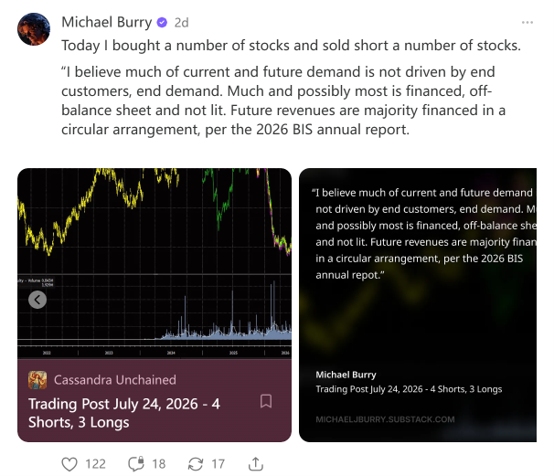
Source: Substack
Judging by his latest moves, Burry has not only maintained his cautious stance on tech stocks but has further reinforced his bearish position on the AI supply chain.
Specifically, he indicated that he continued to add to his Micron short at $933.86, increased his Nvidia short position at $210.28, and further shorted SOXX at $535.83.
Meanwhile, he also revealed that he still holds a sizeable position in Nvidia put options, and that the combined SOXX-related short and option positions have become one of the larger holdings in his portfolio.
More than his portfolio changes, the market is paying closer attention to Burry's outlook on the AI industry. He believes that a significant portion of Nvidia's current and future demand does not actually come from end-use customers, but is instead supported by a large amount of off-balance-sheet financing arrangements, with future revenues also largely built on a circular financing model.
To support this view, he cited the Bank for International Settlements (BIS) 2026 annual report, arguing that AI infrastructure investment conceals high financial leverage and financing risks.
Meanwhile, international credit rating giant Moody's also issued a warning in its latest report, pointing out that the AI infrastructure race, which costs nearly $1 trillion annually, is eroding the free cash flow of hyperscale cloud providers.
Moody's believes that the AI investment boom is forcing companies that were originally cash-rich, such as Google and Microsoft, to rely heavily on debt, equity, and off-balance-sheet financing to support their expansion plans. This transition from an asset-light to an asset-heavy model has brought unprecedented investment scale and financing needs, increasing balance sheet risks.
Data shows that the direct debt of the six major hyperscale cloud providers has now reached approximately $460 billion.
In fact, this is not the first time Burry has publicly expressed a bearish view on the AI chip sector. As early as the beginning of July, he first disclosed a short position in Micron Technology, stating that the memory chip industry had entered a historically overvalued range, and that Micron's stock price faced a high risk of correction regardless of valuation levels, technical trends, or industry cycles.
Subsequently, in another Substack post published in late June, he disclosed short positions in Nvidia, Applied Materials ( AMAT ), and SOXX, predicting a correction of around 30% for AI-related chip stocks as a whole.
In Burry's view, the biggest concern for the current AI supply chain is not the technology itself, but that the pace of investment has clearly outrun real demand growth. He believes that large-scale AI infrastructure construction relies more on continuous capital injection while end-user commercialization demand has yet to be fully realized; if the financing environment changes in the future, the entire supply chain's valuation could face a repricing.
Notably, since Burry first publicly shorted the semiconductor sector, the relevant sectors have undergone a significant correction.
So far this month, Micron Technology's stock price has retreated about 20% cumulatively, while SOXX fell nearly 18% over the same period, and the Philadelphia Semiconductor Index has also seen a sizable recent pullback. However, in terms of full-year performance, Micron's stock price is still up nearly twofold from the beginning of the year, and Nvidia remains positive for the year, showing that while the AI theme has experienced a correction, its overall gains remain substantial.
Recommended Articles


