


Indian Rupee recovers further as US-Iran war pause hits oil prices
- The Indian Rupee gains further, capitalizing on a correction in oil prices and the US Dollar.
- US President Donald Trump pauses attacks on Iran to allow time for diplomacy.
- Investors expect the Fed to leave interest rates unchanged on Wednesday.
The Indian Rupee (INR) extends its recovery against the US Dollar (USD) at the start of the Federal Reserve’s (Fed) monetary policy week. The USD/INR pair falls further to near 96.10 as the pause in military aggression between the United States (US) and Iran has weighed heavily on oil prices and has diminished the safe-haven appeal of the US Dollar.
In the opening trade, the MCX Crude Oil contract expiring on August 19 trades 4.75% lower to near Rs. 8,200.
The appeal of currencies from economies, such as India, which rely heavily on oil imports to fulfill their energy needs, improves when oil prices fall sharply.
Meanwhile, the US Dollar Index (DXY), which gauges the Greenback’s value against six major currencies, trades 0.25% lower to near 101.25.
US holds strikes on Iran on exhaustion of target list
Two-week-long exchange of attacks between the US and Iran paused over the weekend as Washington confirmed that further military aggression would be unnecessary, confirming that the target list has been exhausted.
According to Axios, Adm Bradley Cooper, the top US military commander in the region, had told Trump the US military campaign had reached the limits of its effectiveness, The Guardian reported. Cooper added that there was little point in continuing the bombing campaign without a return to major combat operations.
In response, Iran also paused attacking US bases in its neighbouring nations, but confirmed that its position remains "attack for attack".
Meanwhile, US ambassador to the United Nations (UN), Mike Waltz, also told Fox News on Sunday that President Donald Trump had decided to pause US attacks to allow more time for diplomacy, Reuters reports. This has renewed hopes for diplomatic efforts between both nations.
Investors await key Fed policy
This week, the major trigger for global markets will be the Federal Reserve’s (Fed) monetary policy announcement on Wednesday, in which the central bank is expected to leave interest rates unchanged in the range of 3.50%-3.75%. So far this year, the Fed has not done any monetary policy adjustments.
Investors will pay close attention to the monetary policy statement and Fed Chair Kevin Warsh’s press conference to get fresh cues regarding inflation and the economic outlook. Warsh is unlikely to deliver any remarks regarding the monetary policy guidance, as he clarified in its last press conference that “so-called forward guidance is not well-suited in the current policy juncture”.
Technical Analysis: USD/INR falls toward 20-day EMA
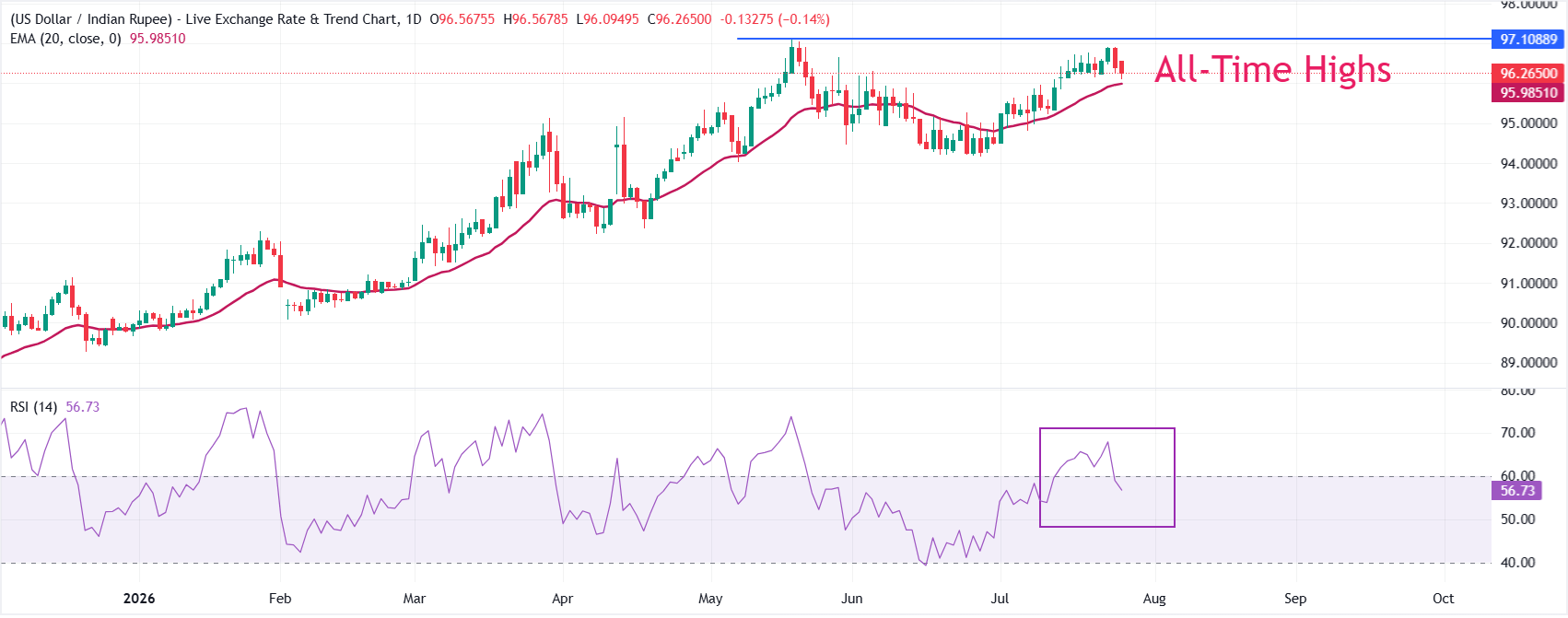
USD/INR trades lower at around 96.26 at press time. The pair remains underpinned by a constructive near-term bias, with spot holding above the 20-day Exponential Moving Average (EMA) at 95.9851.
The mildly positive 14-day Relative Strength Index around 57 suggests ongoing bullish momentum, though not yet in overbought territory, allowing room for further gains while the price action stays supported above the short-term EMA.
On the downside, immediate support is now seen at the 20-day EMA near 95.99, which protects the recent advance; a daily close below this level would hint at a deeper corrective phase toward prior price congestion. Looking up, the all-time high at around 97.10 will be the key resistance level.
(The technical analysis of this story was written with the help of an AI tool. Know more.)
Indian Rupee FAQs
The Indian Rupee (INR) is one of the most sensitive currencies to external factors. The price of Crude Oil (the country is highly dependent on imported Oil), the value of the US Dollar – most trade is conducted in USD – and the level of foreign investment, are all influential. Direct intervention by the Reserve Bank of India (RBI) in FX markets to keep the exchange rate stable, as well as the level of interest rates set by the RBI, are further major influencing factors on the Rupee.
The Reserve Bank of India (RBI) actively intervenes in forex markets to maintain a stable exchange rate, to help facilitate trade. In addition, the RBI tries to maintain the inflation rate at its 4% target by adjusting interest rates. Higher interest rates usually strengthen the Rupee. This is due to the role of the ‘carry trade’ in which investors borrow in countries with lower interest rates so as to place their money in countries’ offering relatively higher interest rates and profit from the difference.
Macroeconomic factors that influence the value of the Rupee include inflation, interest rates, the economic growth rate (GDP), the balance of trade, and inflows from foreign investment. A higher growth rate can lead to more overseas investment, pushing up demand for the Rupee. A less negative balance of trade will eventually lead to a stronger Rupee. Higher interest rates, especially real rates (interest rates less inflation) are also positive for the Rupee. A risk-on environment can lead to greater inflows of Foreign Direct and Indirect Investment (FDI and FII), which also benefit the Rupee.
Higher inflation, particularly, if it is comparatively higher than India’s peers, is generally negative for the currency as it reflects devaluation through oversupply. Inflation also increases the cost of exports, leading to more Rupees being sold to purchase foreign imports, which is Rupee-negative. At the same time, higher inflation usually leads to the Reserve Bank of India (RBI) raising interest rates and this can be positive for the Rupee, due to increased demand from international investors. The opposite effect is true of lower inflation.
Recommended Articles


