


Jensen Huang Signed Toyota, Fanuc, Kioxia, and 5 Other Japanese Industrial Giants Into Nvidia's Physical AI Coalition This Week. Nvidia Has $1 Trillion in Confirmed Demand Through 2027.
Key Points
Some of Japan's leading robotics players are using Nvidia's technology.
Revenue from edge computing platforms, including those used to train robots, grew 29% year over year last quarter.
Data center sales will remain the company's key growth engine in the near term, but investors are not paying much for Nvidia's long-term opportunity in physical AI.
- 10 stocks we like better than Nvidia ›
Nvidia (NASDAQ: NVDA) stock is up 12% year-to-date, outperforming the Nasdaq's roughly 9% return at the time of writing, but the company is not sitting still. With competition in the semiconductor industry heating up, CEO Jensen Huang wants to keep Nvidia at the frontier of artificial intelligence (AI) technology.
In that effort, Huang is positioning the company to lead the race in physical AI, including robots. He recently met with the leaders of several Japanese industrial giants -- including Toyota, Fujitsu Limited, Kawasaki Heavy Industries, Fanuc, and Kioxia -- to discuss how they can implement physical AI in their factories.
Missed Nvidia in 2009? This Rare Signal Is Flashing Again. In 2009, a "Double Down" signal flashed for a little-known chipmaker called Nvidia. For the first time in years, that same "Total Conviction" signal is flashing for a company 1/100th the size of Nvidia. Continue »
As Huang stated, "The next frontier of AI is in the physical world, and this is a once-in-a-generation opportunity for Japan." Three major robotics and automation players -- Kawasaki, Fanuc, and Yaskawa -- are already using Nvidia's technology. This all fits with its strategy to be at the center of every major transition in the world of computing.
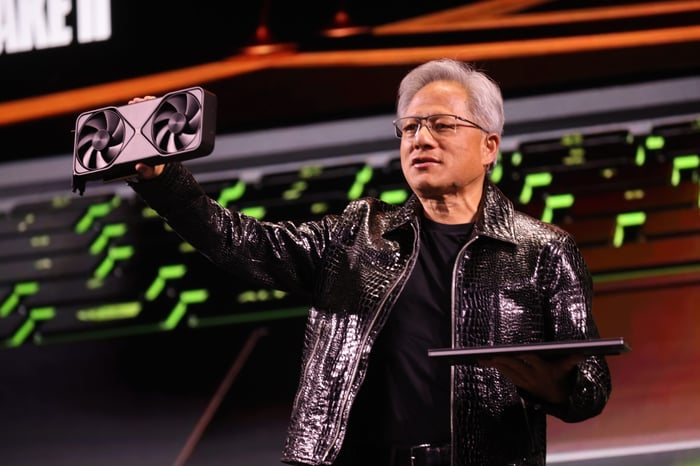
Image source: Nvidia.
What does this mean for Nvidia's prospects?
Nvidia has changed how it will report its financial results to align with its future growth drivers. Based on this new reporting framework, the data center segment reported revenue of $75 billion last quarter, up 92% year over year. The new edge computing segment (robotics, automotive, and PCs) is small by comparison, generating only $6.4 billion in revenue, up 29%.
Physical AI is not going to move the needle for the stock right now. In data center, management expects to book $1 trillion in revenue from its Blackwell and Rubin chips from 2025 through calendar 2027. Its chips and networking products for AI data centers are still its main growth drivers.
But in the long run, physical AI is the next logical step for this technology, and that spells significant growth potential for Nvidia's edge computing business. Similar to its strategy in data centers, Nvidia has put together a full-stack offering that includes its DGX computing systems (Blackwell/Vera Rubin), its Jetson robotics computing platform, and Cosmos for simulating the physical world to accelerate robot development.
As Advanced Micro Devices and Broadcom try to chip away at Nvidia's lead in data centers, Huang is positioning the company for the next big transition in AI. Nvidia's tailored computing solutions for specific industries such as manufacturing give it a competitive advantage. So do its relationships with enterprises and AI researchers around the world.
The recent announcements out of Japan are bullish for Nvidia's long-term prospects, but the data center business will remain the key catalyst for the stock in the near term. The shares do look attractive right now, trading at just 23 times forward earnings, with analysts projecting around 44% annualized earnings growth over the next few years. Investors don't seem to be paying any premium for the long-tail growth potential of the physical AI market over the next few decades.
Should you buy stock in Nvidia right now?
Before you buy stock in Nvidia, consider this:
The Motley Fool Stock Advisor analyst team just identified what they believe are the 10 best stocks for investors to buy now… and Nvidia wasn’t one of them. The 10 stocks that made the cut could produce monster returns in the coming years.
Consider when Netflix made this list on December 17, 2004... if you invested $1,000 at the time of our recommendation, you’d have $371,519!* Or when Nvidia made this list on April 15, 2005... if you invested $1,000 at the time of our recommendation, you’d have $1,281,302!*
Now, it’s worth noting Stock Advisor’s total average return is 892% — a market-crushing outperformance compared to 206% for the S&P 500. Don't miss the latest top 10 list, available with Stock Advisor, and join an investing community built by individual investors for individual investors.
See the 10 stocks »
*Stock Advisor returns as of July 25, 2026.
John Ballard has positions in Nvidia. The Motley Fool has positions in and recommends Advanced Micro Devices, Broadcom, and Nvidia. The Motley Fool recommends Fanuc. The Motley Fool has a disclosure policy.
Recommended Articles


