


Intel (INTC) Stock Price Prediction July 2026: Down 21% in 7 Days — HSBC Says $200, BofA Says Bubble
TradingKey - Intel Corporation (NASDAQ: INTC) is currently priced at $110.32, marking a nearly 21% dip from the $140.05 range highlighted in this coverage on June 30. The pullback came on the heels of a week of general semicondutor selling that started July 1 following a Bank of America report that the AI chip space was becoming overvalued. The selling pressure persisted through July 2, finally reaching Intel as it fell another 9.87% on July 7 amid speculation that the company's 18A process may not generate profitable yields until 2026 or even 2027. It did confirm some price increases in consumer and Xeon products, however. RSI at 37 is nearing oversold levels with early signs of positive divergence. Even with that weakness, HSBC managed to raise Intel's price target from $100 to $200. Moreover, it kept a Buy rating, calling out the company's foundry potential. Intel will be reporting its Q2 earnings on July 23.
What Caused the 21% Drop: BofA Bubble Warning, Yield Timeline, and Price Hikes
The $140 to $110 decline took place over four trading sessions. It started July 1 when BofA released a report warning that AI semiconductor valuations had become too high. It pulled Intel down 8.32%, alongside other names including AMD (-8.3%), TSMC (-6%), and NVIDIA (-1.8%). The losses picked up again with 9% on July 2, then another 5% on July 3. The selling continued on July 7 as Intel tumbled 9.87% after it was reported that the company's 18A/18A-P processes will probably not achieve profitable yields until late in 2026 or maybe 2027.
Intel also confirmed some price increases in consumer processors and Xeon servers because of higher supply chain costs and manufacturing capacity limits, though the former could help protect profit margins as well as a sign of cost inflation. A second issue in that area is the company's foundry operations, which are still in the early phases of development with just $174 million in customer revenue in Intel Foundry during Q1 2026 and a $2.4 billion operating loss.
While there are partnerships with names including Apple, Google, Tesla, and SpaceX, the 18A process is expected to generate foundry revenue during the second half of 2026, with some looking at 2027 as a better window.
There are differing opinions on where to take this now. HSBC raised its target on Intel from $100 to $200 and maintained its Buy rating, noting that foundry is still a good business over the long term even with the delayed 18A production timeline. But others are wondering if the sell-off makes this a better buy or if the stock simply ran a bit hot before execution.
HSBC’s $200 Target vs. BofA’s Valuation Warning
While the market has not yet made up its mind on Intel, bullish analysts have a new target and bullish thesis. HSBC recently raised its price target on Intel to $200, which is about an 81% upside from here, saying Intel’s foundry business, the upcoming 18A process, and advanced packaging put Intel in the right place to ride the tailwinds of hyperscalers’ ramp in AI and governments’ support for domestic semiconductor production. Also, Cantor Fitzgerald raised its price target to $150 (Neutral), citing the expected increase in the scale of AI infrastructure over the next several years. Despite the recent sell-off, Intel has been up 182% from its 52-week low of $18.97.
Regarding Intel’s valuation, the bearish view is less about overvaluation and more about the likelihood of Intel achieving its stated goals. Intel reported 41% non-GAAP gross margin in Q1 2026 and expects it to approach 50% later in 2027. This assumes higher 18A foundry utilization, faster growth in sales of its AI server processor, and better control of opex. But if reports of Intel making a profit from 18A production don’t emerge until late 2026 or 2027, will Intel achieve its targeted margins on time? Meanwhile, Intel may continue increasing its processor prices at a more selective rate, and although this is likely to help margins, it may not make Intel’s business more competitive compared to other chips like AMD’s.
The next key event to watch is on July 23, when Intel releases Q2 earnings. In its quarterly call, management must provide an update on Intel’s 18A manufacturing, as well as a view on external foundry revenue, and its expected earnings outlook from management. The wide dispersion of analyst price targets from $25 to $200 reflects the wide margin of error as to how well Intel will execute.
INTC Technical Analysis: Channel at $110, RSI 37 Oversold, Target $141.40
Intel (NASDAQ: INTC) was trading at $110.32 and was just above the 200 EMA at $108.66. RSI is at 37.82 which is approaching oversold territory and shows positive divergence. It might be able to target the $141.40 price if it can close a daily candlestick above $125.70 and it will get weaker if the daily candlestick closes below $108.60.
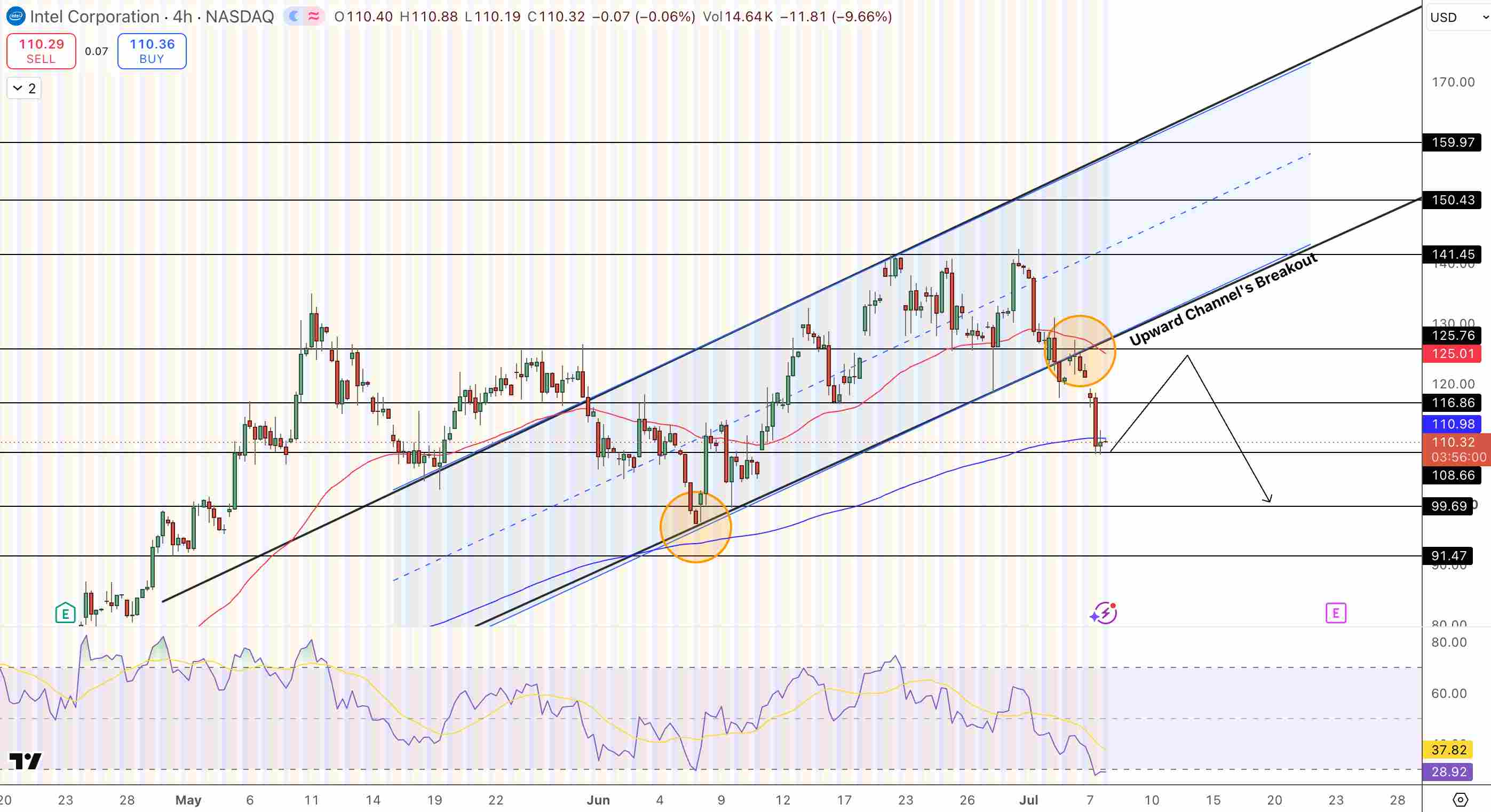
INTC Price Chart - Source: Tradingview
- ENTRY: Long above $125.70, as the channel breakout has been confirmed.
- TARGET: $141.40, representing a channel extension with prior support.
- STOP LOSS: Close below $108.60, as EMA200 support has failed.
- DRAWDOWN (21%): $140.05 to $110.32 on June 30 to July 7 (7d)
- HSBC price target: $200 (Buy rating), as the foundry is too good to ignore
- Key Event: Q2 earnings report (July 23, 2026), where updates on external foundry revenues and 18A yields will be critical.
Why Did Intel Drop 21% in Seven Days?
Intel slid from $140.05 to $110.32 across a seven-day trading period due to a mix of negative catalysts. The sell-off started on July 1 when Bank of America said AI chip valuations have become too stretched, leading to a general pullback in the space. It also retreated on July 2 and July 3, and fell a further 9.87% on July 7 after it was reported that Intel's 18A process is unlikely to become profitable until 2026 or 2027. It also gave notice that it would start selectively raising prices on consumer and Xeon server processors. This comes on the heels of an impressive rally in the first half of the year, meaning there is a lot more room for concerns regarding execution.
Why Did HSBC Raise Its Target to $200?
Even though the shares are lower, HSBC raised its Intel price target to $200, from a previous $100, while keeping its Buy rating on the company and saying it believes Intel's foundry business is still very undervalued. It sees Intel's foundry business growing partnerships to drive more earnings in the AI server business over the next few years, as demand for more advanced chips to build more production capacity increases.
What Should Investors Watch at Intel's July 23 Earnings?
In its earnings report that's due to come out on July 23, investors will be looking specifically at Intel Foundry external revenue as well as an update on the 18A process. Intel Foundry generated $174 million in external customer revenue and a $2.4 billion operating loss in Q1 2026, so the business is still very much in its early stages, although the company is making progress. Investors will want to see some proof that the business has begun to build customer production volumes and a clear plan to improve the manufacturing yields.
The Bottom Line
Trading at $110.32, the shares have now pulled back 21% in seven trading days. While the production timelines for 18A continue to be a problem for investors, the RSI is now at 37.82 so it is getting close to the oversold zone. The stock may trade higher to $141.40 as long as it closes above the current resistance level of $125.70. The chart could also break down if $108.60 gets breached. Investors will be hoping for more clarity in the next Intel earnings update on July 23, which will likely come from Intel Foundry and the 18A process.
Recommended Articles


