

TradingKey Daily Market Briefing: Three Major US Stock Indexes Fall, Samsung's Strong Earnings Fail to Boost Chip Stocks, Oil Prices Surge on Rising Iran Risks

Source Tradingkey

Tracking market trends

TradingKey - On July 7, Eastern Time, the three major US stock indexes collectively closed lower, with the AI and semiconductor sectors once again serving as the core drag on the market. Although Samsung Electronics' second-quarter earnings preview showed that demand for AI memory remains robust, the better-than-expected results failed to boost sentiment for chip stocks. Instead, they exacerbated market concerns over high valuations of AI hardware stocks, profit-taking, and the pricing-in of positive news. Meanwhile, attacks on vessels near the Strait of Hormuz pushed oil prices higher, bringing inflation and the Federal Reserve's policy path back into focus.

At the close, the Dow Jones Industrial Average fell 0.25% to 52,930.28; the S&P 500 Index fell 0.45% to 7,503.86; and the Nasdaq Composite Index fell 1.16% to 25,818.69.

In terms of sectors and individual stocks, the semiconductor sector continued to face pressure. The Philadelphia Semiconductor Index closed down 4.65%, Micron Technology ( MU) fell by about 4.7%, SanDisk ( SNDK) fell by about 7.3%, AMD ( AMD) fell by about 6.5%, and Nvidia ( NVDA) rose slightly but failed to reverse the sector's weakness. Large-cap tech stocks also diverged. SpaceX ( SPCX) fell nearly 7% on its first day of official inclusion in the Nasdaq 100 Index. Although several brokerages initiated coverage with optimistic ratings following its IPO, the market remained cautious about its valuation and short-term gains.

In the commodities market, oil prices rebounded sharply. Brent crude closed up 5.46% at $75.93, and WTI ( USOIL) crude closed up 5.22% at $72.19. The main driver behind the rise in oil prices was allegations that Iran attacked multiple commercial vessels near the Strait of Hormuz, after which the US revoked the general license allowing Iran to sell oil and reinstated relevant sanctions.

In precious metals, gold ( XAUUSD) fell about 1.42%, briefly dipping below $4,100 during the session, and was last trading at $4,105. Rising oil prices have renewed inflation concerns, and as the market awaits the Federal Reserve minutes, investors remain cautious about whether the Fed will maintain a tight policy stance.

Market News

DeepSeek is reportedly developing its own proprietary AI chip. Reports indicate that DeepSeek, a Chinese AI startup, is advancing its own proprietary AI inference chip project to reduce reliance on chips from Nvidia and Huawei. The project remains in its early stages; DeepSeek has begun recruiting chip design engineers and is exploring collaborations with foundries and memory chip makers. This news has intensified market discussions regarding changes in the competitive landscape of AI chips, and also served as a major backdrop for the pressure felt by the US semiconductor sector on the day.

Samsung Electronics' Q2 earnings guidance beats expectations. Samsung expects its second-quarter operating profit to surge approximately 19-fold year-on-year, primarily driven by rising prices of memory chips such as DRAM, NAND, and HBM due to demand for AI servers. However, Samsung's shares fell in South Korean trading, and US chip stocks followed suit, indicating that investors' expectations for the AI memory cycle are already high, and strong earnings alone are insufficient to continue driving the sector upward. The market will next focus on HBM orders, memory pricing, and second-half demand guidance in Samsung's official financial report.

US revokes Iran oil sales licenses, raising Strait of Hormuz risks once again. Following attacks on vessels near the Strait of Hormuz, the US government revoked general licenses previously allowing Iran to sell oil and reinstated relevant restrictions. This move poses a new test to the temporary easing of tensions between the US and Iran over energy exports and shipping security that had formed since June. As the Strait of Hormuz remains a critical global energy transit corridor, any attacks or escalation of sanctions could quickly drive up crude oil risk premiums and impact market assessments of inflation and Federal Reserve policy.

SpaceX officially added to the Nasdaq 100 Index. Less than a month after its IPO, SpaceX has been added to the Nasdaq 100, becoming a new member among heavyweights in US tech stocks. Several brokerages initiated coverage with relatively optimistic ratings, believing that the Starlink satellite network, Starship reusable rockets, and potential space AI infrastructure business will support long-term growth. However, SpaceX performed weakly on its first trading day in the Nasdaq, showing that the market still prefers to digest short-term gains first amid high valuations.

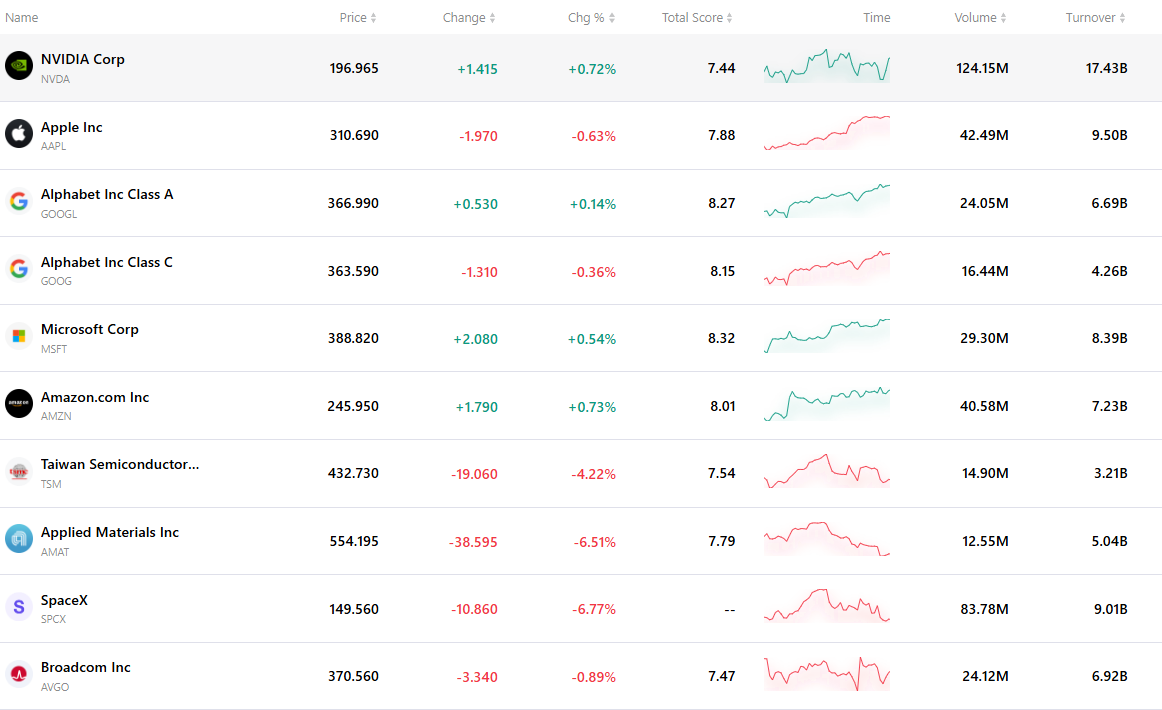
The top 10 most active stocks

The table below lists the ten most actively traded stocks in the latest market. Supported by massive trading volumes and excellent liquidity, these assets have become key benchmarks for tracking global market dynamics.
stock-88274192ef9d4d719ed7fd4b79c5f657

Disclaimer: For information purposes only. Past performance is not indicative of future results.
placeholder
Bitcoin CME gaps at $35,000, $27,000 and $21,000, which one gets filled first?Prioritize filling the $27,000 gap and even try higher.
Author  FXStreet
Aug 22, 2023
Prioritize filling the $27,000 gap and even try higher.
placeholder
Pinduoduo Earnings Incoming: Morgan Stanley Sees Long-Term Profit Potential​Insights – On November 21, Chinese e-commerce giant Pinduoduo (PDD) will release its Q3 2024 earnings.
Author  Mitrade
Nov 20, 2024
​Insights – On November 21, Chinese e-commerce giant Pinduoduo (PDD) will release its Q3 2024 earnings.
placeholder
Elon Musk’s xAI and Neuralink Launch New Funding Rounds​Billionaire Elon Musk recently raised funds for his two high-profile tech companies, xAI and Neuralink.
Author  Insights
Jun 03, 2025
​Billionaire Elon Musk recently raised funds for his two high-profile tech companies, xAI and Neuralink.
placeholder
Bitcoin briefly loses 2025 gains as crypto plunges over the weekend.Bitcoin experienced a sharp decline this weekend, briefly erasing its 2025 gains and dipping below its year-opening value of $93,507. The cryptocurrency fell to a low of $93,029 on Sunday, representing a 25% drop from its all-time high in October. Although it has rebounded slightly to around $94,209, the pressures on the market remain significant. The downturn occurred despite the reopening of the U.S. government on Thursday, which many had hoped would provide essential support for crypto markets. This year initially appeared promising for cryptocurrencies, particularly after the inauguration of President Donald Trump, who has established the most pro-crypto administration thus far. However, ongoing political tensions—including Trump's tariff strategies and the recent government shutdown, lasting a historic 43 days—have contributed to several rapid price pullbacks for Bitcoin throughout the year. Market dynamics are also being influenced by Bitcoin whales—investors holding large amounts of Bitcoin—who have been offloading portions of their assets, consequently stalling price rallies even as positive regulatory developments emerge. Despite these sell-offs, analysts from Glassnode argue that this behavior aligns with typical patterns seen among long-term investors during the concluding stages of bull markets, suggesting it is not indicative of a mass exodus. Notably, Bitcoin is not alone in its struggles, as Ethereum and Solana have also recorded declines of 7.95% and 28.3%, respectively, since the start of the year, while numerous altcoins have faced even steeper losses. Looking ahead, questions linger regarding the viability of the four-year cycle thesis, particularly given the increasing institutional support and regulatory frameworks now in place in the crypto landscape. Matt Hougan, chief investment officer at Bitwise, remains optimistic, suggesting a potential Bitcoin resurgence in 2026 driven by the “debasement trade” thesis and a broader trend toward increased adoption of stablecoins, tokenization, and decentralized finance. Hougan emphasized the soundness of the underlying fundamentals, pointing to a positive outlook for the sector in the longer term.
Author  Mitrade
Nov 17, 2025
Bitcoin experienced a sharp decline this weekend, briefly erasing its 2025 gains and dipping below its year-opening value of $93,507. The cryptocurrency fell to a low of $93,029 on Sunday, representing a 25% drop from its all-time high in October. Although it has rebounded slightly to around $94,209, the pressures on the market remain significant. The downturn occurred despite the reopening of the U.S. government on Thursday, which many had hoped would provide essential support for crypto markets. This year initially appeared promising for cryptocurrencies, particularly after the inauguration of President Donald Trump, who has established the most pro-crypto administration thus far. However, ongoing political tensions—including Trump's tariff strategies and the recent government shutdown, lasting a historic 43 days—have contributed to several rapid price pullbacks for Bitcoin throughout the year. Market dynamics are also being influenced by Bitcoin whales—investors holding large amounts of Bitcoin—who have been offloading portions of their assets, consequently stalling price rallies even as positive regulatory developments emerge. Despite these sell-offs, analysts from Glassnode argue that this behavior aligns with typical patterns seen among long-term investors during the concluding stages of bull markets, suggesting it is not indicative of a mass exodus. Notably, Bitcoin is not alone in its struggles, as Ethereum and Solana have also recorded declines of 7.95% and 28.3%, respectively, since the start of the year, while numerous altcoins have faced even steeper losses. Looking ahead, questions linger regarding the viability of the four-year cycle thesis, particularly given the increasing institutional support and regulatory frameworks now in place in the crypto landscape. Matt Hougan, chief investment officer at Bitwise, remains optimistic, suggesting a potential Bitcoin resurgence in 2026 driven by the “debasement trade” thesis and a broader trend toward increased adoption of stablecoins, tokenization, and decentralized finance. Hougan emphasized the soundness of the underlying fundamentals, pointing to a positive outlook for the sector in the longer term.
placeholder
Bitcoin Takes a 'Major Leap Forward' with $97K Price Targets in SightBitcoin holds steady above $90,000 as traders eye $100,000, buoyed by Thanksgiving market lull.
Author  Mitrade
Nov 28, 2025
Bitcoin holds steady above $90,000 as traders eye $100,000, buoyed by Thanksgiving market lull.
goTop
quote