


AMD Price Forecast: Data Center Hits $5.8B as Triangle Breakout Targets $607
TradingKey - Advanced Micro Devices (NASDAQ: AMD) stands at $575, having pierced through the symmetrical triangle on the 4-hour chart. Green candles display firm buyer interest in the breakout territory, with the RSI at 66.83 sitting in neutral-bullish ground without any bearish divergence. In Q1 2026 earnings on May 5, AMD clocked in with revenues of $10.25 billion (up 38% year-on-year), non-GAAP earnings per share (EPS) of $1.37, and non-GAAP operating income of $2.5 billion, as well as an all-time quarterly free cash flow in absolute terms.
The company saw an 18% share price increase the day after the earnings (one of the biggest single-day movements in recent memory for a company of AMD's market capitalisation), and the stock has formed the current symmetrical triangle since then. Lisa Su, AMD’s CEO said this was an “outstanding” quarter, with Data Center now the focus for revenue and earnings growth.
Data Center at $5.8 Billion — MI350 Driving Now, MI450 Already Exceeding Forecasts
Q1 2026 Data Center revenue of $5.8 billion, up from $3.7 billion in the year earlier, is AMD’s headline numbers for their current bull case. The drivers behind this growth were the 5th-generation AMD EPYC processors, and the Instinct MI350 Series of GPUs, the state-of-the-art AI accelerator chip in the AMD product lineup. MI350 competes directly with NVIDIA’s Blackwell chip series for the training and inference GPU market; it is a competitive product, not a concept.
The $5.8 billion data center quarter means that AMD customers are spending real money with AMD in terms of large cloud service providers, and large enterprises. The data center segment represents 57% of the total company revenue, which has more than doubled in the past six quarters with the Client and Gaming segments both doing fine but not growing as fast.
More relevant is a comment from the Q1 call about the MI450 Series GPUs and the Helios platform (next generation products, not in production yet). Lisa Su commented that the level of customer engagement and interest in MI450 “is increasing”, that customer’s expectations for MI450 “exceed our initial forecast” as it is part of a “growing pipeline” of “large-scale deployments that will provide AMD with increased visibility into its growth trajectory”.
The comment about the customer expectations exceeding initial forecasts is a strong comment, not just a “roadmap is on track” type of a comment. This may suggest that AMD’s dialogue with major hyperscalers is trending in a direction where management was comfortable sharing that information during their Q1 2026 earnings call.
The Client and Embedded Recovery — AI PCs and the Ryzen NPU Story
Apart from Data Center, AMD’s other segments totaled $4.5 billion in Q1 2026 revenue, and both are important in different ways when looking forward. Client and Gaming generated $3.6 billion in Q1 2026 revenue, thanks to higher Ryzen processor unit volume. This is primarily because of the Ryzen chip being used in AI PCs as Ryzen’s dedicated neural processing units (NPU).
With the requirements for Microsoft’s Copilot+ PC to have a minimum threshold of NPU performance, AMD’s Ryzen 9000 and Ryzen AI series meet or exceed these requirements, positioning AMD alongside Intel and Qualcomm as a three-way supplier to the AI PC transition. It also suggests a multi-year AI PC upgrade cycle with a more predictable CPU volume as the primary catalyst, rather than the typical annual CPU performance cycle. AMD is a major component of AI PCs as it’s an ecosystem play rather than one that is driven by hardware.
The Embedded revenue was at $873 million in Q1 2026, after a period of inventory correction for most of 2025. The Embedded segment serves industries such as industrial automation, automotive electrification, and 5G network infrastructure where AMD’s Xilinx FPGA and adaptive computing products serve as the differentiator. The product lifecycle and demand for embedded are more predictable and the revenue stream less quarter-to-quarter volatile than the AI GPU revenue which can be dictated by the capital expenditure spending of hyperscalers.
At the end of Q1 2026, AMD had $12.3 billion in total cash, cash equivalents and short-term investments, supported by $3 billion in cash flow from operations during the quarter and $221 million in share buybacks.
AMD Technical Setup — Triangle Breakout at $575, RSI 66.83, Target $607.50
The 4-hour chart shows AMD has broken out from a symmetrical triangle (A-B-C) with bullish candles as sellers have failed to overcome buyers at the breakout price level, while the long-term upward trend channel remains intact. The RSI of 66.83 is neutral bullish with ample space before reaching overbought levels, and no bearish divergence suggesting it will continue to gain momentum.
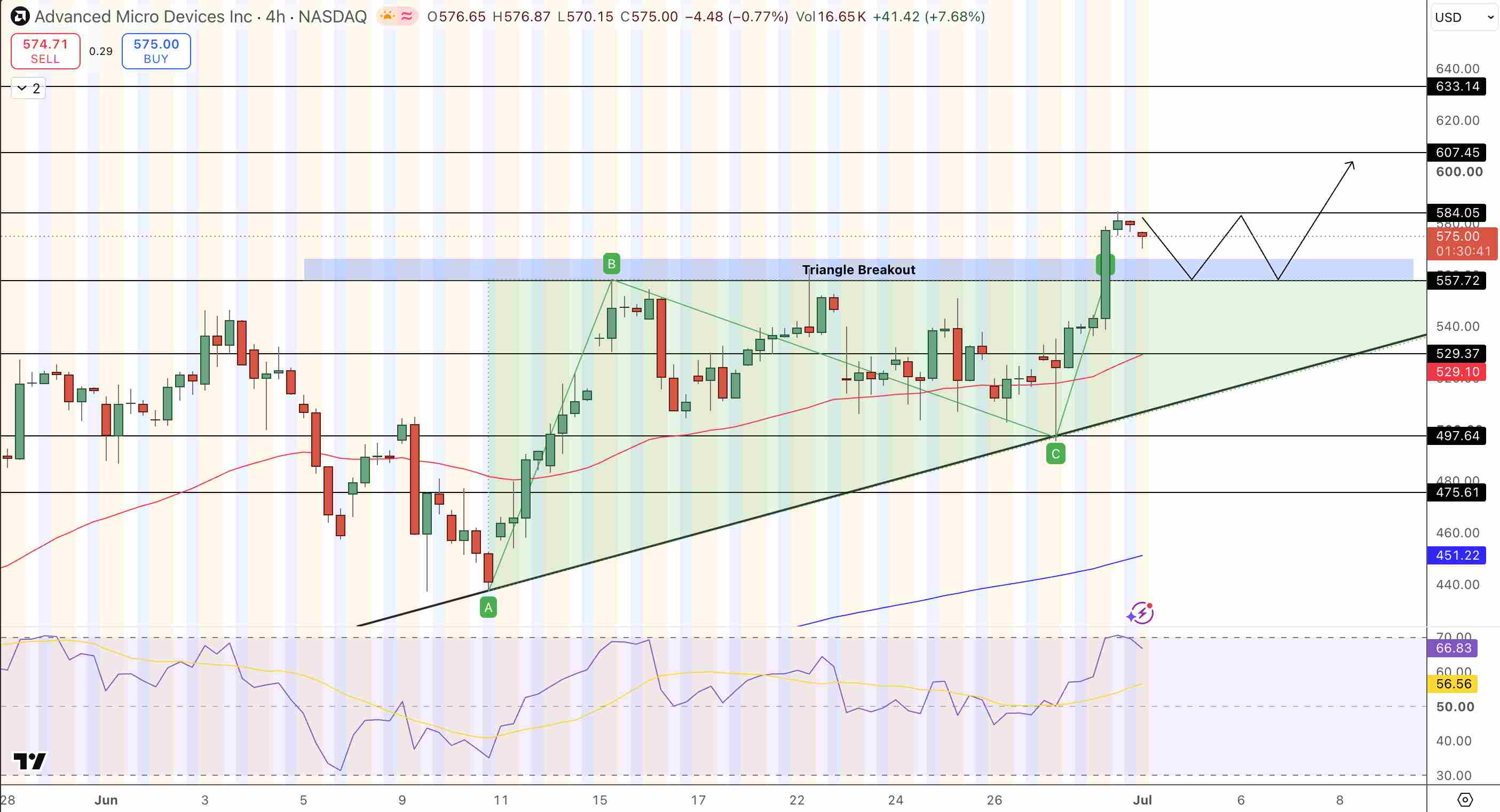
AMD Price Chart - Source: Tradingview
The triangle breakout gives a price target of between $607 to $633, with the ascending trend line and horizontal support at the $529 to $497 levels providing price floors. The breakout above $584.00 provides a $607.50 target price for continuation of triangle breakout.
- Entry: Long above $584.00 — triangle breakout confirmed
- Target 1: $607.50 — triangle projected move
- Target 2: $633 — extended channel target
- Stop Loss: Close below $529.00 — trendline and triangle floor fails
- Q1 2026: $10.25B revenue +38%, Data Center $5.8B, non-GAAP EPS $1.37
- Next earnings: Q2 2026 — expected late July / early August 2026
Bottom Line
AMD shares surged 18% in one day and later formed a symmetrical triangle pattern around the current $575 price point. The catalyst behind this move was the company's fiscal 2026 first quarter results which showed $10.25 billion in total revenue, an increase of 38% compared to the prior year; $5.8 billion in Data Center revenue; a non-GAAP EPS of $1.37; and a record-breaking free cash flow amount.
MI350 is currently driving momentum in AMD's Data Center segment, and the outlook for MI450 products from customers has beaten initial expectations which will serve as the next forward catalyst. The relative strength index (RSI) is at 66.83 (neutral to bullish) and there is no bearish divergence in the context of the uptrend channel pattern. If shares are able to sustain above $584.00 the next targets could reach the $607.50 region while invalidation occurs below $529.00.
NVIDIA's software platform will remain the largest overhang in AMD stock; the success or failure of AMD's MI450 software stack will be the biggest unknown to determine if, and how much additional portion, of the Data Center segment AMD can capture during the next cycle.
Recommended Articles


