


UiPath Price Forecast: PATH Posts First-Ever GAAP Profit as AI Deals Grow 6x Larger
TradingKey - Trading at $10.87, UiPath (NYSE: PATH) has found support at its ascending trendline on the four-hour chart following a pullback from $13.20. The company announced first quarter (FY27) earnings on May 28, 2026, which revealed a raft of firsts, and several accelerations: revenue of $418 million, up 17% year over year (YoY) and an acceleration from the 14% growth in the prior quarter; ARR of $1.901 billion, up 12% YoY; and, by far the most significant, a GAAP operating profit of $28 million in the company’s history.
16 out of the top 20 deals the company booked during the quarter featured AI; and expansion deals that included AI were six times larger than those that didn’t. Meanwhile, UiPath has been buying back its own stock: 22 million shares repurchased, including 2 million shares bought in at $9.63 by May 27, suggesting that management believes the stock is trading well below its intrinsic value. With an RSI at 64.33, UiPath sits at a neutral bullish level with plenty of upside room but has not seen a single bearish divergence.
The First GAAP Profit in UiPath’s History — Why This Milestone Changes the Valuation Story
UiPath went public in April 2021. In every quarter since then, the company has reported a GAAP loss. As such, the reported $28 million GAAP operating income for the quarter ended April 30, 2026 is not simply just a number; it’s also a fundamental re-characterization of UiPath as an investment. The fact that UiPath is transitioning from GAAP loss to GAAP profitability changes how a fund with a profitability mandate is able to hold UiPath, how the company screens into fundamental valuation frameworks, and what kind of terminal value the average analyst might feel comfortable applying.
Chief executive and founder Daniel Dines stated in the Q1 (FY27) earnings release that agentic products are now “moving from pilot to production, with customers standardising on UiPath as the orchestration and automation execution layer for their enterprise AI transformation.” (i.e. UiPath serves as the layer which then executes on AI agents’ decisions.) That product positioning is a product positioning that has been coming since the product was launched.
What is now clear is that that product positioning has translated directly into revenues. From the Q1 (FY27) numbers, AI featured in 16 of the 20 biggest deals UiPath booked in the quarter. Expansion deals that included AI were six times larger than those without, and at UiPath’s size ($1.9 billion in ARR; an average new logo base), such a difference would be meaningful to the company’s overall ARR growth if AI became the standard expansion vector, potentially boosting the current 12% growth rate well above that level.
In addition, UiPath posted dollar-based gross retention of 97% and a dollar-based net retention of 109% (108% adjusted for FX). The numbers show that customers are sticking around and buying more products, even with an increasingly competitive landscape. Meanwhile, the number of UiPath customers worth $1 million or more in ARR increased 18% YoY to 374, the segment where AI monetization is likely most visible.
The Gap Between $10.87 and $9.63 — What the Buybacks Are Telling You
The most telling proxy we have for how the board of directors feels about current value versus the future trajectory of the business is the buyback. UiPath bought 2M shares at an average $9.63/share on May 27. After Q1 FY2027 was released. This is a 10b5-1 program, meaning purchases are made according to a predefined schedule regardless of what the stock price might be. Management doesn't control that buyback price.
The size and frequency of the buyback program is what matters here, though. The board is committing 20M shares at an average $11.47/share plus the 2M at $9.63/share. They are making a decision to repurchase stock instead of doing something else with that cash. They are making that decision with knowledge of Q1 results. And they are making that decision with knowledge of FY2027 guidance. They have $1.4B cash and zero debt. They could continue to buy at these levels.
Q1 also had forward looking guidance for FY2027. Q2 FY2027 revenue guidance of $395M to $400M with a corresponding $1.929B to $1.934B ARR. Continuation of that 12% ARR growth + revenue acceleration. Analyst expectations, according to multiple sources, run the gamut from $12 to $17. At the low end ($12) is an advance of about 10% from $10.87. The high end of that range ($17) is over 50% upside.
So that drop from $13.20 to $10.87 was probably more of a reflection of general market conditions across the software sector, and perhaps some concern over net new ARR relative to installed base. It would also appear as if the churn has not been in their enterprise and large commercial customers that drive the revenue, but rather in the very small, sub $30k ARR customers.
PATH Technical Setup — Trendline at $10.87, RSI 64.33, Target $12.60
On the 4H time frame PATH is defending the rising trendline that has seen it tested many times at the resistance levels. The black trendline at bottom is ascending and multiple green candles show strong absorption at support. RSI is 64.33. It's neutral-bullish, has no divergence and room to go. Resistance is overhead at $11.91 to $12.57. Holding at this trendline could mean another run to $11.91 to $12.57.
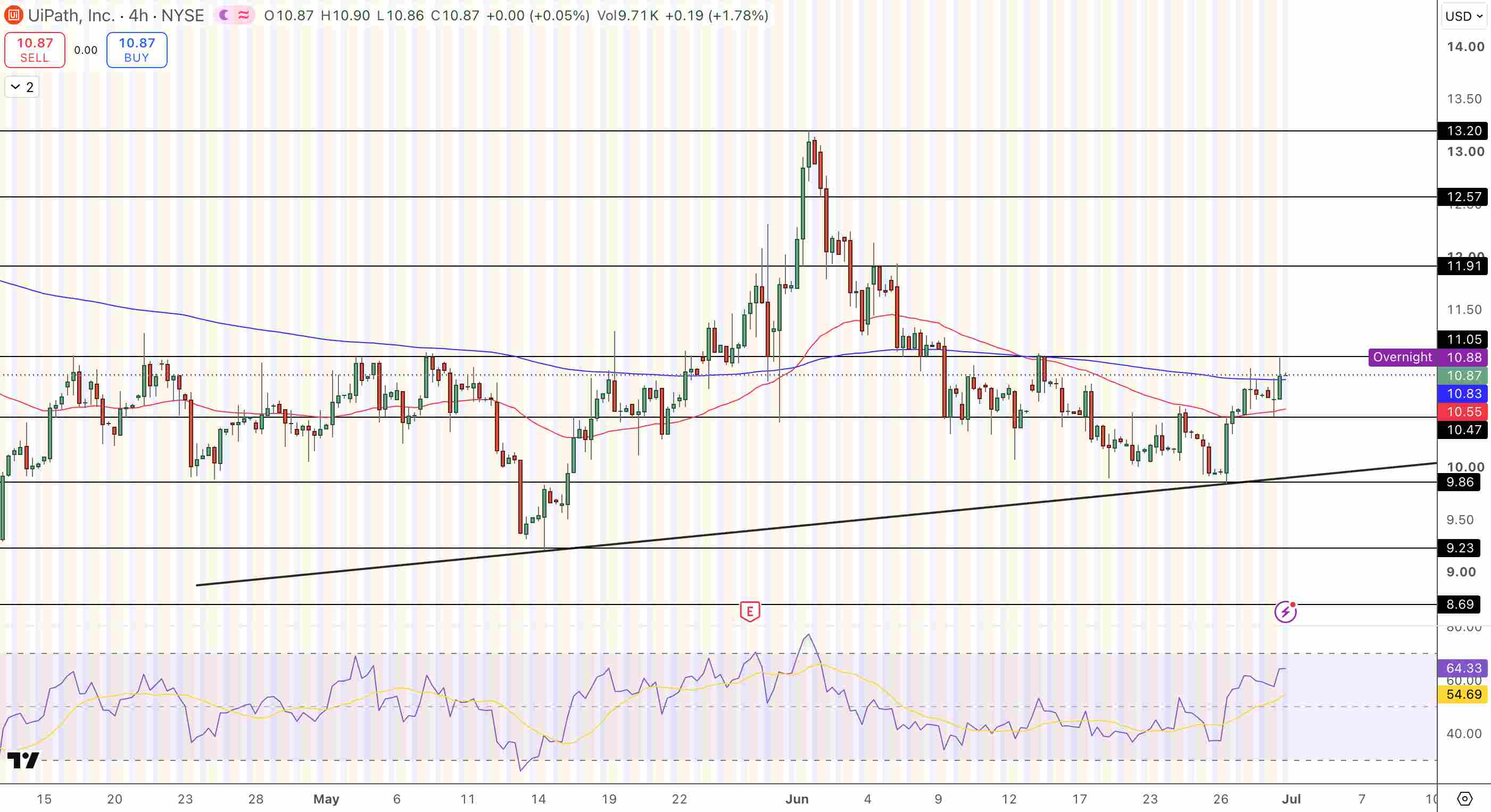
UiPath Price Chart - Source: Tradingview
A break at $10.87 opens up $9.86 to $8.69. If we can get a confirmed close above $11.90 then the $12.60 becomes a target on the trendline bounce:
- Entry: Long above $11.90 — trendline and channel resistance cleared
- Target: $12.60 — trendline bounce extension
- Stop Loss: Close below $9.86 — ascending trendline fails
- Q1 FY2027: $418M revenue +17% YoY, ARR $1.901B +12%, first GAAP profit ($28M)
- Buyback: 2M shares at $9.63 (May 27) — management signalling undervaluation
- Next earnings: September 8, 2026
What Did UiPath Report in Q1 Fiscal 2027?
UiPath reported revenue of $418 million in its fiscal first quarter 2027, ending April 30, 2026, an increase of 17 percent from the same quarter one year ago, and up from 14 percent growth in the preceding quarter. Annual recurring revenue was $1,901 million, up 12 percent. The company booked its first GAAP quarter of operating profit in its history, at $28 million.
The company says that artificial intelligence (AI) was a factor in 16 of its 20 largest deals, and that AI-inclusive expansion deals were six times larger than those that didn’t have AI. The firm raised its fiscal second quarter 2027 guidance to $395 to $400 million in revenue, and to $1,929 million to $1,934 million in ARR. It had $1.4 billion in cash and no debt.
Why Are UiPath’s AI Deals Six Times Larger Than Non-AI Deals?
Because the platform is positioned as the orchestration and execution layer for enterprise AI agents, AI deals involve larger platform deployments (more modules, more orchestration capacity, more connections to other enterprise systems) than pure RPA deals to automate a single workflow. AI-inclusive expansion deals were six times larger than those that didn’t, and if that premium holds at scale, it would mean higher per-customer revenue as current customers start using AI in addition to the platform.
Why Is the Stock at $10.87 If the Business Is Reaching Profitability?
The stock was $13.20 in recent weeks despite the company’s strong first-quarter earnings, as multiples of software companies are being squeezed again. There has been mild anxiety about net ARR growth in light of the $1.9 billion base, but the main churn is in the smallest customers, under $30,000, and UiPath expects a modest currency headwind this quarter. Every analyst target I’ve seen, $12 to $17, implies the stock has room to rise, and the 10b5-1 share buyback at $9.63 through May 27 shows where management believes the fair market value is.
Bottom Line
UiPath posted its first GAAP profit in its first fiscal quarter 2027 with revenue growth at 17 percent and ARR accelerated to $1.901 billion. The first time the company reported AI usage in 16 out of its 20 largest deals, and expansion deals involving AI were six times bigger than those without AI. The company is also buying back its shares at $9.63 with $1.4 billion in the bank and no debt, which is where management believes its market value should be. UiPath’s PATH stock is defending the ascending trendline at $10.87 with RSI (64.33) showing neutral to bullish and no bearish divergence. If the price closes above the previous week’s high at $11.90, a target for $12.60 comes into play, while I would place a protective stop at $9.86. The three figures making up the case are the company’s 10b5-1 buyback price at $9.63, the current price at $10.87, and every analyst’s target between $12 and $17.
Recommended Articles


