


I Own a Popular Bond ETF With 1 Big Risk -- This Short-Term Bond Fund Might Be a Better Buy
Key Points
The T. Rowe Price Ultra Short-Term Bond ETF has strongly outperformed the Vanguard Total Bond Market ETF since September 2021.
If interest rates go higher in the future, bond prices will go down -- and that’s an extra-large risk for longer-duration bonds.
About 20% of the Vanguard Total Bond Market ETF portfolio is in longer-duration bonds.
- 10 stocks we like better than T. Rowe Price Exchange-Traded Funds - T. Rowe Price Ultra Short-Term Bond ETF ›
There's a lot of discussion among bond investors right now about duration and interest rate risk. Longer-duration bonds, such as bonds that repay their investors over 10 to 20 years or more, have a risk of losing value if interest rates go higher in the future. When interest rates go up, bond prices go down -- and that's bad for investors who currently own bonds. Longer-duration bonds are more sensitive to this risk.
The recent rise in interest rates during 2022 is a big reason why the Vanguard Total Bond Market ETF (NASDAQ: BND) has delivered disappointing annualized returns of only 0.19% over the past five years. This popular ETF (exchange-traded fund) holds more than 11,000 bonds and charges an ultra-low expense ratio of 0.03%. But it has one big problem: interest rate risk.
Where to invest $1,000 right now? Our analyst team just revealed what they believe are the 10 best stocks to buy right now, when you join Stock Advisor. See the stocks »
Let's take a closer look at why longer-duration bonds can be riskier for investors -- and why a short-term bond ETF might be a better buy.

Image source: Getty Images.
Interest rate risk: Why higher yields make bond prices go down
No one knows what will happen to interest rates on any given day or year. But medium-term and long-term interest rates (such as 10-year, 20-year and 30-year Treasury bond yields) are a sign of investor confidence in the U.S. government. These longer-term rates are not set by the Federal Reserve. Instead, they are determined every day by global investors in the bond market.
Longer-term interest rates go up for a few reasons. If investors are concerned about excessive government borrowing or worry that a government won't pay its bills, they tend to demand a higher yield on government debt to compensate for that risk. If inflation is high and economic growth is strong, bond investors will also want higher yields to compensate them for their higher costs or missed opportunities to invest in stocks. This pushes up the price of money and the cost of borrowing -- for governments and everyone else.
Here's the risk of buying longer-term bonds: Interest rates might go up in the future. If you believe that inflation is likely to stay higher for longer, that the U.S. government will keep borrowing money and issuing more debt, that the Fed will raise interest rates, and that longer-term interest rates could go higher than they are today, buying longer-duration bonds (such as 10-year or 20-year Treasuries or longer) could be a bad investment.
Vanguard Total Bond Market ETF (BND): 19 years of 3.08% annualized returns
I own the Vanguard Total Bond Market ETF, and it's a popular, ultra-low-cost way to buy thousands of bonds. I don't regret my choice of buying this bond fund; it's a basic building block for many portfolios. Over the past 19 years since the fund's inception in April 2007, the Vanguard Total Bond Market ETF has delivered average annual returns of 3.08%.
But the fund's portfolio includes some medium-term and longer-term bonds. That could be risky. Approximately 20% of the fund's portfolio is in bonds with durations of 10 to 15 years or longer. If interest rates go up in the future, these bonds will be more sensitive to interest rate risk and could lose value.
This is the biggest risk of this bond ETF: What if interest rates go higher? Inflation is not "over" yet. Energy costs could keep rising, prices could keep going up, and government debt could increase in a way that hurts bond investors.
With that in mind, buying a portfolio of only short-term bonds could be a better choice. Let's look at a unique bond ETF that lets you do that.
T. Rowe Price Ultra Short-Term Bond ETF (TBUX): 4.1% annualized returns for almost 5 years
The T. Rowe Price Ultra Short-Term Bond ETF (NYSEMKT: TBUX) is an actively managed bond ETF that intends to provide higher income for bond investors, with modest additional risk compared to traditional cash investments. It charges an expense ratio of 0.17%, but the returns recently have been worth paying for.
This fund has delivered a 4.92% return (by net asset value) in the past year, and 5.85% in the past three years. It only invests in short-term bonds -- the fund has a weighted average maturity of 1.37 years and an effective duration of 0.69 years. The fund's holdings are about 75% U.S. bonds and 25% international bonds.
It also has a larger weighting toward corporate bonds than the Vanguard fund. About 61% of the T. Rowe Price fund's assets are in investment-grade corporate bonds, and only 5.8% in U.S. Treasuries. In the past (nearly) five years since its inception, the T. Rowe Price Ultra Short-Term Bond ETF has delivered average annual returns of about 4.1%. It has strongly outperformed the Vanguard Total Bond Market ETF, and with less volatility:
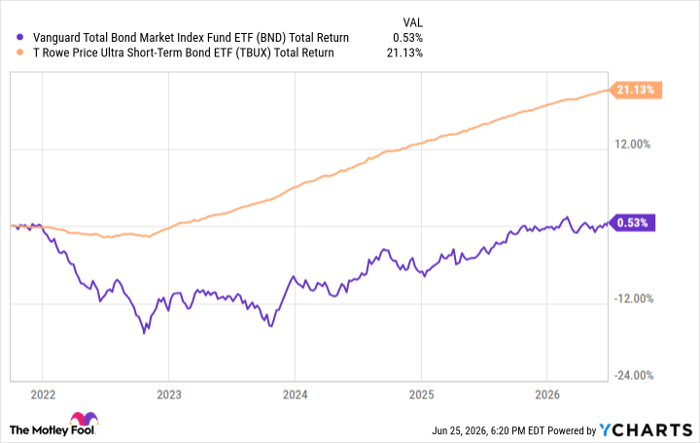
BND Total Return Level data by YCharts
I'm a long-term bond investor, and I accept the possible risks and downsides of the Vanguard Total Bond Market ETF. It's one of the best bond ETFs. Even if this fund doesn't deliver excellent returns in the short run, I want to keep it in my portfolio for diversification and possible "dry powder" to rebalance during a stock market downturn.
But if you're worried about future high inflation and long-term interest rate rises, the T. Rowe Price Ultra Short-Term Bond ETF could be a better buy. It lets you avoid the interest-rate risk of longer-duration bonds.
Should you buy stock in T. Rowe Price Exchange-Traded Funds - T. Rowe Price Ultra Short-Term Bond ETF right now?
Before you buy stock in T. Rowe Price Exchange-Traded Funds - T. Rowe Price Ultra Short-Term Bond ETF, consider this:
The Motley Fool Stock Advisor analyst team just identified what they believe are the 10 best stocks for investors to buy now… and T. Rowe Price Exchange-Traded Funds - T. Rowe Price Ultra Short-Term Bond ETF wasn’t one of them. The 10 stocks that made the cut could produce monster returns in the coming years.
Consider when Netflix made this list on December 17, 2004... if you invested $1,000 at the time of our recommendation, you’d have $398,052!* Or when Nvidia made this list on April 15, 2005... if you invested $1,000 at the time of our recommendation, you’d have $1,181,688!*
Now, it’s worth noting Stock Advisor’s total average return is 892% — a market-crushing outperformance compared to 205% for the S&P 500. Don't miss the latest top 10 list, available with Stock Advisor, and join an investing community built by individual investors for individual investors.
See the 10 stocks »
*Stock Advisor returns as of June 30, 2026.
Ben Gran has positions in Vanguard Total Bond Market ETF. The Motley Fool has positions in and recommends Vanguard Total Bond Market ETF. The Motley Fool has a disclosure policy.
Recommended Articles


