


The Probability of a Federal Reserve Rate Hike Is Soaring, Which Poses a Serious Problem for Wall Street
Key Points
It's been a history-packed year, highlighted by a changing of the guard at the Federal Reserve in May.
The CME Group's FedWatch Tool suggests that interest rate hikes are a near certainty in the not-too-distant future.
Higher borrowing costs can stymie the artificial intelligence data center build-out and put valuations for the second-priciest stock market in history under a microscope.
- 10 stocks we like better than S&P 500 Index ›
The last two months have been packed with history-making moments on Wall Street. We've watched the Dow Jones Industrial Average (DJINDICES: ^DJI), S&P 500 (SNPINDEX: ^GSPC), and Nasdaq Composite (NASDAQINDEX: ^IXIC) climb to record highs, and witnessed the largest initial public offering, courtesy of Space Exploration Technologies (SpaceX).
But perhaps the most noteworthy moment was the changing of the guard at the central bank. Jerome Powell's term as Fed chair ended on May 15, and his successor, Kevin Warsh, officially took the lead role at the Federal Reserve on May 22. Warsh became only the 17th Fed chair since the central bank was created in December 1913.
Missed Nvidia in 2009? This Rare Signal Is Flashing Again. In 2009, a "Double Down" signal flashed for a little-known chipmaker called Nvidia. For the first time in years, that same "Total Conviction" signal is flashing for a company 1/100th the size of Nvidia. Continue »
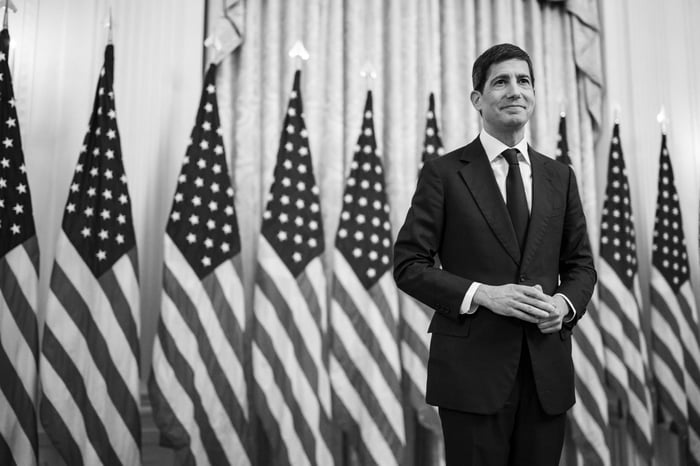
Fed Chair Kevin Warsh has pledged to reform the central bank. Image source: Official White House Photo by Daniel Torok.
Warsh promised "a reform-oriented Federal Reserve" at his White House swearing-in ceremony, and he began delivering on this regime change at his first Federal Open Market Committee (FOMC) meeting as head of the central bank on June 17. He avoided forward-looking guidance and stuck to a considerably shorter FOMC statement that left Wall Street and investors guessing.
But the biggest change of the Warsh-led Fed is yet to come, with projections pointing to a rapidly rising probability of one or more interest rate hikes.
Interest rate hikes appear likely, which is awful news for the stock market
Although no predictive tool can guarantee what's to come, the CME Group's FedWatch Tool has an uncanny ability to accurately forecast the Fed's monetary policy actions. Using the 30-day Fed Funds futures prices as a guide, the FedWatch Tool predicts the probability of rate hikes/cuts at future meetings.
Over the last month, the probability of an FOMC rate hike has soared. As of June 23, there's a 36% chance of a hike by the next FOMC meeting in late July, a 70% chance of a hike by mid-September, a nearly 86% probability of a hike by December, and 90% chance of a rate increase come March 2027.
Very hawkish dot plot.
-- Nick Timiraos (@NickTimiraos) June 17, 2026
Nine out of 18 officials have at least one hike this year (and six of those 9 have *multiple hikes*).
Only one person has a cut this year, and one participant (presumably Warsh) didn't submit an SEP
The statement gets a complete writethru from top to... pic.twitter.com/KRwatpTFOP
These projections have notably jumped following the quarterly release of the dot plot (officially, the Summary of Economic Projections). The dot plot is a graph that anonymously plots the forward-looking federal funds target rate projections of FOMC members. Though Warsh abstained, nine of the other 18 FOMC members forecast one or more rate hikes by the end of 2026.
Additionally, Kevin Warsh's voting record leans decisively hawkish. He's traditionally favored high interest rates as a tool to suppress inflation and promote price stability.
If the Federal Reserve raises interest rates, it could halt this historic bull market in its tracks. Higher borrowing costs may slow the artificial intelligence (AI) data center build-out, forcing overzealous investors in a historically pricey stock market to temper their growth expectations for Wall Street's leading AI stocks.
Shiller PE Ratio is now just 3.5% away from passing the Dot Com Bubble as the most expensive stock market valuation in history 🚨🚨🚨 pic.twitter.com/1ceOa3yhfs
-- Barchart (@Barchart) June 1, 2026
Furthermore, rate hikes would likely put stock valuations under a microscope. Investors appeared more than willing to look the other way when 2026 began, given that several rate cuts were expected. But if borrowing becomes costlier, it'll be considerably more challenging for investors to look past the reality that this is the second-priciest stock market in history, behind only the dot-com bubble.
If the CME's FedWatch Tool is correct, a serious problem awaits Wall Street.
Should you buy stock in S&P 500 Index right now?
Before you buy stock in S&P 500 Index, consider this:
The Motley Fool Stock Advisor analyst team just identified what they believe are the 10 best stocks for investors to buy now… and S&P 500 Index wasn’t one of them. The 10 stocks that made the cut could produce monster returns in the coming years.
Consider when Netflix made this list on December 17, 2004... if you invested $1,000 at the time of our recommendation, you’d have $387,428!* Or when Nvidia made this list on April 15, 2005... if you invested $1,000 at the time of our recommendation, you’d have $1,221,398!*
Now, it’s worth noting Stock Advisor’s total average return is 895% — a market-crushing outperformance compared to 205% for the S&P 500. Don't miss the latest top 10 list, available with Stock Advisor, and join an investing community built by individual investors for individual investors.
See the 10 stocks »
*Stock Advisor returns as of June 26, 2026.
Sean Williams has no position in any of the stocks mentioned. The Motley Fool has positions in and recommends CME Group. The Motley Fool has a disclosure policy.
Recommended Articles


