


Why Is Nvidia Stock So Cheap? This Is the Only Plausible Answer
Key Points
Nvidia stock is up just 4% this year, underperforming the S&P 500 and its semiconductor peers.
Wall Street expects Nvidia's EPS to nearly double this year.
Uncertainty about an AI bubble is holding the stock back.
- 10 stocks we like better than Nvidia ›
For much of the AI boom, Nvidia (NASDAQ: NVDA) has been the stock market darling.
The stock started soaring shortly after the release of ChatGPT in Nov. 2022 as it was primed to benefit from demand for its GPUs, which are used for AI training.
Missed Nvidia in 2009? This Rare Signal Is Flashing Again. In 2009, a "Double Down" signal flashed for a little-known chipmaker called Nvidia. For the first time in years, that same "Total Conviction" signal is flashing for a company 1/100th the size of Nvidia. Continue »
Since then, the stock has gained more than 1,000%, and Nvidia has become the most valuable company in the world, with a market cap of nearly $5 trillion.
However, in 2026, chip stock investors seemed to have moved on from the industry leader, piling into the new chip sector bottlenecks, including memory chip stocks like Micron and Sandisk, which are experiencing a shortage, and CPU stocks like Intel, AMD, and Arm Holdings, which are expected to benefit from increasing demand for AI inference.
As a result, Nvidia's performance has been downright pedestrian this year. At nearly the halfway point of 2026, Nvidia stock is up just 4%, compared to an 8% gain in the S&P 500, and a 9% increase in the Nasdaq Composite. The iShares Semiconductor ETF, which tracks the sector, has more than doubled this year due to breakout gains from Intel, Micron, and other stocks, rather than Nvidia.
While Nvidia stock is slumping, down 17% from its peak in May, the business performance remains excellent. Revenue jumped 85% in the first quarter to $81.6 billion, and adjusted net income rose 139% $45.5 billion. Nvidia's net income is on track to top $200 billion this year, easily making it the most profitable company in the world. To put that number into perspective, only a few dozen companies make that much in annual revenue. $200 billion is similar to the GDP of countries like Ukraine and Qatar.
Based on its trailing adjusted earnings per share of $5.84, the stock now has a price-to-earnings ratio of 33, which is modestly more expensive than the S&P 500, at 26.

Image source: Nvidia.
Where Nvidia starts to look like a bargain
The trailing valuation isn't the best way to look at Nvidia. After all, this is a company that just grew revenue by 85% and more than doubled its net income. You have to factor in its growth and its direction.
Below is the consensus EPS forecast for Nvidia for the next three years.
| Fiscal year ending | EPS consensus |
|---|---|
| Jan. 2027 | $8.69 |
| Jan. 2028 | $11.67 |
| Jan. 2029 | $15.76 |
Source: Nasdaq.com
Nvidia reported $4.77 in adjusted EPS last year, so analysts expect EPS to nearly double this year and to more than triple over the next three years.
Based on fiscal 2029 estimates, the stock looks ridiculously cheap, trading at just 12 times expected earnings. That's a valuation normally reserved for no-growth or slow-growth stocks in sleepy industries like banking and manufacturing.
Nvidia, on the other hand, has been one of the most disruptive companies of the decade and is still growing like wildfire.
Is Wall Street right?
It's worth remembering that the numbers in the chart above are just forecasts, and the further out they go, the more inaccurate they become. A lot could change between now and Jan. 2029.
However, investors should also be aware that analysts have significantly underestimated the sustainability of the AI boom and Nvidia's growth.
The chart below shows how Wall Street's estimates for Nvidia's next fiscal-year revenue have changed.
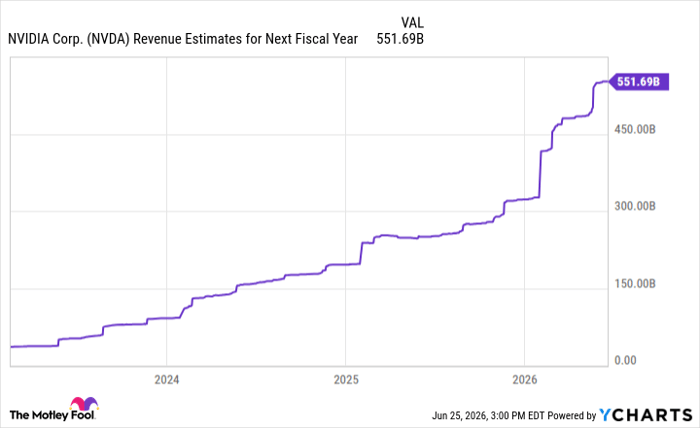
NVDA Revenue Estimates for Next Fiscal Year data by YCharts
Through much of 2025, Wall Street thought Nvidia would bring in around $250 billion in revenue for the current fiscal year (fiscal 2027). Instead, Nvidia is on track for close to $400 billion in revenue this year. That's a huge miss; Wall Street simply did not expect the company's growth rate to reaccelerate, which it has in recent quarters.
Why Nvidia looks so undervalued
The best explanation for why the stock is trading at just 12 times fiscal 2029 earnings is that investors don't believe these profits are sustainable over the long term. According to that argument, semiconductors are historically cyclical, and when the massive AI capex build-out slows down, so will demand for Nvidia chips.
The debate over whether there's an AI bubble has been brewing for nearly a year now, and there's no clear answer. Last night's earnings report from Micron showed that there's still a huge shortage in memory chips, which seems bullish for companies like Nvidia. While Nvidia is a customer of Micron, the memory shortage means that demand for AI chips like Nvidia's would be even higher if there were sufficient memory supply. In other words, Nvidia's revenue could be even higher than what it is now. Nonetheless, Nvidia stock fell on the news.
At some point, there will likely be a peak in the AI chip cycle, and depending on valuations, there will be a pullback in some stocks. If that happens, some observers will surely say the AI bubble has burst.
However, that risk seems more than priced into Nvidia stock at this point, and Wall Street has thus far been too conservative, underestimating its growth. While the fiscal 2029 EPS forecast is probably wrong, there's a good chance that it's wrong because it's too low, rather than too high.
Should you buy stock in Nvidia right now?
Before you buy stock in Nvidia, consider this:
The Motley Fool Stock Advisor analyst team just identified what they believe are the 10 best stocks for investors to buy now… and Nvidia wasn’t one of them. The 10 stocks that made the cut could produce monster returns in the coming years.
Consider when Netflix made this list on December 17, 2004... if you invested $1,000 at the time of our recommendation, you’d have $387,428!* Or when Nvidia made this list on April 15, 2005... if you invested $1,000 at the time of our recommendation, you’d have $1,221,398!*
Now, it’s worth noting Stock Advisor’s total average return is 895% — a market-crushing outperformance compared to 205% for the S&P 500. Don't miss the latest top 10 list, available with Stock Advisor, and join an investing community built by individual investors for individual investors.
See the 10 stocks »
*Stock Advisor returns as of June 25, 2026.
Jeremy Bowman has positions in Advanced Micro Devices, Arm Holdings, Micron Technology, and Nvidia. The Motley Fool has positions in and recommends Advanced Micro Devices, Arm Holdings, Intel, Micron Technology, Nvidia, and iShares Trust-iShares Semiconductor ETF. The Motley Fool has a disclosure policy.
Recommended Articles


