


New Fed Chair Kevin Warsh Has So Far Defied President Trump at Every Turn. But He May Yet Find a Way to Deliver for One of the Fed's Biggest Critics.
Key Points
The interest rate-setting Federal Open Market Committee (FOMC) was more hawkish at new Federal Reserve Chair Kevin Warsh's first meeting.
Warsh has also spoken about potentially implementing some policies at the Fed that may not be so great for the market.
However, one option Warsh is currently considering by may yet prove capable of delivering for Trump.
- These 10 stocks could mint the next wave of millionaires ›
Kevin Warsh has only been chair of the Federal Reserve's Board of Governors for a little over a month, but given how mad President Trump got at former Fed Chair Jerome Powell when the Fed didn't lower interest rates earlier this year, it's a bit of a headscratcher why Trump chose Warsh.
So far, Warsh has publicly said he thinks inflation is a problem and the market is now pricing in more interest-rate increases than it did under Powell. Warsh has also been pretty clear that he thinks the Fed has been overly communicative with markets and that its bloated balance is a problem.
Where to invest $1,000 right now? Our analyst team just revealed what they believe are the 10 best stocks to buy right now, when you join Stock Advisor. See the stocks »
But the large balance sheet and the Fed's transparency have also been considered a boon to the market in recent years, and Trump clearly wants the market to do well during his time in office.
While Warsh has seemingly defied Trump early and often so far, he may yet find a way to deliver for one of the Fed's biggest critics in due time.
Warsh has defied Trump early on
Based on statements made before he was appointed Fed chair, many believed Warsh would argue for lower interest rates by suggesting that artificial intelligence would be highly deflationary.
And while he may still believe that, Warsh, in his first post-Fed-meeting press conference earlier this month, said he views inflation as a problem. He also said that the Fed's top priority would be to rein it in, statements the market largely viewed as hawkish.
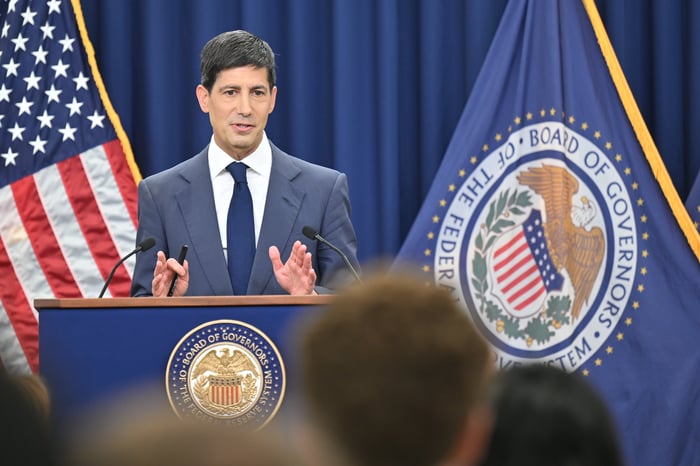
Image source: Federal Reserve.
Furthermore, the rate-setting Federal Open Market Committee (FOMC) dropped an easing bias from its policy statement, while all 12 voting members of the 19-member FOMC elected to hold the federal funds rate steady, a big change from one of the most divided votes at the FOMC's prior meeting.
Now, the role of the Fed chair is to build consensus, so even if Warsh truly believed the Fed should have lowered rates at the June meeting, a dissent at his first meeting as chair would have been very controversial and likely not a good way for him to start.
Still, Warsh's comments and actions so far are not indicative of a chair trying to lower rates in the near term.
How Warsh could still find a way to lower rates sooner rather than later
Interestingly, Trump has been strikingly calm during all of this. Earlier in June, Trump said that Warsh should "... do whatever he wants" and "I don't want to have a big influence on him."
Perhaps Trump didn't realize the blowback he would face from imposing all that public pressure on Powell and simply wants to move on. Or perhaps Warsh has given him assurances that he will do what he can to lower rates in due time. It's hard to know.
But there is still a chance that Warsh finds a way to lower interest rates sooner rather than later. At his first Fed meeting as chair, Warsh made it clear that big changes are coming.
Warsh did not participate in the Fed's Summary of Economic Projections, breaking a 14-year precedent for the Fed chair. He also announced five new task forces to examine major areas of the Fed's operations, including Fed communications, the balance sheet, economic data, productivity and jobs, and the Fed's inflation framework.
It's the inflation framework where things could get interesting. Warsh has not been shy about his belief that the Fed may be looking at inflation through the wrong lens.
"I've said for years inflation is a choice," Warsh said in the Fed's June post-meeting press conference. "You bet it is. And today I'm announcing that this committee unambiguously and unanimously have decided we are going to deliver on that."
Warsh has previously said he would like the Central Bank to focus its inflation view more on the "trimmed mean," which removes many of the most volatile price moves, even beyond food and energy.
In April, the Fed's preferred inflation gauge, the Personal Consumption Expenditures (PCE) price index, came in at 3.3% year over year, excluding food and energy, still well above the Fed's 2% inflation target.
However, at this time, the "trimmed mean" inflation number was only 2.3%, according to The Wall Street Journal.
So, if the Fed's task force, focused on the agency's inflation framework, came back with a recommendation to focus on the "trimmed mean," it would be much easier for Warsh to pitch a rate cut to the rest of the FOMC.
That would be likely to appeal to Trump.
Where to invest $1,000 right now
When our analyst team has a stock tip, it can pay to listen. After all, Stock Advisor’s total average return is 895%* — a market-crushing outperformance compared to 205% for the S&P 500.
They just revealed what they believe are the 10 best stocks for investors to buy right now, available when you join Stock Advisor.
See the stocks »
*Stock Advisor returns as of June 25, 2026.
The Motley Fool has a disclosure policy.
Recommended Articles


