


AI Sector Pulls Back: Micron Plunges Over 13%, Can Earnings Be the Clarion Call for a Counterattack?
TradingKey - On Tuesday, Eastern Time (June 23), dragged down by the collapse of the semiconductor sector in the South Korean stock market, U.S. tech stocks saw a notable correction, which directly dented sentiment across the U.S. memory chip and AI hardware supply chains.
In terms of market performance, South Korea's KOSPI index plummeted nearly 10% at one point on Tuesday, marking its largest single-day drop in over three months, while Samsung Electronics and SK Hynix both plunged over 12%. Because Samsung, SK Hynix, and Micron ( MU) all operate in the global memory chip supply chain and are crucial suppliers of AI server HBM and high-end DRAM, the severe sell-off in the South Korean market quickly spilled over to U.S. equities. The Philadelphia Semiconductor Index tumbled about 7.9%, the Nasdaq fell roughly 2.2%, Micron Technology plummeted over 13% in a single session, and SanDisk ( SNDK ), Marvell ( MRVL ), AMD ( AMD ), Nvidia ( NVDA) and other AI hardware supply chain stocks also came under collective pressure.
Against this backdrop, Micron is scheduled to release its fiscal third-quarter 2026 earnings results after the U.S. market close today. As a major beneficiary of demand for AI memory, HBM, and data center storage, whether Micron can deliver strong results will directly influence market judgment on the AI hardware upcycle. If the earnings and guidance are robust enough, Micron has a chance to drive a short-term rebound in the AI sector; however, if they merely "meet expectations" or if guidance is slightly conservative, the market may continue to interpret it as a signal that the AI trade is cooling down from its peaks.
The market's primary concern is whether earnings can beat high expectations.
Looking at previous earnings reports, Micron has already delivered very strong results. The company's second-quarter fiscal 2026 revenue reached $23.86 billion, higher than the $13.64 billion of the previous quarter and well above the $8.05 billion in the same period last year. Non-GAAP net income reached $14.02 billion, non-GAAP EPS was $12.20, and operating cash flow stood at $11.9 billion. This means Micron has transitioned from a traditional cyclical memory stock into one of the companies demonstrating the most pronounced profit release within AI computing infrastructure.
Looking at earnings expectations, the company's previously provided Q3 guidance was for revenue of approximately $33.5 billion and non-GAAP EPS of around $19.15. However, Wall Street currently generally expects Micron's adjusted Q3 EPS to reach around $20.76, representing a nearly tenfold year-over-year increase, while revenue is projected to be approximately $35.75 billion, up about 284% year-over-year. Market expectations indicate that investors' focus regarding this earnings report is not just on performance growth, but more importantly, on whether Micron can significantly beat market consensus.
HBM remains the biggest highlight of the earnings report
In this earnings report, the core metric drawing the most market attention is HBM, or High Bandwidth Memory. HBM is a critical component of AI GPUs, AI servers, and large-scale data center training clusters, directly tied to the AI capital expenditures of Nvidia, AMD, and major cloud service providers. Over the past year, the core logic driving the surge in Micron's stock price has been the market's belief that demand for HBM and high-end DRAM from AI servers will remain in short supply over the long term.
For investors, three key issues warrant close attention: First, whether Micron's HBM revenue continues to grow rapidly; second, whether its HBM capacity for 2026 remains fully sold out; and third, whether the company provides clearer updates on the progress of HBM4 and next-generation AI memory products. If management confirms that HBM order visibility continues to extend and that demand is driven by multiple leading AI customers rather than a single client, market confidence in the AI hardware cycle will significantly recover.
Gross margin determines whether the market believes the supercycle will continue.
In addition to HBM, gross margin is equally critical. The current market is buying Micron not just because of its rapid revenue growth, but because AI server demand is driving up the prices of high-end memory products such as HBM, DDR5, and data center DRAM, rapidly magnifying Micron's earnings leverage. Wall Street firms generally expect Micron's Q3 gross margin to reach a record level of approximately 81.6%. If the actual gross margin continues to exceed expectations, it would indicate that memory supply and demand remain tight and that Micron still possesses strong pricing power, leading the market to believe that the AI memory supercycle has not yet peaked.
Conversely, if gross margins begin to fall short of expectations, or if management signals that subsequent gross margins will struggle to continue rising, the stock price could come under pressure even if revenue and EPS for this quarter beat expectations. This is because the memory chip industry is highly cyclical, and stock prices typically price in future earnings trends in advance rather than focusing solely on already reported profits for the current quarter. If gross margins peak, the market will worry that the upside for memory prices is narrowing and that cost advantages will be difficult to expand further, thereby inferring that EPS growth could slow in the coming quarters.
Whether this can drive a rally in the AI sector hinges on next-quarter guidance.
Whether Micron can drive the AI sector to rally again ultimately depends on the industry signals released in its earnings report. If Micron raises its revenue and earnings guidance for the next quarter and explicitly states that AI data center demand remains robust, the market may resume buying into the semiconductor supply chain, particularly in memory, AI servers, GPUs, networking chips, and semiconductor equipment. Stocks like Micron, SanDisk, Western Digital ( WDC ), Marvell, AMD, Nvidia, Broadcom ( AVGO) and other stocks are all expected to benefit from the recovery in sentiment.
However, if Micron's third-quarter results merely beat expectations without a further upward revision in its next-quarter guidance, the market might assume that the high demand for AI memory has already been fully priced in, and the stock price could instead experience a "sell-the-news" reaction. A greater risk lies in the possibility that if the company hints at slowing customer orders, narrowing price increases, or difficulty in continuing to expand gross margins, then yesterday's AI sector pullback might not be just short-term profit-taking, but the beginning of a valuation rerating.
Institutions remain bullish, but stock prices have risen too high.
From an institutional perspective, Wall Street remains generally optimistic overall. Deutsche Bank, TD Cowen, and Cantor Fitzgerald have all recently set price targets of around $1,500, believing that AI-driven DRAM demand and pricing power continue to strengthen. Needham raised Micron's price target to $1,550, while Susquehanna was more aggressive with a target of $1,750, projecting that Micron's FY2027 EPS could reach $160. BofA also raised its target from $950 to $1,500 during the market pullback, emphasizing that Micron's memory value in the AI era is being re-rated.
However, it is worth noting that Micron's stock price has already surged by over 260% year-to-date. Even with yesterday's plunge of over 13%, its market capitalization remains at the trillion-dollar level, and the market's optimistic expectations for its future earnings growth are already largely priced in. Should Micron's earnings report fall short of market expectations, the stock price could enter a deep correction phase. Only if strong performance, strong guidance, strong HBM, and strong gross margins all materialize simultaneously in this earnings release can the stock price truly regain upward momentum.
Micron Stock Price Trend Analysis
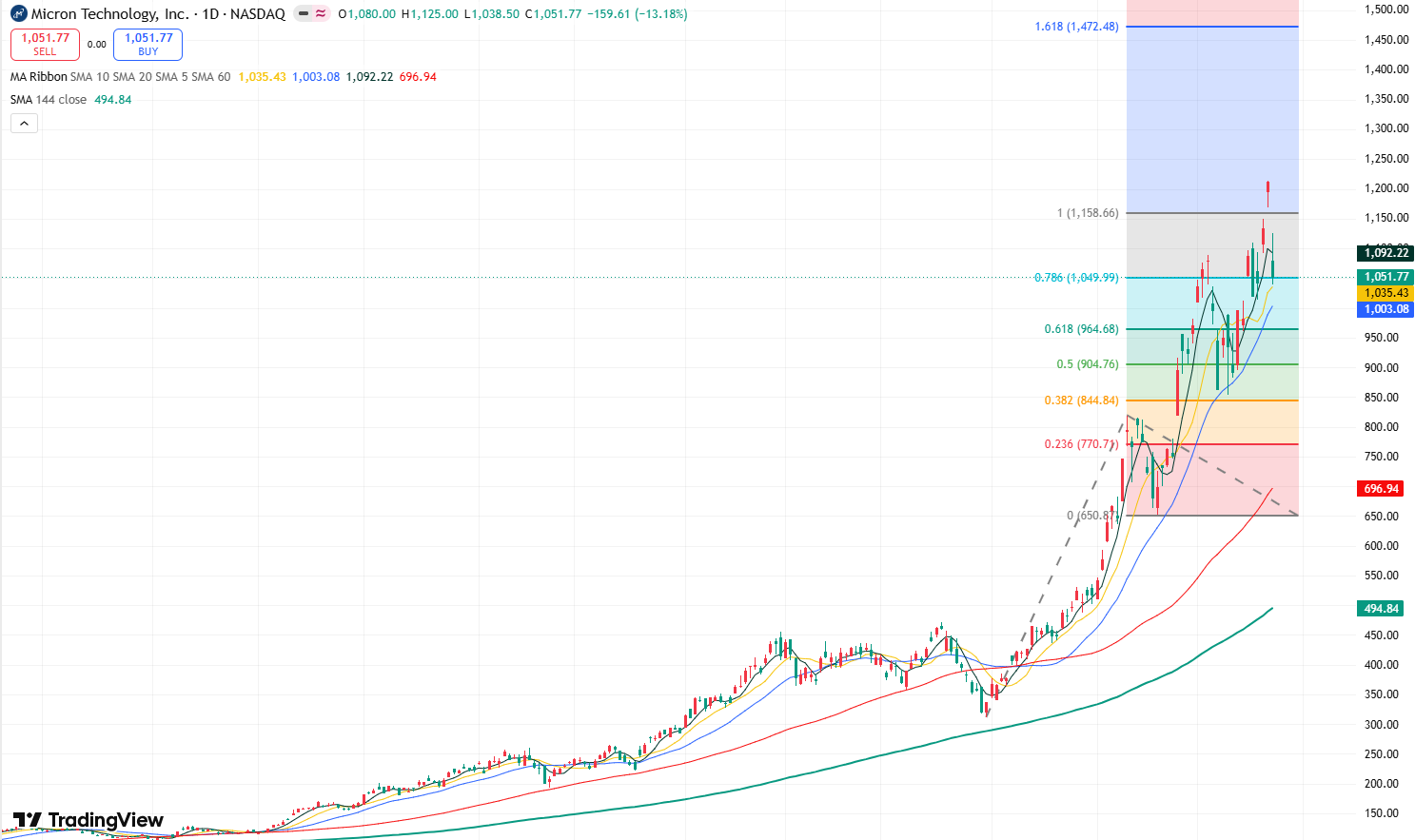
Micron Technology stock price daily chart, Source: TradingView
According to Micron's daily chart, the stock plunged over 13% on Tuesday but did not break below the 0.786 Fibonacci retracement level of $104.90, indicating that this level still offers some support. If Micron's stock price can hold above this level at today's close, it would suggest that Tuesday's plunge was merely a normal correction and that the stock will continue its uptrend, potentially testing the resistance level at $147.20. Conversely, if Micron's stock price breaks below this level, it could decline further in the short term to test the key psychological $100.00 level, and may even head down to test the critical support level at $86.40.
Recommended Articles


