


Netflix (NFLX) Hits a 52-Week Low — Why 37 Analysts Still See 56% Upside
TradingKey - On June 23, shares of Netflix (NASDAQ: NFLX) touched a 52-week low of $72.97. At this price point, 37 out of the 50 analysts who cover the stock rate it a Buy, and the average price target they offer is $114, which suggests around 56% upside to the current stock price. The stock price has been declining over the past 12 months from the post-split high of $134.12 as the company experienced a string of negative events, which included the loss of a potential acquisition with Warner Bros. Discovery, a one-off $2.8 billion payment that artificially inflated Q1 earnings per share (EPS), the guidance for both revenue and EPS below Wall Street's expectations in Q2, and the departure of co-founder Reed Hastings from the role of chairman at the June 4 annual shareholders meeting.
The stock's relative strength index (RSI) of 16.87 indicates extreme oversold territory, with strong signs of positive price-volume divergence developing at the recent lows, and the latest candles on a smaller scale suggest the recent downtrend may have been a result of a decrease in the selling pressure.
The Q1 Results — What Was Real and What Was the Termination Fee
Netflix (NASDAQ: NFLX) reported Q1 2026 revenue of $12.25 billion, a 16% increase year-over-year (YoY) with an EPS of $1.23 compared with the consensus analyst estimates of approximately $0.76 to $0.78. The outperformance was significantly above expectations and for an important reason. The Q1 results included the termination fee of $2.8 billion that was paid by Warner Bros. Discovery when an acquisition of the latter company did not go through. The underlying business Q1 results were decent on a standalone basis, with 16% revenue growth being real, the 32.3% operating margin achieved in Q1 being ahead of the full-year guidance of 31.5%, and free cash flow trending towards the full-year target of $12.5 billion.
However, the headline EPS number that investors saw was significantly higher than the company's underlying earnings run-rate, and when the company reported Q2 guidance for revenue at $12.57 billion versus the $12.63 billion estimate and for EPS at $0.78 versus the $0.84 estimate, the equity market re-anchored expectations on a business that they have in part been valuing based on the one-time termination fee.
Netflix (NASDAQ: NFLX) Co-CFO Spence Neumann noted on the April 16 conference call that Q2 has the highest rate of YoY content amortization in the full year of 2026, but in the second half the growth rates decelerate to the mid-to-high single digits. This is a timing explanation, not a quality issue; there is a higher spend in content in the first half of the year, and the margins therefore will be higher in H2 and not necessarily representative of the Q2 margins. Equity markets are typically impatient to wait for H2 to prove whether a timing explanation is valid as opposed to being a quality issue, hence why the stock sold off 9.1% on April 17 in the session following the earnings conference call and has since continued to sell off.
What Reed Hastings’ Departure and the Ad Business Signal About the Future
Reed Hastings will step down as chairman of the Netflix board at the annual meeting of shareholders on June 4, 2026. Hastings, co-founder of the company who stepped down in January 2023 as co-CEO but remains a key influence as chairman, offered stability during the transition as the original vision behind the product. “It’s spooking investors,” said Rich Greenfield, chief investment officer at LightShed Partners, on CNBC. Furthermore, Hastings had reportedly been on record for approving the WBD deal before it was scrapped, and with both the merger deal and the director who approved it in place, Netflix’s board, led by Chairman Jay Hoag, had yet to clearly articulate the future direction of its M&A policy. Hoag received 78% opposing votes in a shareholder vote last month that led to his continued position as director for the 2025 season, after the board rejected his proposed resignation. Since then, it was announced that Netflix is in talks with Lionsgate and purchased a studio, implying the content and streaming studio strategy remains a priority despite the changes in board leadership.
The most irrelevant component of Netflix’s stock price today is its ad business. The ad tier made up more than 60% of all new sign-ups in countries with an ad option in the first quarter of 2026. Advertiser number hit over 4,000 in number in the same quarter, up 70% over last year. For the full year of 2026, advertising income is forecast at around $3 billion, more than doubling that of the previous year.
According to research firm MoffettNathanson, the advertising income could reach around $9.6 billion in 2030, a level that would equal the amount of revenue streaming subscription sales generated a few years back. With NFLX at RSI 16.87 at a 52-week low with its ad rollout just beginning to be reflected in price, the market is currently assessing Netflix on a guidance miss for Q2 and the exit of Hastings, but ignoring the company it will be in 2027 and 2028.
NFLX Technical Setup — RSI 16.87 Extreme Oversold, Descending Channel, Target $81.90
NFLX sits at $72.97 on the 4H chart and a 52-week low, trending downward inside a falling blue channel below EMA50, $79.98, and EMA200, $86.23. The RSI stands at 16.87, extreme oversold territory not generally seen except during major market shocks; strong positive divergence is developing as price lows make lower lows, but the RSI lows are trending higher; selling momentum has peaked. Volume is thinning off on the recent red candles, which means less selling pressure.
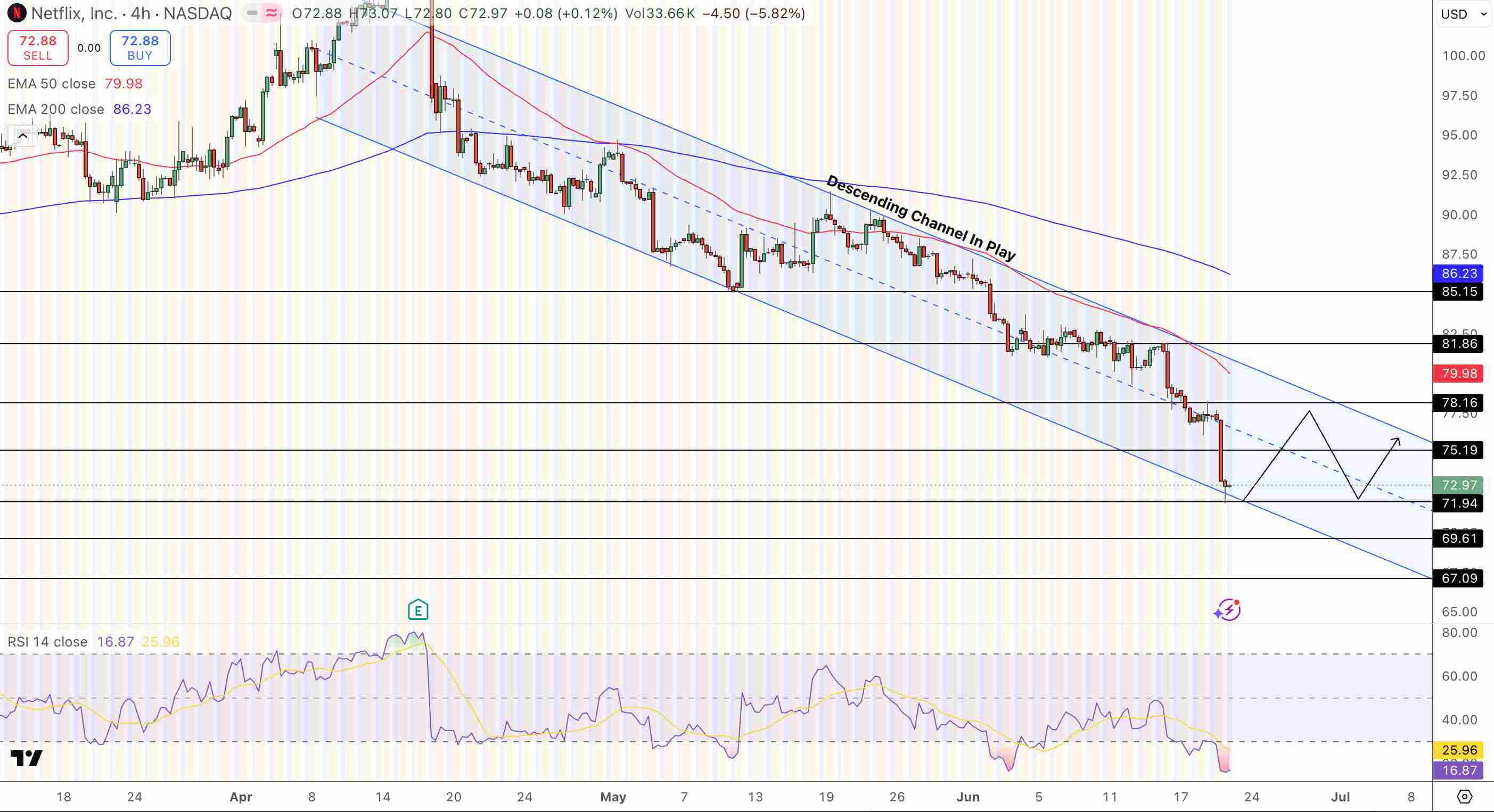
Netflix Price Chart - Source: Tradingview
A level to watch for the next support is between $71.94 and $69.61, a horizontal zone; a close over $69.60 and a move back above $75.20 will aim for $81.90 in an oversold rebound.
- Stop: under $69.60
- Entry: Long over $75.20, short-term resistance broken
- Target: $81.90, oversold rebound to EMA50
- Support: $71.94, 69.61, horizontal confluence; next support area
- Stop Loss: Close at $69.60 or less, support confluence breached
- Consensus Analyst Rating: $114 target; 37 Buy; 12 Hold; 1 Sell from 50
- Upcoming Catalyst: Q2 2026 Earnings: scheduled for July 16, 2026
What Is Netflix’s Advertising Business and Why Does It Matter?
Netflix’s ad-supported plan accounts for more than 60% of all new sign-ups in ad-supported markets in Q1 2026 and advertiser numbers have grown 70% year-over-year to more than 4,000. Annual 2026 advertising revenue is on track to come in at approximately $3 billion, roughly double the level from 2025. MoffettNathanson, an independent securities research and advisory firm, has modelled ad revenue growing to $9.6 billion by the end of 2030. This second, faster-growing revenue stream is not valued in the current NFLX stock price as the Street discounts the company to the Q2 guidance miss and management departure versus 2027 and 2028 earnings growth.
Is NFLX a Buy at $72.97 With RSI at 16.87?
NFLX technical setup is among the most oversold on the chart and the 16.87 RSI is showing strong positive divergence at a 52-week low while volume shrinks on the most recent bar sets. A long position over $75.20 is targeting $81.90 on the oversold bounce and the stop should be placed below $69.60. The 37-Buy, 12-Hold, 1-Sell analyst consensus rating has an average price target of $114 for the stock, which is 56% higher than the current level.
At the end of the day, the fundamentals that are driving the NFLX stock valuation are missing from the current price: $12.5 billion full-year free cash flow guidance in 2026, operating margins in excess of 32%, and the Netflix ad business doubling every year. The main risk is the Q2 July 16 earnings delivery, which risks a miss that would extend the correction to below $69.61.
Bottom Line
At the 52-week low of $72.97, Netflix stock is getting priced for a Q2 guidance miss and a founder departure rather than the fundamental business that 37 out of 50 analysts rate as a Buy with a $114 price target. A $2.8 billion termination fee is boosting Q1 2026 EPS, Q2 content cost front-loading is a timing issue and not a structural one, and the ad business, which is doubling every year on its way toward a $3 billion revenue target for 2026 and $9.6 billion in 2030, is getting almost no credit at the current price. A position above $75.20 has a trade target of $81.90 on the oversold bounce. Stop at $69.60. The July 16 Q2 earnings delivery is the next fundamental test for the NFLX stock.
Recommended Articles


