

Why Are Small-Cap Stocks Booming? See What the Research Says.

Source The Motley Fool

Key Points

  • Recent research shows that small-cap stocks have achieved strong earnings growth and might be seriously undervalued compared to their historical average.

  • The iShares Russell 2000 ETF has delivered 26 years of 8.6% annualized returns.

  • This iShares small-cap fund has outperformed the tech-heavy Nasdaq-100 index for the past year.

  • These 10 stocks could mint the next wave of millionaires ›

Most discussion of the stock market in the past few years has focused on large-cap companies such as the "Magnificent Seven" and trillion-dollar tech businesses that are leading the artificial intelligence (AI) boom. But what if some of the biggest future opportunities for investors could come from much smaller sources?

So far in 2026, small-cap stocks are outperforming the S&P 500 index. The iShares Russell 2000 ETF (NYSEMKT: IWM), a broad index fund of U.S. small-cap stocks, has risen about 18% year to date, outperforming the S&P 500. In the past year, the iShares Russell 2000 ETF has delivered total returns of 42.46%, outperforming the S&P 500 and the tech-heavy Nasdaq-100 index.

Where to invest $1,000 right now? Our analyst team just revealed what they believe are the 10 best stocks to buy right now, when you join Stock Advisor. See the stocks »
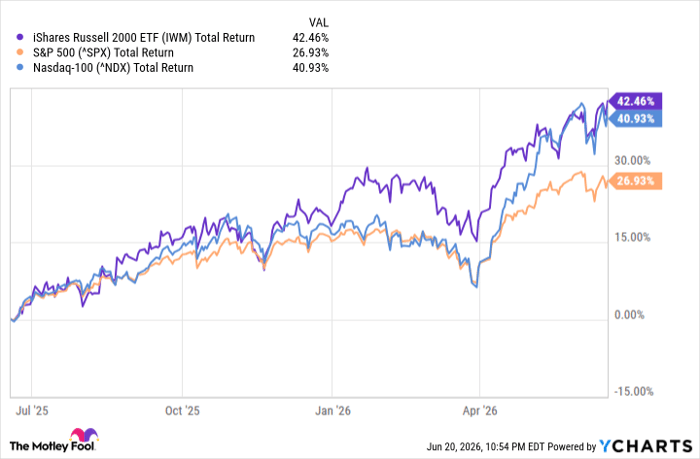
IWM Total Return Level Chart

IWM Total Return Level data by YCharts

Is this recent run-up in small-cap share prices a flash in the pan, or could this rally have staying power? Recent research from T. Rowe Price and Fidelity offers valuable insights on what's driving the strong returns in U.S. small-cap stocks – and why the momentum could continue.

Let's look at a few reasons small-cap stocks -- and the iShares Russell 2000 ETF -- could be a good buy.

Satisfied investor watches small-cap stock returns.

Image source: Getty Images.

Small-cap stocks: better earnings growth since late 2025

According to T. Rowe Price research from February, U.S. small-cap earnings (as measured by trailing 12-month earnings per share of the S&P 600 index) saw strong improvement during the last few months of 2025. From Sept. 19, 2025, to Jan. 27, 2026, small-cap earnings increased by 27%.

The T. Rowe Price research says, "there is now clear evidence that U.S. small‑cap stocks are experiencing a renaissance." The company's research projects that U.S. small-cap earnings will continue to benefit from other positive economic fundamentals, such as reduced tariff uncertainty, a stronger environment for regional banks, and fiscal stimulus from recent changes in U.S. tax policy.

Fidelity research: Small-caps might be seriously undervalued

Cheap valuations are another reason why now could be a good time to buy small-cap stocks. The iShares Russell 2000 ETF has a price to earnings (P/E) ratio just under 20 at recent prices-- far lower than the S&P 500 but also cheaper when you account for the massive influence the tech giants have on the index's valuation. The Russell 2000 ETF trades at a roughly 12% discount to the Invesco S&P 500 Equal Weight ETF (NYSEMKT: RSP), whose 22.7 earnings multiple reflects a more even distribution between the companies that make it up.

According to Fidelity research, as of March 2026, small-cap stocks made up about 4% of total U.S. market capitalization -- a lot lower than their long-term average of 9%. Just by doing some simple math, if small-caps could grow to regain another half of that long-term average and reach a 6.5% weighting in the overall stock market, that could represent about a 62.5% future gain in small-cap valuations.

Fidelity's research offered a few more reasons to be bullish on small-cap stocks, such as potentially lower interest rates, more mergers and acquisitions among small-cap companies, and the prospects for an overall healthy U.S. economy. The Fidelity research projects that "valuation trends have raised the historical odds for U.S. small cap outperformance, especially over the next five to 10 years."

How to buy small-cap stocks: iShares Russell 2000 ETF (IWM)

The iShares Russell 2000 ETF is a diversified index fund that holds 1,906 stocks of U.S. small-cap companies. It charges an expense ratio of 0.19%. This fund was established in May 2000, and during the past 26 years it has delivered average annual returns of 8.6%. That's slightly lower than the long-term S&P 500 average of 10% annualized returns.

Why buy the iShares Russell 2000 ETF now? If the latest research from experts such as T. Rowe Price and Fidelity is accurate, small-cap stocks might be experiencing a resurgence that could last for years. These small companies seem to be getting better at delivering profitable growth. They might be undervalued compared to other parts of the stock market.

This iShares fund lets you invest in a wide variety of sectors, not just major tech names and the AI trade. The top five sectors in this ETF are:

  • Industrials: 19.4% of the fund
  • Information technology: 18.6%
  • Healthcare: 16.5%
  • Financials: 16.02%
  • Consumer discretionary: 7.87%

If you want to own a wide range of smaller, up-and-coming companies that might have strong growth potential and are being overlooked and ignored by many other investors, the iShares Russell 2000 ETF can give you a good way to do it. There are many good reasons this fund is ranked among the best small-cap ETFs.

Where to invest $1,000 right now

When our analyst team has a stock tip, it can pay to listen. After all, Stock Advisor’s total average return is 936%* — a market-crushing outperformance compared to 209% for the S&P 500.

They just revealed what they believe are the 10 best stocks for investors to buy right now, available when you join Stock Advisor.

See the stocks »

*Stock Advisor returns as of June 23, 2026.

Ben Gran has no position in any of the stocks mentioned. The Motley Fool has no position in any of the stocks mentioned. The Motley Fool has a disclosure policy.

Disclaimer: For information purposes only. Past performance is not indicative of future results.
placeholder
Bitcoin CME gaps at $35,000, $27,000 and $21,000, which one gets filled first?Prioritize filling the $27,000 gap and even try higher.
Author  FXStreet
Aug 22, 2023
Prioritize filling the $27,000 gap and even try higher.
placeholder
Pinduoduo Earnings Incoming: Morgan Stanley Sees Long-Term Profit Potential​Insights – On November 21, Chinese e-commerce giant Pinduoduo (PDD) will release its Q3 2024 earnings.
Author  Mitrade
Nov 20, 2024
​Insights – On November 21, Chinese e-commerce giant Pinduoduo (PDD) will release its Q3 2024 earnings.
placeholder
Elon Musk’s xAI and Neuralink Launch New Funding Rounds​Billionaire Elon Musk recently raised funds for his two high-profile tech companies, xAI and Neuralink.
Author  Insights
Jun 03, 2025
​Billionaire Elon Musk recently raised funds for his two high-profile tech companies, xAI and Neuralink.
placeholder
Bitcoin briefly loses 2025 gains as crypto plunges over the weekend.Bitcoin experienced a sharp decline this weekend, briefly erasing its 2025 gains and dipping below its year-opening value of $93,507. The cryptocurrency fell to a low of $93,029 on Sunday, representing a 25% drop from its all-time high in October. Although it has rebounded slightly to around $94,209, the pressures on the market remain significant. The downturn occurred despite the reopening of the U.S. government on Thursday, which many had hoped would provide essential support for crypto markets. This year initially appeared promising for cryptocurrencies, particularly after the inauguration of President Donald Trump, who has established the most pro-crypto administration thus far. However, ongoing political tensions—including Trump's tariff strategies and the recent government shutdown, lasting a historic 43 days—have contributed to several rapid price pullbacks for Bitcoin throughout the year. Market dynamics are also being influenced by Bitcoin whales—investors holding large amounts of Bitcoin—who have been offloading portions of their assets, consequently stalling price rallies even as positive regulatory developments emerge. Despite these sell-offs, analysts from Glassnode argue that this behavior aligns with typical patterns seen among long-term investors during the concluding stages of bull markets, suggesting it is not indicative of a mass exodus. Notably, Bitcoin is not alone in its struggles, as Ethereum and Solana have also recorded declines of 7.95% and 28.3%, respectively, since the start of the year, while numerous altcoins have faced even steeper losses. Looking ahead, questions linger regarding the viability of the four-year cycle thesis, particularly given the increasing institutional support and regulatory frameworks now in place in the crypto landscape. Matt Hougan, chief investment officer at Bitwise, remains optimistic, suggesting a potential Bitcoin resurgence in 2026 driven by the “debasement trade” thesis and a broader trend toward increased adoption of stablecoins, tokenization, and decentralized finance. Hougan emphasized the soundness of the underlying fundamentals, pointing to a positive outlook for the sector in the longer term.
Author  Mitrade
Nov 17, 2025
Bitcoin experienced a sharp decline this weekend, briefly erasing its 2025 gains and dipping below its year-opening value of $93,507. The cryptocurrency fell to a low of $93,029 on Sunday, representing a 25% drop from its all-time high in October. Although it has rebounded slightly to around $94,209, the pressures on the market remain significant. The downturn occurred despite the reopening of the U.S. government on Thursday, which many had hoped would provide essential support for crypto markets. This year initially appeared promising for cryptocurrencies, particularly after the inauguration of President Donald Trump, who has established the most pro-crypto administration thus far. However, ongoing political tensions—including Trump's tariff strategies and the recent government shutdown, lasting a historic 43 days—have contributed to several rapid price pullbacks for Bitcoin throughout the year. Market dynamics are also being influenced by Bitcoin whales—investors holding large amounts of Bitcoin—who have been offloading portions of their assets, consequently stalling price rallies even as positive regulatory developments emerge. Despite these sell-offs, analysts from Glassnode argue that this behavior aligns with typical patterns seen among long-term investors during the concluding stages of bull markets, suggesting it is not indicative of a mass exodus. Notably, Bitcoin is not alone in its struggles, as Ethereum and Solana have also recorded declines of 7.95% and 28.3%, respectively, since the start of the year, while numerous altcoins have faced even steeper losses. Looking ahead, questions linger regarding the viability of the four-year cycle thesis, particularly given the increasing institutional support and regulatory frameworks now in place in the crypto landscape. Matt Hougan, chief investment officer at Bitwise, remains optimistic, suggesting a potential Bitcoin resurgence in 2026 driven by the “debasement trade” thesis and a broader trend toward increased adoption of stablecoins, tokenization, and decentralized finance. Hougan emphasized the soundness of the underlying fundamentals, pointing to a positive outlook for the sector in the longer term.
placeholder
Gold declines below $4,500 on stalled US-Iran ceasefire talks, US NFP data loomsGold price (XAU/USD) edges lower to near $4,470 during the early Asian session on Friday. The precious metal remains volatile amid ongoing geopolitical turmoil. Traders will closely monitor the developments surrounding the US-Iran peace deal and the US May employment report later on Friday. 
Author  FXStreet
Jun 05, Fri
Gold price (XAU/USD) edges lower to near $4,470 during the early Asian session on Friday. The precious metal remains volatile amid ongoing geopolitical turmoil. Traders will closely monitor the developments surrounding the US-Iran peace deal and the US May employment report later on Friday. 
goTop
quote