


SanDisk Breaks Through $2,300 to Hit Record High. Surging 50-Fold This Year, New Patent Reveals 'NAND + Computing Unit Direct Bonding' Architecture
TradingKey - Following the disclosure of SanDisk's (SNDK) new patent, its stock price continued to hit a record high. As of press time, it rose 5.65% to $2,308.24, with its latest market capitalization reaching $342.5 billion, representing an astonishing year-to-date gain of approximately 50 times.
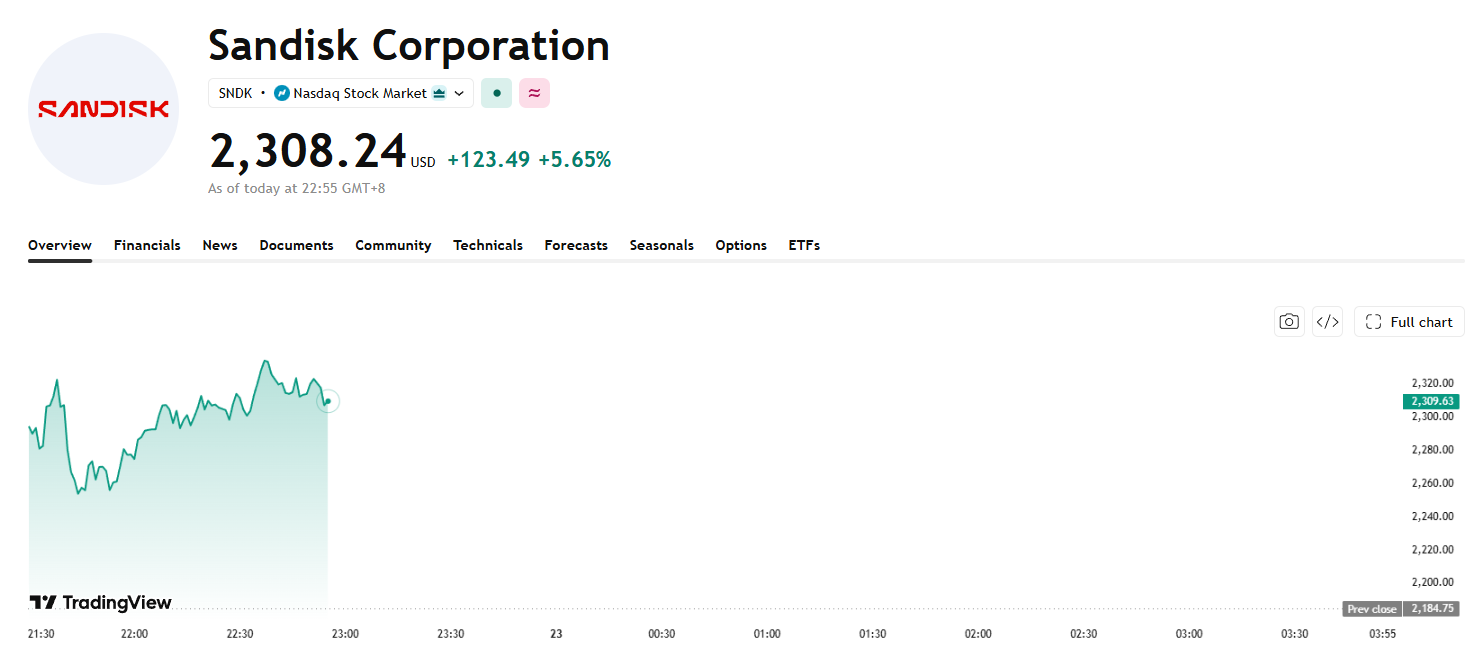
[Source: TradingView]
On the news front, SanDisk plans to directly bond computing units with NAND flash memory, demoting the role of HBM from core memory to an auxiliary level.
According to patent documents disclosed by the United States Patent and Trademark Office (USPTO), SanDisk has proposed a 3D stacked architecture that directly integrates multi-core processors onto CBA memory chips, with the entire structure packaged on the same interposer, while HBM is distributed around the perimeter of the stacked structure. This design aims to simultaneously break through the capacity ceiling of HBM and the limitations of existing high-bandwidth flash (HBF) architectures in terms of latency, power consumption, and system integration.
The exposure of this patent indicates that while SanDisk is accelerating its HBF mass production roadmap, it has already laid out a more aggressive storage-computation integration scheme at the patent level, which has potential far-reaching implications for the memory architecture design path of AI accelerators and GPUs.
Morgan Stanley stated that AI inference demand is driving a structural transformation in the NAND market, with the cloud market poised to become the largest end-use market. SanDisk remains optimistic about the prospects of the NAND industry and its company-specific drivers, with no current signs of the industry returning to a supply-demand balance.
The firm believes that SanDisk has significant upside potential in the current cycle and is optimistic about its position as a beneficiary of the structural shift in the NAND market.
A report released by Counterpoint Research shows that, driven by growing investment in AI infrastructure, the global memory chip market size is expected to reach 1,500 trillion Korean won (approximately $975 billion) by 2026, an increase of about 3.2 times from last year's 360 trillion Korean won.
Counterpoint Research stated that the structural shift toward server-oriented memory products has become a key driver of growth in the memory market.
The research firm added that robust demand for server memory has exacerbated the supply-demand imbalance, driving up memory prices, and this upward trend is expected to continue into the first half of next year.
Recommended Articles


