


Why I'm Not Selling ASML After a 230% Gain
Key Points
I invested in ASML five years ago.
Its stock looks a bit pricey, but it still deserves a premium valuation.
- 10 stocks we like better than ASML ›
I started investing in ASML (NASDAQ: ASML) in early 2021. As of this writing, I'm sitting on an unrealized gain of about 230% on that position, which accounts for 5% of my portfolio. It might seem prudent to take some profits, but I'm not planning to sell my shares anytime soon.
Why did I invest in ASML?
ASML, which is based in the Netherlands, is the world's largest producer of lithography machines for optically etching circuit patterns onto silicon wafers. It's also the only producer of extreme ultraviolet (EUV) lithography systems, which the world's top foundries -- including TSMC and Samsung -- use to manufacture their most advanced chips.
Where to invest $1,000 right now? Our analyst team just revealed what they believe are the 10 best stocks to buy right now, when you join Stock Advisor. See the stocks »
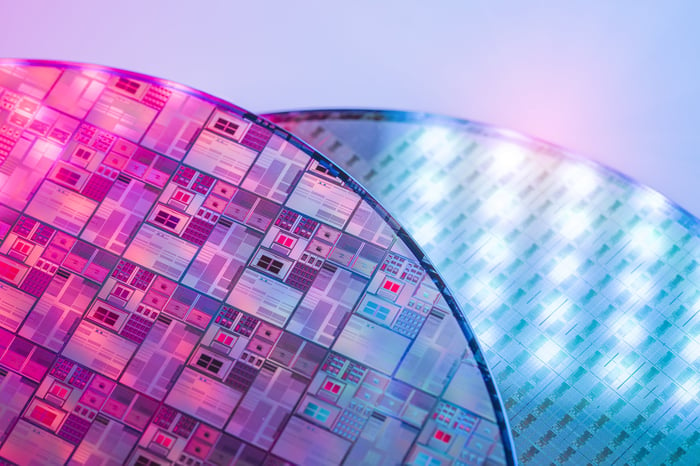
Image source: Getty Images.
ASML's EUV systems, which cost $200 million to $400 million, require multiple planes to ship. As a linchpin of the global semiconductor industry, it has tremendous pricing power and an impenetrable moat. That's why its gross margin rose from 48.6% in 2020 to 52.8% in 2025.
From 2020 to 2025, its revenue and EPS grew at CAGRs of 18% and 24%, respectively. It achieved that growth even as the pandemic, supply chain disruptions, inflation, rising interest rates, geopolitical conflicts, and other macro headwinds rattled the global economy.
ASML kept growing because the world's top foundries must keep installing its lithography systems to stay competitive. In the past, its growth was pegged to the semiconductor market's boom-and-bust cycles. But over the past few years, its growth has been driven by surging demand for GPUs, memory chips, and custom networking chips in the booming AI market.
All of those chipmakers need to use ASML's EUV systems -- whether at their third-party foundries or first-party plants -- to manufacture their smallest and densest chips. That makes ASML one of the easiest ways to profit from the semiconductor sector's long-term expansion without investing too heavily in a single chipmaker. It also makes ASML an evergreen stock.
Why won't I sell my ASML shares?
From 2025 to 2028, analysts expect ASML's revenue and EPS to grow at CAGRs of 18% and 27%, respectively, as the AI boom continues. It will sell more of its newest high-NA EUV systems, which are used to produce the world's most powerful chips, as well as a steady stream of its older low-NA EUV systems and deep ultraviolet (DUV) systems for mature nodes.
ASML's stock isn't cheap at 39 times next year's earnings. However, it's consistently traded above 30 times forward earnings since my first purchase more than five years ago -- presumably because its monopolization of the EUV market justifies a higher valuation. I won't sell my shares unless that bullish thesis changes.
Should you buy stock in ASML right now?
Before you buy stock in ASML, consider this:
The Motley Fool Stock Advisor analyst team just identified what they believe are the 10 best stocks for investors to buy now… and ASML wasn’t one of them. The 10 stocks that made the cut could produce monster returns in the coming years.
Consider when Netflix made this list on December 17, 2004... if you invested $1,000 at the time of our recommendation, you’d have $417,305!* Or when Nvidia made this list on April 15, 2005... if you invested $1,000 at the time of our recommendation, you’d have $1,293,148!*
Now, it’s worth noting Stock Advisor’s total average return is 936% — a market-crushing outperformance compared to 209% for the S&P 500. Don't miss the latest top 10 list, available with Stock Advisor, and join an investing community built by individual investors for individual investors.
See the 10 stocks »
*Stock Advisor returns as of June 22, 2026.
Leo Sun has positions in ASML. The Motley Fool has positions in and recommends ASML and Taiwan Semiconductor Manufacturing. The Motley Fool has a disclosure policy.
Recommended Articles


