


The Vanguard S&P 500 ETF Just Broke an Incredible Record. Here's What It Means for the Stock Market.
Key Points
The Vanguard S&P 500 ETF (VOO) is the biggest ETF available.
Its combination of low fees, diversification, and liquidity makes it an ideal core portfolio cornerstone.
In June 2026, it became the first ETF to hold more than $1 trillion in assets.
- 10 stocks we like better than Vanguard S&P 500 ETF ›
The artificial intelligence (AI)-fueled bull market has made a lot of investors very wealthy. The Vanguard S&P 500 ETF (NYSEMKT: VOO) is easily on pace for its fourth consecutive year of double-digit gains and, since the beginning of 2023, is up 96%.
During this time, the Vanguard S&P 500 ETF has become the industry's net inflow king. Over the past three years, it's taken in a net $403 billion. That's more than twice the net inflow of the next closest fund, the iShares Core S&P 500 ETF (NYSEMKT: IVV), which has taken in around $176 billion. Roughly $1 of every $10 that's getting invested in ETFs today is in the Vanguard S&P 500 ETF.
Where to invest $1,000 right now? Our analyst team just revealed what they believe are the 10 best stocks to buy right now, when you join Stock Advisor. See the stocks »
Earlier in June, the milestone that seemed inevitable for a while finally became reality: The Vanguard S&P 500 ETF became the first ETF to reach $1 trillion in assets under management (AUM).
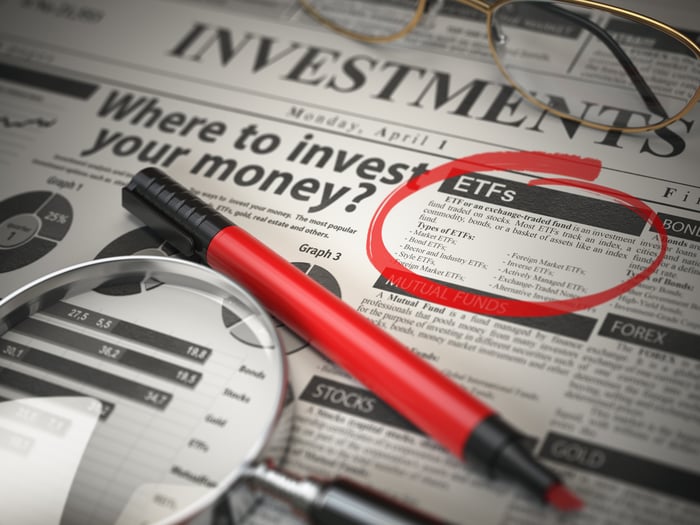
Image source: Getty Images.
Why the Vanguard S&P 500 ETF has become king
Market performance is a big reason this fund has excelled. Over the past 10 years, it's delivered an average annual return of 15.6%. That time frame includes the COVID-19 pandemic and the 2022 bear market. Thanks to its heavy tech allocation, the Vanguard S&P 500 ETF has outperformed many more diversified and thematic funds that don't have the same exposure to tech.
But as is the case with the Vanguard ETFs in general, it's the structural factors that give a big advantage.
Its expense ratio of 0.03% is among the lowest in the marketplace. The sheer size and liquidity of the fund ensure that trading spreads are incredibly thin. Both things mean that almost all of the fund's returns remain in investors' pockets.
What happens in a bear market?
The one question that hasn't really been tested lately is what happens to ETF flows if there's a major bear market? Will investors pull their money out of ETFs and move to cash, or will they simply rotate into other asset classes?
2022 provides clues about what might happen. During the bear market in global stocks, AUM for the Vanguard S&P 500 ETF fell by about 13% from start to finish. But that decline was due to market performance, not investor net flows.
For the year as a whole, the fund took in about $40 billion. In 2023, it added another $42 billion and has been well above $100 billion a year ever since. In short, it slowed momentum, but it definitely didn't stop it.
For everyday investors, the Vanguard S&P 500 ETF is about as ideal a core equity ETF as you'll find. You may consider the Vanguard Total Stock Market ETF (NYSEMKT: VTI) if you want to include mid-caps and small-caps. The size, liquidity, and low fees make both of them great.
Should you buy stock in Vanguard S&P 500 ETF right now?
Before you buy stock in Vanguard S&P 500 ETF, consider this:
The Motley Fool Stock Advisor analyst team just identified what they believe are the 10 best stocks for investors to buy now… and Vanguard S&P 500 ETF wasn’t one of them. The 10 stocks that made the cut could produce monster returns in the coming years.
Consider when Netflix made this list on December 17, 2004... if you invested $1,000 at the time of our recommendation, you’d have $417,305!* Or when Nvidia made this list on April 15, 2005... if you invested $1,000 at the time of our recommendation, you’d have $1,293,148!*
Now, it’s worth noting Stock Advisor’s total average return is 936% — a market-crushing outperformance compared to 207% for the S&P 500. Don't miss the latest top 10 list, available with Stock Advisor, and join an investing community built by individual investors for individual investors.
See the 10 stocks »
*Stock Advisor returns as of June 20, 2026.
David Dierking has positions in Vanguard Total Stock Market ETF. The Motley Fool has positions in and recommends Vanguard S&P 500 ETF. The Motley Fool has a disclosure policy.
Recommended Articles


