


Prediction: This Will Be Nvidia's Stock Price in 2030
Key Points
Nvidia believes data center capital expenditures could rise to $3 trillion to $4 trillion by 2030.
The company already takes the majority of revenue being spent on data centers.
- 10 stocks we like better than Nvidia ›
Nvidia (NASDAQ: NVDA) may be the world's largest company by market value, but there is plenty of upside left in its stock. Most of Nvidia's gains will come from the enormous spending on data centers, and no company appears to be slowing down in that area anytime soon.
I think there's a huge amount of potential left in Nvidia's stock, and it may shock investors as to where I believe the stock price will end up by 2030. If I'm right, the stock looks like a no-brainer buy now, and investors should waste no time loading up on shares.
Where to invest $1,000 right now? Our analyst team just revealed what they believe are the 10 best stocks to buy right now, when you join Stock Advisor. See the stocks »
Image source: The Motley Fool.
The data center build-out is picking up steam
In 2026, the big four artificial intelligence (AI) hyperscalers shocked the world by announcing a record $650 billion in data-center capital expenditures. This number will likely be exceeded based on projections from a few of these companies.
That's a huge business boost for Nvidia, because a large chunk of its sales comes from data-center equipment. Its graphics processing units (GPUs) and the various gear that Nvidia makes to support the computing ecosystem are best-in-class and have become the go-to computing hardware for any company looking to train and run AI models. Although $650 billion sounds like a lot, and it is, Nvidia believes next year could be even more.
During a conference call, Nvidia noted that it expects this figure to reach $1 trillion in 2027. That's another major boost and shows that the AI build-out is far from over. But there's still another larger target looming in the distance.
By 2030, Nvidia expected global data-center capital expenditures to rise to $3 trillion to $4 trillion annually. If we reach that point, Nvidia would be thriving from computing equipment sales and would easily be far larger than it is today.
Although some investors may be hesitant to trust a huge growth projection like that, remember that Nvidia has a lot more information about future demand than the average investor does. Clients are likely informing Nvidia of their multiyear data-center build-out plans, so Nvidia's capacity will be ready when it's time to fill the newly constructed data centers with computing units.
Furthermore, the mix of computing hardware will lean more toward Nvidia and other competitors' computing units, rather than toward construction and infrastructure costs, during the next few years. That will give Nvidia a larger slice of the pie, potentially leading to further upside.
Nvidia has major upside ahead
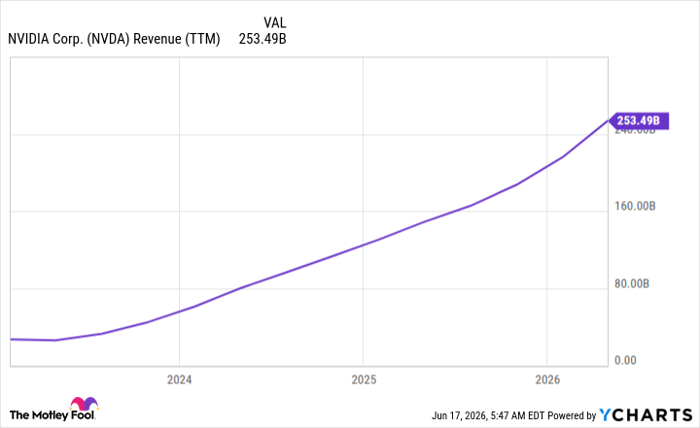
So, what will Nvidia's stock price be by 2030? Wall Street analysts expect Nvidia to generate about $392 billion in revenue this year, giving it about a 60% share of the total spending. If we use the $3 trillion to $4 trillion figure and Nvidia maintains its market share, that would result in $1.8 trillion to $2.4 trillion in revenue.
However, there are some issues there. Nvidia has been careful to use the word "global" each time it gives this projection, which includes China. Right now, Nvidia and China's relationship is in an odd spot, and Nvidia no longer includes sales to China in its forecasts because it's still working on getting China to accept the product and the U.S. to let it export it.
That's a significant chunk of the global AI market, so this will put a limit on Nvidia's total. Furthermore, there are rising competitors in the AI realm, such as companies offering custom AI chips more purpose-built for AI workloads than Nvidia's GPUs.
NVDA Revenue (TTM) data by YCharts
On the flip side, the capital expenditure mix will be further tilted toward computing units by 2030, so some of this comes out in the wash.
To make this a more conservative estimate, I'll assume that Nvidia can capture 40% of the low end of the market projection, $3 trillion. That would result in $1.2 trillion in revenue by 2030. If Nvidia can maintain a 50% profit margin and trade for 30 times earnings, that would give the company a market cap of $18 trillion.
That's 250% upside from today's figure of $5.1 trillion and would result in a stock price of about $750 per share compared with todays price of about $210. That would be a huge gain in just four years, making the stock a no-brainer buy today.
Should you buy stock in Nvidia right now?
Before you buy stock in Nvidia, consider this:
The Motley Fool Stock Advisor analyst team just identified what they believe are the 10 best stocks for investors to buy now… and Nvidia wasn’t one of them. The 10 stocks that made the cut could produce monster returns in the coming years.
Consider when Netflix made this list on December 17, 2004... if you invested $1,000 at the time of our recommendation, you’d have $417,305!* Or when Nvidia made this list on April 15, 2005... if you invested $1,000 at the time of our recommendation, you’d have $1,293,148!*
Now, it’s worth noting Stock Advisor’s total average return is 936% — a market-crushing outperformance compared to 207% for the S&P 500. Don't miss the latest top 10 list, available with Stock Advisor, and join an investing community built by individual investors for individual investors.
See the 10 stocks »
*Stock Advisor returns as of June 20, 2026.
Keithen Drury has positions in Nvidia. The Motley Fool has positions in and recommends Nvidia. The Motley Fool has a disclosure policy.
Recommended Articles


