


2 Nuclear Stocks Worth Buying as AI and Geopolitics Drive Demand for Power
Key Points
Nuclear energy could help meet the demands from AI infrastructure and model training.
BWX Technologies is a major supplier of nuclear components.
Oklo is designing a microreactor with fuel recycling capabilities.
- 10 stocks we like better than BWX Technologies ›
For most of the past two decades, utilities companies have faced the challenges of extreme weather, aging infrastructure, and decarbonization goals. None of those problems have gone away, but lately another has been added: supplying enough electricity to power warehouses of computers training artificial intelligence (AI).
The amount of power these warehouses, or data centers, will need is staggering. According to the International Energy Agency (IEA), global electricity consumption for data centers is expected to more than double by 2030. That would be 945 terawatt-hours (TWh) annually, or roughly the amount of electricity the nation of Japan consumes today.
Where to invest $1,000 right now? Our analyst team just revealed what they believe are the 10 best stocks to buy right now, when you join Stock Advisor. See the stocks »
Meeting that demand will require an enormous build-out of generating capacity. The challenge isn't simply producing more electricity but producing it reliably, around the clock, without adding carbon emissions. Few sources of power meet that description better than an old favorite: nuclear power.
Whether nuclear does emerge as the backbone of the AI era remains to be seen. But if it does, these two nuclear energy stocks could be among its biggest winners.

Image source: Getty Images.
1. BWX Technologies
BWX Technologies (NYSE: BWXT) is a manufacturing company that makes components for nuclear power and defense. Think of it as a pick-and-shovel company for the nuclear sector: It doesn't build or operate nuclear reactors but rather it supplies highly specialized reactor parts to companies and entities that do.
The company has a long history, dating back to the 1950s when it supplied components to the world's first nuclear-powered submarine. Today, BWX continues to hold multibillion-dollar contracts with the U.S. Navy to make critical components for nuclear reactors and submarines.
It's no surprise, then, that the majority of BWX's revenue comes from its government operations segment, one of two that constitute its business (the other is commercial operations). In 2025, roughly $2.3 billion came from this segment, with commercial making up another $853 million.
Revenue growth during the last decade has been steadily climbing, as the graph below illustrates. Additionally, the company's backlog at the end of March 2026 was about $8.6 billion, with $1.4 billion added in May 2026 through contracts with the U.S. Navy.
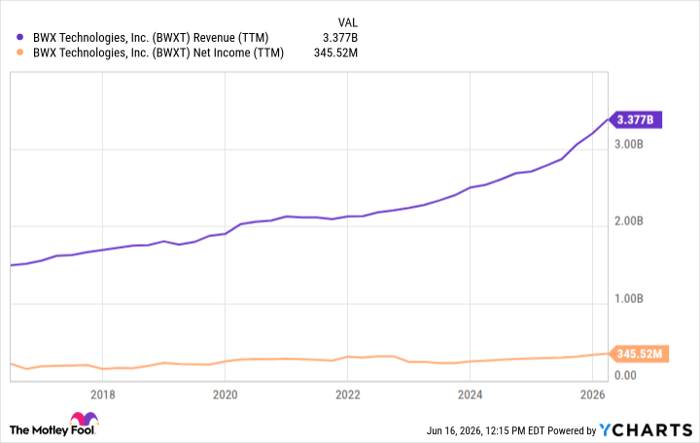
Data by YCharts.
BWX is profitable, and its technical experience, combined with decades of operations, has dug a strong moat around its business. The company is also working with GE Vernova (NYSE: GEV) and Hitachi (OTC: HTHIY) to develop small modular reactor (SMR) technology -- exactly the kind of technology that's expected to power AI data centers.
2. Oklo
Oklo (NYSE: OKLO) is an advanced nuclear technology company designing a fast-fission microreactor design that it calls Aurora powerhouse.
Oklo's technology, while still untested commercially, could solve a major problem for AI data centers: meeting their huge electricity demands. Oklo's powerhouses can run nonstop for years, don't emit carbon, can use nuclear waste as fuel, and can be deployed where power is needed. Since many data centers are being planned for rural areas, where land is more abundant but grid power is not, Oklo's powerhouses could bring power directly to customers without waiting years for new infrastructure to connect it to the local grid.
Oklo stock, at this point, is a waiting game. The Nuclear Regulatory Commission (NRC) has not certified its Aurora design for commercialization. The company is participating in a Department of Energy pilot program to demonstrate its reactor technology as early as next month. Even if it succeeds, the company is a few years from generating significant revenue, and management expects cash burn of $80 million to $100 million for 2026.
Oklo's biggest promise -- that it will supply power to data centers -- is being pressured by other companies outside of nuclear with the same idea. Bloom Energy (NYSE: BE), for instance, is already deploying fuel-cell systems to support AI.
Its future, therefore, isn't guaranteed. But granting it the assumption that the NRC gives it approval, the company's powerhouses could light up the next generation of AI infrastructure.
Should you buy stock in BWX Technologies right now?
Before you buy stock in BWX Technologies, consider this:
The Motley Fool Stock Advisor analyst team just identified what they believe are the 10 best stocks for investors to buy now… and BWX Technologies wasn’t one of them. The 10 stocks that made the cut could produce monster returns in the coming years.
Consider when Netflix made this list on December 17, 2004... if you invested $1,000 at the time of our recommendation, you’d have $415,040!* Or when Nvidia made this list on April 15, 2005... if you invested $1,000 at the time of our recommendation, you’d have $1,256,076!*
Now, it’s worth noting Stock Advisor’s total average return is 920% — a market-crushing outperformance compared to 207% for the S&P 500. Don't miss the latest top 10 list, available with Stock Advisor, and join an investing community built by individual investors for individual investors.
See the 10 stocks »
*Stock Advisor returns as of June 19, 2026.
Steven Porrello has positions in Bloom Energy, GE Vernova, and Oklo. The Motley Fool has positions in and recommends BWX Technologies, Bloom Energy, and GE Vernova. The Motley Fool recommends Hitachi. The Motley Fool has a disclosure policy.
Recommended Articles


