


Inflation Is Heating up, While SpaceX Had the Biggest IPO Ever: Recipe for a Market Crash?
Key Points
Inflation just rose to its highest rate since April 2023.
There are similarities to the dot-com bubble, which led to three years of market losses.
With profitable companies leading the way, the AI revolution could be different.
- These 10 stocks could mint the next wave of millionaires ›
It's been an exciting time to be in the stock market. Space Exploration Technologies Corp., a k a SpaceX, just completed the biggest initial public offering (IPO) ever, and OpenAI and Anthropic are likely to IPO later this summer. The S&P 500 is up 9.8% year to date, and artificial intelligence (AI) companies continue to generate incredible performance.
However, the market's rise comes with a few caveats: Inflation is rising again, in part because of the Iran war, and the Consumer Price Index (CPI) rose 4.2% in May, the highest level in three years. The market is near the second-highest valuation ever, per the cyclically adjusted P/E (CAPE) ratio. When it hit a record high of 44 back in 2000, it was followed by a market crash and three back-to-back years of market losses. Hovering at 41, is this market getting too close for comfort?
Where to invest $1,000 right now? Our analyst team just revealed what they believe are the 10 best stocks to buy right now, when you join Stock Advisor. See the stocks »

Image source: Getty Images.
Bull case: Is this time really different?
The CAPE ratio hit its peak during what's known as the dot-com bubble. At the time, money was being poured into hot internet stocks that were changing the world at a dizzying pace. Sound familiar? These companies were building at breakneck speed, but it all came tumbling down when there were no profits and people started withdrawing their money. Hundreds of companies went out of business. The S&P 500 lost 40% of its value over three years, while the Nasdaq lost 67%.
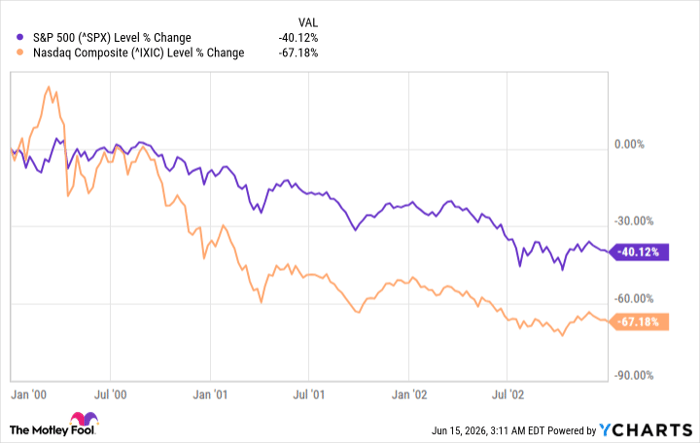
Data by YCharts.
Investors who have been there before or studied history point out that this time things are different because the companies that are the face of the AI revolution, and many companies involved in it, are profitable and thriving. Nvidia and Palantir Technologies, the two companies perhaps most associated with the AI revolution, have incredibly high operating margins, and the most established tech companies in the world, like Microsoft, Amazon, and Alphabet, are spearheading the charge. These are stable companies that aren't in danger of going bust.
Bear case: A crash is going to happen eventually
Does the "this time it's different" argument hold up? While the marquee AI names are, in fact, profitable, there are still dangers. For one, many of the smaller names aren't profitable. A slew of data center companies has sprung up everywhere, and many energy companies that are supposed to provide the energy needed to power the data centers have barely launched an actual product. In the meantime, funders are pouring money into their development, and production is still a few years away for many of them.
The more acute danger is that the required spend becomes too high before there are results, or that demand dries up either because AI becomes more efficient or for any other reason. Demand can't accelerate forever, and valuations that depend on it won't hold. That's already happening to Palantir, and to a lesser extent, Nvidia.
SpaceX might be the clearest example, with a price-to-sales ratio topping 100 and a $4.9 billion loss last year.
That doesn't mean a market crash is imminent, but it may happen when you least expect it. Prepare now for any eventuality.
Where to invest $1,000 right now
When our analyst team has a stock tip, it can pay to listen. After all, Stock Advisor’s total average return is 940%* — a market-crushing outperformance compared to 209% for the S&P 500.
They just revealed what they believe are the 10 best stocks for investors to buy right now, available when you join Stock Advisor.
See the stocks »
*Stock Advisor returns as of June 17, 2026.
Jennifer Saibil has no position in any of the stocks mentioned. The Motley Fool has positions in and recommends Alphabet, Amazon, Microsoft, Nvidia, and Palantir Technologies. The Motley Fool has a disclosure policy.
Recommended Articles


