


TSMC Partners With Ibiden and Innolux to Advance Glass Substrate Packaging Technology; CoPoS Advanced Packaging Validation Data Revealed for the First Time
TradingKey - According to a Digitimes report on June 16, TSMC ( TSM) recently disclosed for the first time that it is collaborating with major ABF substrate supplier Ibiden and panel manufacturer Innolux to jointly validate the application of glass substrates in next-generation advanced packaging technology, CoPoS. This move indicates that competition in advanced packaging is extending from wafer-level to panel-level processing.
In terms of market reaction, TSMC's US-listed shares closed up 4.12% at $441.40 on Monday. Ibiden, a core supplier of packaging substrates for AI chips, benefited from a collective rally in MLCC-related stocks, surging over 19% on June 15 to hit an all-time intraday high, but faced profit-taking today, losing upward momentum.
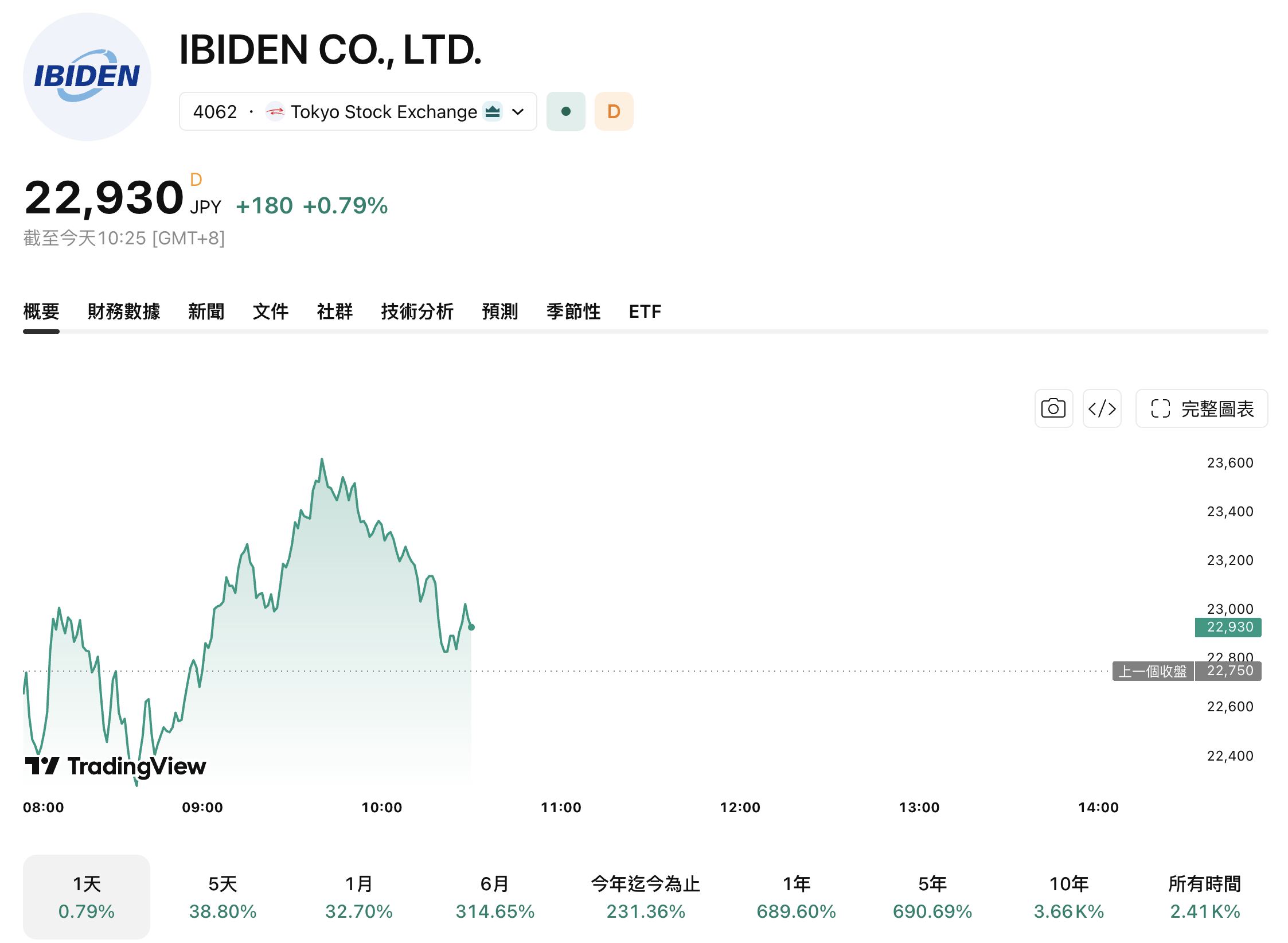
[Ibiden's stock price trend on June 16, Source: TradingView]
CoPoS stands for Chip-on-Panel-on-Substrate, which focuses on shifting packaging from traditional circular wafer-level processes to larger-area rectangular panel-level processes. TSMC's existing CoWoS technology has entered mass production at 5.5x reticle size and is planned to scale to 14x reticle size by 2028, at which point it could integrate approximately 10 large compute dies and 20 HBM stacks.
As packaging sizes expand, traditional organic substrates and silicon interposers encounter bottlenecks in areas such as warpage and signal loss, whereas rectangular panels can increase material utilization from less than 70% at the wafer level to over 90%.
According to supply chain sources, simulation results from the three-party collaboration show that glass substrates can improve packaging warpage by 16%, reduce the effective coefficient of thermal expansion by 19%, and increase the effective elastic modulus by 31%. Regarding power integrity, resistance decreased by 27% and inductance by 42%. The test sample used a 0.8mm glass core substrate with a 5x reticle CoW packaging specification and overall dimensions of 85x110mm, placing it in the large-scale AI GPU packaging class. No severe warpage or delamination occurred during testing. In a comparison, TSMC stated that glass substrates can be 'thin yet with better COP,' while organic substrates are 'thick but with worse COP.'
Ibiden is currently a key substrate supplier for NVIDIA ( NVDA) and AMD ( AMD) AI chips, and has announced a 500-billion-yen investment to expand its Gifu Prefecture plant. The involvement of Innolux is seen by the industry as a critical milestone for panel manufacturers entering the glass substrate sector; panel makers possess a natural advantage in large-size glass processing and, after modifications, can handle substrates several times larger than a wafer's area.
TSMC Chairman C.C. Wei revealed at a shareholder meeting in early June that the company has established a CoPoS pilot line and expects to achieve large-scale mass production within 2 to 3 years. Industry insiders pointed out that full-scale adoption of glass substrates still requires resolving core technical issues such as copper filling for through-glass vias (TGV), large-area warpage control, and yield ramp-up.
Recommended Articles


