


US Stocks Close: Nasdaq Rises More Than 3%, Philadelphia Semiconductor Index Hits All-Time High. SpaceX Rises Another 19% on Second Day After Listing
Tradingkey - On June 15, ET, news that the U.S. and Iran will sign a peace agreement on Friday, alongside falling oil prices, bolstered the investment climate. The Dow Jones Industrial Average and the Philadelphia Semiconductor Index continued to reach record highs, as the three major U.S. indices rose for a third consecutive session, with chip stocks leading the rally.
At the close, the Dow Jones Industrial Average rose 0.92% to 51,671.03; the S&P 500 Index gained 1.65% to 7,554.29; and the Nasdaq Composite Index surged 3.07% to 26,683.94.
Tech stock performance
Micron Technology (MU) shares hit an all-time high, closing up 10.84% at $1,088.1 after reaching an intraday peak.
RBC analyst Srini Pajjuri maintained a "Buy" rating on Micron and raised the price target from $525 to $1,200; TD Cowen hiked its price target for Micron Technology from $660 to $1,500, more than doubling it. Furthermore, Micron is set to release its latest quarterly earnings report on June 24. Market focus will include revenue guidance for the next quarter, changes in gross margins, HBM4 shipments, SOCAMM orders, and price trends for NAND and enterprise-grade SSDs.
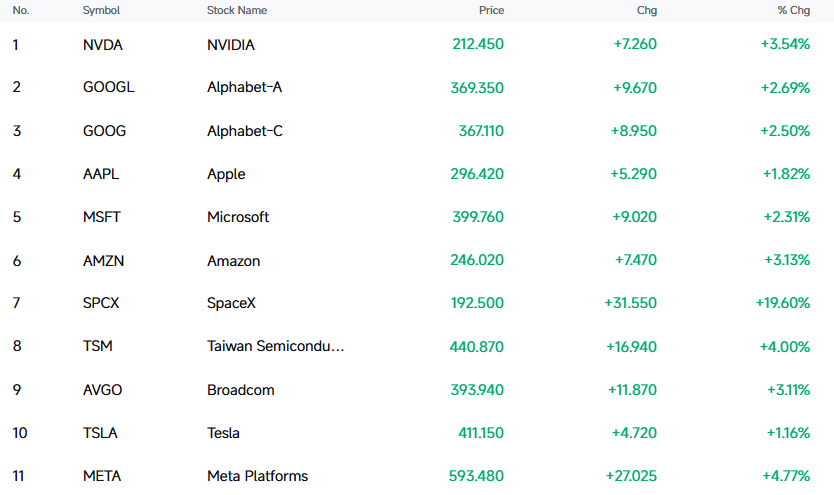
SpaceX (SPCX) shares hit a record high, surging 19.58% to $192.46, with its latest market capitalization reaching $252 million.
Among large-cap tech stocks, SpaceX rose 19.60%, Meta Platforms (META) gained 4.77%, TSMC (TSM) climbed 4.00%, Nvidia (NVDA) increased 3.54%, Amazon (AMZN) rose 3.13%, Broadcom (AVGO) gained 3.11%, Alphabet (GOOGL) advanced 2.69%, Microsoft (MSFT) rose 2.31%, Apple (AAPL) gained 1.82%, and Tesla (TSLA) ticked up 1.16%.
The PHLX Semiconductor Index rose 5.45% to 14,099.62 points, hitting another all-time high. Of its 30 components, 29 ended the day higher.
Storage stocks led the gains, with Western Digital (WDC) jumping 16.10%, Micron Technology (MU) up 10.84%, Seagate Technology (STX) gaining 9.43%, and SanDisk (SNDK) rising 6.45%.
According to Bank of America statistics, South Korea's semiconductor exports in the first 10 days of June reached approximately $11 billion, an increase of 30% month-over-month and 206% year-over-year, nearly triple the projected monthly average for 2025. Memory spot prices showed no signs of weakening; in early June, some DRAM products continued to rise by 3% to 4% within a single week.
According to data from Bank of America, DRAM remains the strongest category in terms of pricing. DDR4, in particular, has seen a significant contraction in supply as Samsung, SK Hynix, and Micron continue to shift production capacity toward HBM and DDR5. However, since servers, industrial equipment, and certain consumer electronics still require DDR4, a temporary shortage has emerged. Some DDR4 spot prices are already higher than those of DDR5 with the same capacity. Typically, the newer generation DDR5 commands a higher price; the current DDR4 premium suggests that legacy capacity is being phased out faster than demand is declining.
Chinese concept stocks saw more gainers than losers, with Kingsoft Cloud (KC) rising 5.68%, Zai Lab (ZLAB) up 3.87%, BOSS Zhipin (BZ) gaining 3.65%, Hesai (HSAI) advancing 3.42%, GDS Holdings (GDS) rising 2.86%, Futu Holdings (FUTU) gaining 2.65%, and PDD Holdings (PDD) climbing 2.44%.
Corporate News
Fox to Acquire Roku for $22 Billion
Fox announced on Monday that it will acquire streaming provider Roku for $160 per share, representing a total value of approximately $22 billion. The transaction is structured as a mix of cash and stock, with $12 billion funded through debt financing.
Fox's news and sports rights, alongside its free streaming platform Tubi, will complement Roku's streaming hardware portal and proprietary channel business, spanning the full value chain from terminal devices to content operations and advertising monetization. Fox CEO Murdoch defined it as a "defining moment" for the company and noted that user overlap is only about one-third. Tubi and the Roku Channel will remain independent operations after the transaction.
Nvidia Plans $25 Billion Bond Offering with Subscriptions Reaching $85 Billion
Nvidia plans to raise $25 billion through an investment-grade bond issuance, with subscription demand exceeding three times the size of the offering. According to people familiar with the matter, the bond issuance attracted as much as $85 billion in orders. Sources also indicated that Nvidia will issue the bonds in seven tranches with maturities ranging from 2 to 30 years. The yield on the longest-dated bond was priced at approximately 0.65 percentage points above Treasuries.
SpaceX Total Fundraising Reaches $85.7 Billion
SpaceX underwriters have officially exercised their over-allotment option, bringing the total fundraising scale to $85.7 billion and continuing to set new historical records for global IPOs. The SpaceX underwriting syndicate, including Goldman Sachs and Morgan Stanley, held an over-allotment allocation for an additional 83.3 million shares, a mechanism commonly known as a "greenshoe option."
Industry & Macro News
UBS Expects the Fed's Next Move to Be a Rate Cut
UBS stated that the U.S. and Iran have reached an agreement to reopen the Strait of Hormuz, which has suppressed oil prices and sparked a rally in the U.S. Treasury market, easing the pressure on the Fed to raise interest rates this year.
New Fed Chair Warsh will preside over his first interest rate decision this week. UBS expects the meeting to officially remove the easing bias and shift toward a neutral-to-hawkish stance, but it will not initiate a rate hike cycle. The Fed is likely to remain on hold throughout 2026 to monitor the subsequent performance of economic growth and the labor market, with the first rate cut window expected in the first or second quarter of 2027.
U.S. Strategic Petroleum Reserve Hits 43-Year Low
Due to reserve releases intended to stabilize prices during the Iranian conflict, the U.S. Strategic Petroleum Reserve has fallen to its lowest level since 1983. Once the 172 million-barrel release plan pushed by the Trump administration is fully implemented, the reserve size will stand at only 243 million barrels—less than one-third of the 700 million-barrel total authorized capacity—significantly narrowing the U.S. buffer against future crude supply shocks.
JPMorgan Bullish on U.S. Equities Following U.S.-Iran Peace Deal
A week after downgrading U.S. stocks due to a correction in AI trades, JPMorgan on Monday officially raised its short-term outlook from "tactically cautious" to "tactically bullish," driven by the recovery in risk appetite following the implementation of the interim U.S.-Iran peace agreement. The bank believes that the reopening of the Strait of Hormuz will directly alleviate oil price and inflation pressures, which, combined with fundamental support, is expected to drive a broad rally in risk assets across the market.
Regarding allocation, JPMorgan continues to favor the technology sector while maintaining a tactical long position in financial stocks. The bank also warned that a broad-based rally across all sectors is unlikely to be sustainable in the long term and will likely converge toward a few leading stocks; core risks include inflation and growth data exceeding expectations, Treasury volatility triggered by hawkish central bank comments, and correction pressure in the semiconductor sector amid rising high-leverage ETF trading.
Recommended Articles


