


Trading Near Its 52-Week Low, Is Palantir Technologies Stock a Buy?
Key Points
Palantir's growth rate has been accelerating and was just under 85% in its most recent quarter.
Despite the decline in share price this year, Palantir's stock still isn't cheap.
Retail investors may not be as excited about the stock anymore.
- 10 stocks we like better than Palantir Technologies ›
After a few years of spectacular gains, Palantir Technologies (NASDAQ: PLTR) stock has finally been cooling off. Entering this week, it's down 28% since the beginning of the year. Over a five-year stretch, its gains remain impressive at around 420%, but there's clearly been less excitement around the company of late.
Palantir's stock is trading near its 52-week low of $122.68, potentially making it a more enticing value option for investors. The business has, after all, been generating some impressive growth. Is now a good time to buy Palantir Technologies stock?
Will AI create the world's first trillionaire? Our team just released a report on the one little-known company, called an "Indispensable Monopoly" providing the critical technology Nvidia and Intel both need. Continue »

Image source: Getty Images.
Palantir has been a big winner due to AI
Using artificial intelligence (AI) to enhance its platform has been a huge win for Palantir. Its data analytics software helps businesses and government organizations make the best decisions available. It's highly trusted, with U.S. President Donald Trump previously posting on social media about Palantir and its impressive technological abilities on the battlefield.
The proof is in the numbers: Palantir has continually improved its growth rate. Even as its business is growing rapidly, it's still accelerating higher, which is no small task, underscoring just how strong demand has been for the company's products and services.
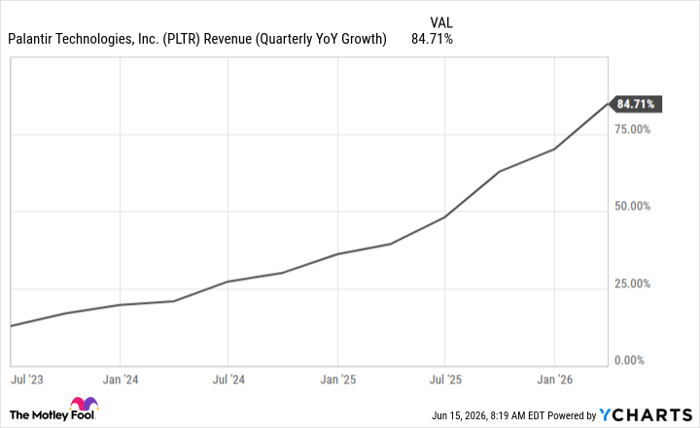
PLTR Revenue (Quarterly YoY Growth) data by YCharts
In its most recent quarter, which covered the first three months of the year, Palantir also boasted of its Rule of 40 score, which came in at 145%. The score encompasses both its growth rate and adjusted operating margin. It's an excellent sign for a growth stock that it's doing well on both its top and bottom lines. CEO Alex Karp says the company has effectively "shattered the metric."
Its growth may be impressive, but that may not be enough for the stock to rally higher
The problem with Palantir has been that the stock has been trading at exceedingly high levels for a while, which means its valuation is pricing in the company's future growth opportunities. Investors who buy the stock today are paying a significant premium, as its price-to-earnings multiple is more than 140. Even though that has come down significantly from a year ago, it's still fairly high, given that the average stock in the S&P 500 trades at 25 times its earnings.
With a high valuation, it may not be easy for the stock to rise further, especially given many other growth stocks that may be more attractive to retail investors today and in the near future, including new offerings such as SpaceX, OpenAI, and Anthropic. Palantir may no longer be the hot stock to own for retail investors, which is why I wouldn't be surprised if it continues to fall even further this year.
Should you buy stock in Palantir Technologies right now?
Before you buy stock in Palantir Technologies, consider this:
The Motley Fool Stock Advisor analyst team just identified what they believe are the 10 best stocks for investors to buy now… and Palantir Technologies wasn’t one of them. The 10 stocks that made the cut could produce monster returns in the coming years.
Consider when Netflix made this list on December 17, 2004... if you invested $1,000 at the time of our recommendation, you’d have $433,268!* Or when Nvidia made this list on April 15, 2005... if you invested $1,000 at the time of our recommendation, you’d have $1,259,391!*
Now, it’s worth noting Stock Advisor’s total average return is 935% — a market-crushing outperformance compared to 207% for the S&P 500. Don't miss the latest top 10 list, available with Stock Advisor, and join an investing community built by individual investors for individual investors.
See the 10 stocks »
*Stock Advisor returns as of June 15, 2026.
David Jagielski, CPA has no position in any of the stocks mentioned. The Motley Fool has positions in and recommends Palantir Technologies. The Motley Fool has a disclosure policy.
Recommended Articles


