


Warren Buffett Just Sent the Stock Market an 8-Word Warning. Here's What History Says Is Coming Next.
Key Points
In a recent interview, Buffett expressed concern about where some investors are buying right now.
History can offer a clear answer as to what investors should do to prepare for potential volatility.
- 10 stocks we like better than S&P 500 Index ›
The stock market has spent much of the past few years reaching record highs, with the S&P 500 (SNPINDEX: ^GSPC) and Nasdaq Composite (NASDAQINDEX: ^IXIC) earning total returns of 80% and 100%, respectively, since June 2023.
However, at least one investor is feeling cautious right now. In a recent interview with CNBC during Berkshire Hathaway's annual meeting, Warren Buffett warned that many people are getting too comfortable with certain types of investments. Here's why investors should be paying attention.
Will AI create the world's first trillionaire? Our team just released a report on the one little-known company, called an "Indispensable Monopoly" providing the critical technology Nvidia and Intel both need. Continue »
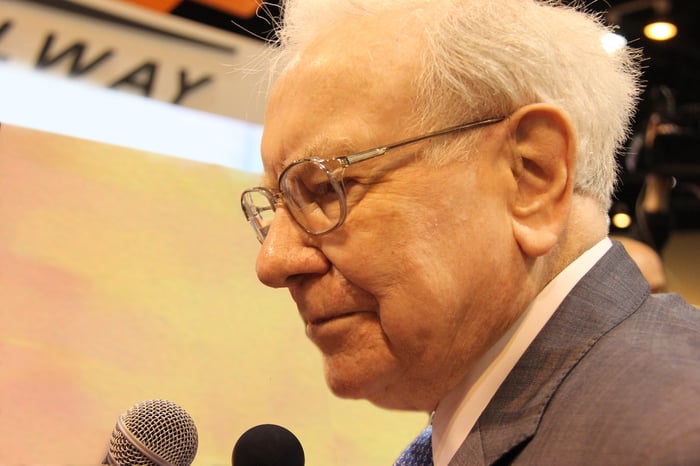
Image source: The Motley Fool.
Buffett warns investors could be taking a gamble right now
In the CNBC interview, Buffett noted that he often compares the stock market to a church with a casino attached. One represents patient long-term investing, while the other symbolizes speculative risk-taking.
He explained that right now, "the casino has gotten very attractive to people." Clarifying, he added that short-term buying is not investing, but more akin to gambling.
"[W]e've never had people in a more gambling mood than now," he said. "But that doesn't mean that investing is terrible. It does mean that prices for an awful lot of things will look very silly."
With many stocks trading at record highs, it is an incredibly expensive time to invest. The S&P 500 Shiller CAPE Ratio -- a common market valuation metric -- is nearing historic levels, suggesting that the index could be overvalued right now.
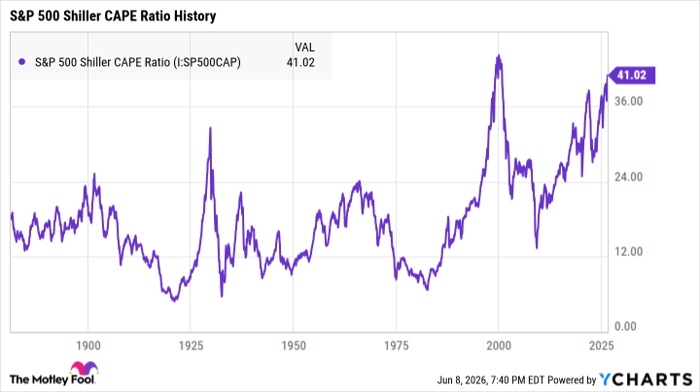
S&P 500 Shiller CAPE Ratio data by YCharts
The last time this ratio neared the mid-40s was just before the dot-com bubble burst in the early 2000s, when it reached a record high of around 44. As of this writing, it sits at just over 41.
What history says is coming next
To be clear, no stock market metric is 100% accurate, so there's no way to know when the next bear market or recession will begin. What history does prove, however, is that investing in strong stocks and holding them for the long haul will better protect your portfolio against volatility.
The market has a flawless track record of eventually recovering from downturns. Since January 2000, in fact, the S&P 500 has earned total returns of more than 700%.
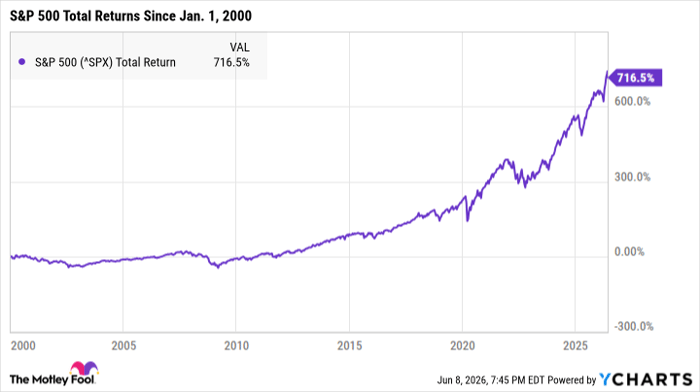
^SPX data by YCharts
Not all stocks will survive a downturn, especially those with shaky fundamentals. Companies built on hype may crash hard during a recession, for example, and so might those without a solid financial foundation or competitive advantage. Healthy stocks may face short-term volatility, but they're far more likely to rebound with enough time.
Even Warren Buffett can't predict the future, but his advice to invest for the long term is more important than ever. By choosing quality stocks and holding them for at least five to 10 years, history suggests you'll be prepared for anything.
Should you buy stock in S&P 500 Index right now?
Before you buy stock in S&P 500 Index, consider this:
The Motley Fool Stock Advisor analyst team just identified what they believe are the 10 best stocks for investors to buy now… and S&P 500 Index wasn’t one of them. The 10 stocks that made the cut could produce monster returns in the coming years.
Consider when Netflix made this list on December 17, 2004... if you invested $1,000 at the time of our recommendation, you’d have $439,038!* Or when Nvidia made this list on April 15, 2005... if you invested $1,000 at the time of our recommendation, you’d have $1,277,804!*
Now, it’s worth noting Stock Advisor’s total average return is 942% — a market-crushing outperformance compared to 206% for the S&P 500. Don't miss the latest top 10 list, available with Stock Advisor, and join an investing community built by individual investors for individual investors.
See the 10 stocks »
*Stock Advisor returns as of June 10, 2026.
Katie Brockman has no position in any of the stocks mentioned. The Motley Fool has positions in and recommends Berkshire Hathaway. The Motley Fool has a disclosure policy.
Recommended Articles


