


2 Growth ETFs to Buy and Hold for 20 Years
Key Points
Since bull markets tend to last longer than bear markets (and rise farther than they fall), growth stocks as a group tend to outperform over time.
Growth-oriented ETFs provide exposure to many growth stocks at once, boosting your chances of success and minimizing risk.
- 10 stocks we like better than Invesco QQQ Trust ›
Growth stocks are driving strong market gains right now. For example, the Nasdaq-100, an index of top tech stocks, is up 22% year to date, nearly double the S&P 500's 12% gain.
If you're looking for high exposure to these trends, I recommend the Invesco QQQ Trust exchange-traded fund (ETF) (NASDAQ: QQQ) and the Vanguard S&P 500 Growth ETF (NYSEMKT: VOOG). But I also recommend holding them for 20 years. Here's why.
Will AI create the world's first trillionaire? Our team just released a report on the one little-known company, called an "Indispensable Monopoly" providing the critical technology Nvidia and Intel both need. Continue »

Image source: Getty Images.
All the growth of the market
Growth stocks tend to outperform in strong bull markets, and that's what's happening today. Artificial intelligence (AI) stocks are driving outperformance, and they're highly represented in growth indexes like the Nasdaq-100, which the Invesco ETF tracks, and the S&P 500 Growth Index, which the Vanguard ETF tracks.
The Invesco ETF's largest positions are in Nvidia, Apple, Microsoft, Amazon, and Tesla, while the Vanguard ETF's top holdings are Nvidia, Microsoft, Meta, Apple, and Broadcom.
By investing in one or both of these ETFs, you get access to many of the best growth stocks on the market without having to pick and choose, and without one of them weighing too heavily on your portfolio. An added benefit is that the ETF's makeup will change as the fastest-growing stocks rise, giving you new growth stocks without you having to lift a finger. For example, when SpaceX goes public next week, it may be included in these ETFs.
There are more bull markets than bear markets
The reason it's so important to adopt a long-term mindset when investing in these ETFs is that, in a market downturn, they tend to fall more than the S&P 500. If you were to buy them today to get in on the AI hype, you would open yourself up to the risk of underperformance whenever there's a correction or a crash.
Invesco makes it clear that this ETF is not diversified and likely to be more volatile than a diversified one. The Vanguard fund, which has 144 stocks, is slightly more diversified. The gains over time tend to match the risk level.
The Invesco ETF has gained 1,600% since inception in 1999, nearly double the S&P 500's 870% gain over that time, while the Vanguard ETF has gained 1,100% since inception in 2010, versus 832% for the S&P 500.
However, consider how they performed in 2022, the most recent year the S&P 500 lost value:
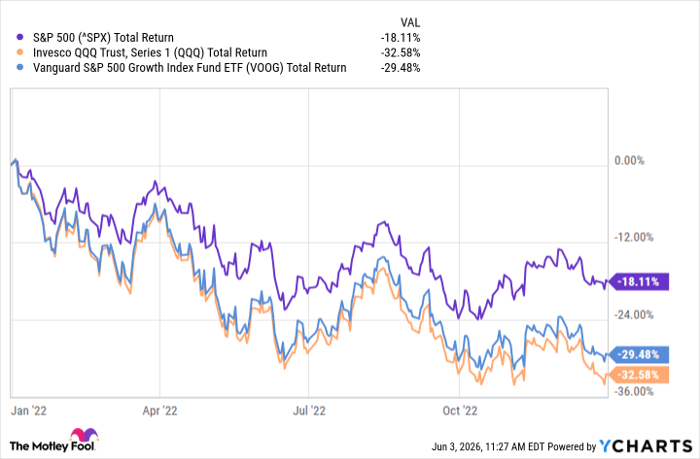
Data by YCharts.
But then consider how they've recovered:
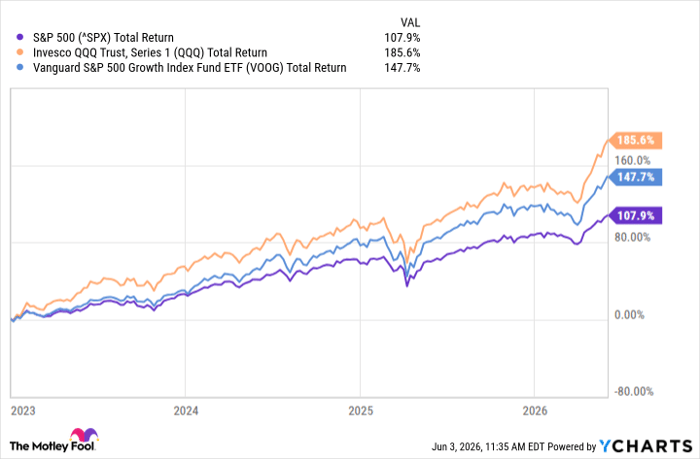
Data by YCharts.
That's why these are excellent picks for investors with patience who can hold them for at least 20 years.
Should you buy stock in Invesco QQQ Trust right now?
Before you buy stock in Invesco QQQ Trust, consider this:
The Motley Fool Stock Advisor analyst team just identified what they believe are the 10 best stocks for investors to buy now… and Invesco QQQ Trust wasn’t one of them. The 10 stocks that made the cut could produce monster returns in the coming years.
Consider when Netflix made this list on December 17, 2004... if you invested $1,000 at the time of our recommendation, you’d have $439,847!* Or when Nvidia made this list on April 15, 2005... if you invested $1,000 at the time of our recommendation, you’d have $1,342,065!*
Now, it’s worth noting Stock Advisor’s total average return is 968% — a market-crushing outperformance compared to 211% for the S&P 500. Don't miss the latest top 10 list, available with Stock Advisor, and join an investing community built by individual investors for individual investors.
See the 10 stocks »
*Stock Advisor returns as of June 5, 2026.
Jennifer Saibil has positions in Apple and Vanguard Admiral Funds-Vanguard S&P 500 Growth ETF. The Motley Fool has positions in and recommends Amazon, Apple, Broadcom, Meta Platforms, Microsoft, Nvidia, and Tesla. The Motley Fool has a disclosure policy.
Recommended Articles


