


The Hidden Nvidia Trade Nobody on Wall Street Is Talking About
Key Points
Nvidia has made strategic investments in Lumentum, Coherent, and Marvell Technology in recent months.
These investments enable Nvidia to maintain strong control over the broader AI hardware market.
- 10 stocks we like better than Nvidia ›
Nvidia (NASDAQ: NVDA) has been one of the best-performing stocks in the artificial intelligence (AI) era, which isn't surprising, as its chips have been instrumental in the training of large language models (LLMs) over the years.
An investment of $1,000 made in Nvidia stock three years ago is now worth more than $5,400. The good news for Nvidia investors is that its growth continues to accelerate. This was evident from Nvidia's latest quarterly report. However, the stock's returns have been lukewarm so far this year, with shares gaining just 14% despite the consistently solid growth that Nvidia has been clocking.
Will AI create the world's first trillionaire? Our team just released a report on the one little-known company, called an "Indispensable Monopoly" providing the critical technology Nvidia and Intel both need. Continue »
There are a few reasons this may be the case, such as rising competition in AI chips and concerns about Nvidia's ability to deliver further upside after becoming the largest company in the world. However, the market may be making a big mistake by viewing Nvidia's AI prospects in isolation. It has been expanding its wings in AI by investing in other companies that are playing a critical role in this space.
Let's take a closer look at how Nvidia's investments make it a much bigger AI play than the market may realize.

Image source: Nvidia.
Nvidia is tapping these fast-growing niches through its investments
AI is not just about the graphics processing units (GPUs) that Nvidia sells. The booming investment in AI infrastructure has created demand for additional components, such as custom processors and networking products. Nvidia has stakes in companies such as Lumentum Holdings (NASDAQ: LITE), Coherent (NYSE: COHR), and Marvell Technology (NASDAQ: MRVL).
Lumentum and Coherent manufacture optical networking, photonics, and laser components that enable the rapid transfer of large amounts of data in data centers and AI chip clusters. Nvidia announced a $2 billion investment in Coherent in March this year to "support research and development, future capacity and operations as Coherent builds out its U.S.-based manufacturing capabilities."
It also announced a similar investment in Lumentum on the same day for identical reasons. Nvidia notes that optical networks will play a critical role in scaling up AI data centers and factories. That's not surprising, as optical networks support help transfer large datasets with low latency in AI chip clusters, enabling AI accelerators to perform optimally with minimal data loss.
Fast networking and high bandwidth reduce downtime for AI accelerators, such as GPUs. This explains why demand for optical networking components is outpacing supply. McKinsey estimates that demand for high-speed 800 Gbps (gigabits per second) optical transceivers deployed in AI data centers will exceed production by 40% to 60% through 2027.
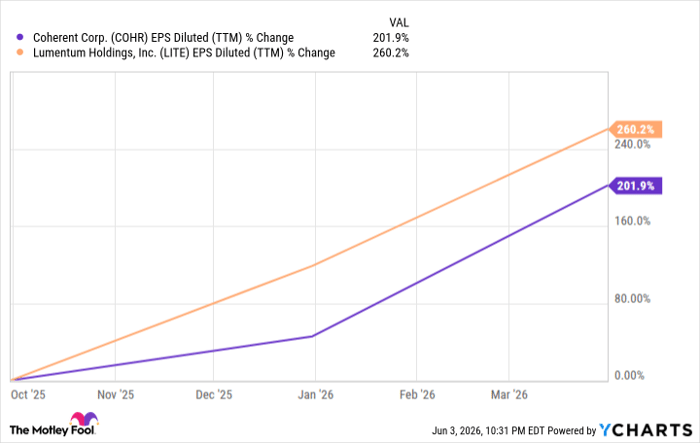
As a result, the prices of these optical components are rising sharply, driving phenomenal growth for Coherent and Lumentum.
Data by YCharts
This terrific earnings growth is translating into healthy upside on the stock market. Lumentum stock has jumped by over 1,100% over the past year, while Coherent has clocked 444% gains. Moreover, Nvidia's investments in these companies should ensure it has access to a supply of optical networking components by helping them build additional capacity.
For example, Coherent CEO Jim Anderson pointed out in March that Nvidia's investment will increase the chip giant's "access to include multiple product families to help them build the AI data centers of the future." Similarly, Lumentum is going to invest "in a new fabrication facility to increase capacity and accelerate innovation" following Nvidia's investments.
So, Nvidia is taking steps to ensure that it controls the AI infrastructure supply chain more tightly by investing in the likes of Coherent and Lumentum, which provide critical components necessary for scaling up AI data centers.
Meanwhile, Nvidia's $2 billion investment in Marvell Technology, announced on March 31, is another strategic move. Marvell designs custom AI processors and networking components that are experiencing strong demand as AI inference grows. Nvidia's investment in Marvell will enable it to make rack-scale server systems that integrate custom AI processors, server processors, and networking components into a single platform.
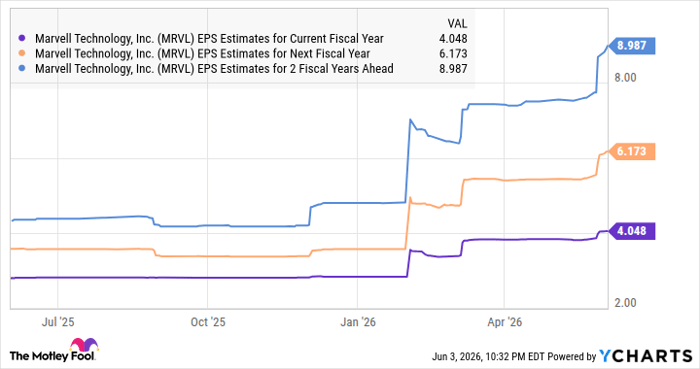
The partnership also strengthens Nvidia's position in optical networking and silicon photonics. What's worth noting is that Marvell designs AI chips and networking components for major hyperscalers and has multiple design wins in the pipeline, poised to go into production over the next couple of years. So, it was easy to see why Marvell raised its full-year guidance when it released its fiscal 2027 first-quarter results (for the three months ended May 2) on May 27.
The company anticipates a 40% increase in revenue in the current fiscal year to $11.5 billion, followed by a larger 45% increase in the next fiscal year. What's more, its earnings growth is also poised to take off.
Data by YCharts
So, Nvidia's investment in Marvell is likely to become a profitable one in the long run. At the same time, its partnership for custom AI processors should ensure the chip giant remains a dominant player in the AI semiconductor space. In fact, Nvidia CEO Jensen Huang recently remarked that Marvell could become a $1 trillion company, sending the AI stock soaring.
Investors should consider loading up on Nvidia stock before it breaks out
Nvidia's growth was fantastic last quarter, and the good news is that it is poised to step on the gas from the current quarter. Moreover, the company's focus on expanding its AI hardware ecosystem by investing in key infrastructure companies should be a long-term tailwind, especially given that its investments are likely to be profitable.
That's why it would be a good idea to buy Nvidia stock, given its price/earnings-to-growth (PEG) ratio of just 0.69, based on the annual earnings growth it can clock over the next five years, according to Yahoo! Finance. The PEG ratio is a forward-looking valuation metric that considers a company's earnings growth potential, and a reading of below 1 indicates the stock is undervalued.
Nvidia, therefore, seems quite undervalued given its future growth potential. So, it won't be surprising to see it jump significantly in the long run, which is why it makes sense to buy it before it soars higher.
Should you buy stock in Nvidia right now?
Before you buy stock in Nvidia, consider this:
The Motley Fool Stock Advisor analyst team just identified what they believe are the 10 best stocks for investors to buy now… and Nvidia wasn’t one of them. The 10 stocks that made the cut could produce monster returns in the coming years.
Consider when Netflix made this list on December 17, 2004... if you invested $1,000 at the time of our recommendation, you’d have $439,847!* Or when Nvidia made this list on April 15, 2005... if you invested $1,000 at the time of our recommendation, you’d have $1,342,065!*
Now, it’s worth noting Stock Advisor’s total average return is 968% — a market-crushing outperformance compared to 211% for the S&P 500. Don't miss the latest top 10 list, available with Stock Advisor, and join an investing community built by individual investors for individual investors.
See the 10 stocks »
*Stock Advisor returns as of June 5, 2026.
Harsh Chauhan has no position in any of the stocks mentioned. The Motley Fool has positions in and recommends Coherent, Lumentum, Marvell Technology, and Nvidia. The Motley Fool has a disclosure policy.
Recommended Articles


