

Nvidia Shares Dropped After Stellar Earnings. Is This a Sign of What's Coming for Artificial Intelligence (AI) Stocks?

Source The Motley Fool

Key Points

  • Nvidia's revenue growth is accelerating as hyperscalers continue to scale up their data center infrastructure.

  • The company is set to ship its new, more powerful Vera Rubin processors.

  • Some anticipated growth has already been priced into AI stocks.

  • 10 stocks we like better than Nvidia ›

Nvidia (NASDAQ: NVDA) stock has been one of the best investments of all time. It's unlikely that anyone who bought it when it went public back in 1999 at $12 per share recognized what the chipmaker would become, but investors who were impressed with the company at nearly any point in its existence and took a long-term approach to it have been well rewarded.

But is the stock's extended run-up largely over? Though the company delivered another outstanding earnings report on May 20, the stock has lost ground since then. Nvidia truly outperformed across metrics, and management provided a confidence-boosting outlook. Let's consider what's going on and whether or not it spells trouble for the artificial intelligence (AI) industry more broadly.

Will AI create the world's first trillionaire? Our team just released a report on the one little-known company, called an "Indispensable Monopoly" providing the critical technology Nvidia and Intel both need. Continue »

Nvidia is still the key to AI

Nvidia's graphics processing units (GPUs), originally developed for the gaming industry, turned out to be the perfect processors to handle the workloads generated by AI development. Since 2022, when ChatGPT took the world by storm, Nvidia has experienced massive revenue growth, which was reflected in its incredible stock gains. Its top line has increased by more than 800%, while the stock has gained about 1,000%.
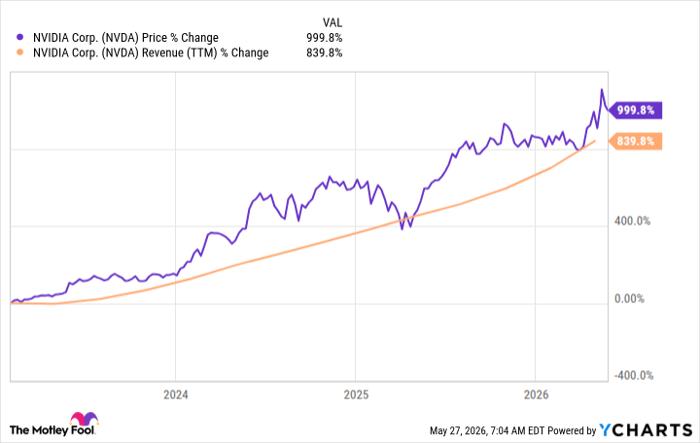
NVDA Chart

NVDA data by YCharts.

Not only has that continued recently, but growth has also been accelerating. In its fiscal 2027 first quarter (which ended April 26), revenue increased 85% year over year, and the gross margin improved to 75%.

The company doesn't expect this to end anytime soon. Despite facing serious new competition from AI chips developed by established companies like Broadcom and Alphabet, its hardware remains the gold standard for AI development, and it continues to roll out more powerful chips for its hyperscaler and data center clients. Its new Vera Rubin line of processors is shipping in the next few months, and CEO Jensen Huang is confident that "every single frontier model company will jump on Vera Rubin from the get-go."

Digital icons surround an illuminated model of the Earth.

Image source: Nvidia.

It's also developing vertically integrated products that further embed its systems into client platforms and make it indispensable. Its new architecture, for example, features the Vera CPU, built for agentic AI and integrated with Nvidia products, opening it up to a completely new $200 billion market. These advancements will help the company maintain and broaden its competitive moat.

Huang explained that the data center segment is "very fragmented, requires a really well-integrated platform solution and a very large go-to-market, and that segment, all of the inference, 100% of that, the vast majority of that is Nvidia."

The future of AI

Despite the excellent fiscal Q1 results, Nvidia stock remains down by more than 3% since the report came out. My take on it is that the market has already baked such high expectations into the stock that even phenomenal earnings can't quite raise its price. And the same goes for many of today's other top AI stocks.

These companies need to continually raise the bar to impress the market, and in the short term at least, that situation could result in some price compression.

The AI sector may continue to thrive, but the stocks in it have become so popular that a large amount of anticipated future earnings growth is already priced into them. If you want to invest in the leading companies in AI, be prepared to hold onto their shares through periods of volatility. And if you own some of the riskier ones in the space, you might want to reconsider some of those positions.

Should you buy stock in Nvidia right now?

Before you buy stock in Nvidia, consider this:

The Motley Fool Stock Advisor analyst team just identified what they believe are the 10 best stocks for investors to buy now… and Nvidia wasn’t one of them. The 10 stocks that made the cut could produce monster returns in the coming years.

Consider when Netflix made this list on December 17, 2004... if you invested $1,000 at the time of our recommendation, you’d have $463,900!* Or when Nvidia made this list on April 15, 2005... if you invested $1,000 at the time of our recommendation, you’d have $1,294,401!*

Now, it’s worth noting Stock Advisor’s total average return is 978% — a market-crushing outperformance compared to 211% for the S&P 500. Don't miss the latest top 10 list, available with Stock Advisor, and join an investing community built by individual investors for individual investors.

See the 10 stocks »

*Stock Advisor returns as of May 31, 2026.

Jennifer Saibil has no position in any of the stocks mentioned. The Motley Fool has positions in and recommends Alphabet, Broadcom, and Nvidia. The Motley Fool has a disclosure policy.

Disclaimer: For information purposes only. Past performance is not indicative of future results.
placeholder
Bitcoin CME gaps at $35,000, $27,000 and $21,000, which one gets filled first?Prioritize filling the $27,000 gap and even try higher.
Author  FXStreet
Aug 22, 2023
Prioritize filling the $27,000 gap and even try higher.
placeholder
Bitcoin briefly loses 2025 gains as crypto plunges over the weekend.Bitcoin experienced a sharp decline this weekend, briefly erasing its 2025 gains and dipping below its year-opening value of $93,507. The cryptocurrency fell to a low of $93,029 on Sunday, representing a 25% drop from its all-time high in October. Although it has rebounded slightly to around $94,209, the pressures on the market remain significant. The downturn occurred despite the reopening of the U.S. government on Thursday, which many had hoped would provide essential support for crypto markets. This year initially appeared promising for cryptocurrencies, particularly after the inauguration of President Donald Trump, who has established the most pro-crypto administration thus far. However, ongoing political tensions—including Trump's tariff strategies and the recent government shutdown, lasting a historic 43 days—have contributed to several rapid price pullbacks for Bitcoin throughout the year. Market dynamics are also being influenced by Bitcoin whales—investors holding large amounts of Bitcoin—who have been offloading portions of their assets, consequently stalling price rallies even as positive regulatory developments emerge. Despite these sell-offs, analysts from Glassnode argue that this behavior aligns with typical patterns seen among long-term investors during the concluding stages of bull markets, suggesting it is not indicative of a mass exodus. Notably, Bitcoin is not alone in its struggles, as Ethereum and Solana have also recorded declines of 7.95% and 28.3%, respectively, since the start of the year, while numerous altcoins have faced even steeper losses. Looking ahead, questions linger regarding the viability of the four-year cycle thesis, particularly given the increasing institutional support and regulatory frameworks now in place in the crypto landscape. Matt Hougan, chief investment officer at Bitwise, remains optimistic, suggesting a potential Bitcoin resurgence in 2026 driven by the “debasement trade” thesis and a broader trend toward increased adoption of stablecoins, tokenization, and decentralized finance. Hougan emphasized the soundness of the underlying fundamentals, pointing to a positive outlook for the sector in the longer term.
Author  Mitrade
Nov 17, 2025
Bitcoin experienced a sharp decline this weekend, briefly erasing its 2025 gains and dipping below its year-opening value of $93,507. The cryptocurrency fell to a low of $93,029 on Sunday, representing a 25% drop from its all-time high in October. Although it has rebounded slightly to around $94,209, the pressures on the market remain significant. The downturn occurred despite the reopening of the U.S. government on Thursday, which many had hoped would provide essential support for crypto markets. This year initially appeared promising for cryptocurrencies, particularly after the inauguration of President Donald Trump, who has established the most pro-crypto administration thus far. However, ongoing political tensions—including Trump's tariff strategies and the recent government shutdown, lasting a historic 43 days—have contributed to several rapid price pullbacks for Bitcoin throughout the year. Market dynamics are also being influenced by Bitcoin whales—investors holding large amounts of Bitcoin—who have been offloading portions of their assets, consequently stalling price rallies even as positive regulatory developments emerge. Despite these sell-offs, analysts from Glassnode argue that this behavior aligns with typical patterns seen among long-term investors during the concluding stages of bull markets, suggesting it is not indicative of a mass exodus. Notably, Bitcoin is not alone in its struggles, as Ethereum and Solana have also recorded declines of 7.95% and 28.3%, respectively, since the start of the year, while numerous altcoins have faced even steeper losses. Looking ahead, questions linger regarding the viability of the four-year cycle thesis, particularly given the increasing institutional support and regulatory frameworks now in place in the crypto landscape. Matt Hougan, chief investment officer at Bitwise, remains optimistic, suggesting a potential Bitcoin resurgence in 2026 driven by the “debasement trade” thesis and a broader trend toward increased adoption of stablecoins, tokenization, and decentralized finance. Hougan emphasized the soundness of the underlying fundamentals, pointing to a positive outlook for the sector in the longer term.
placeholder
Markets in 2026: Will gold, Bitcoin, and the U.S. dollar make history again? — These are how leading institutions thinkAfter a turbulent 2025, what lies ahead for commodities, forex, and cryptocurrency markets in 2026?
Author  Insights
Dec 25, 2025
After a turbulent 2025, what lies ahead for commodities, forex, and cryptocurrency markets in 2026?
placeholder
ECB Policy Outlook for 2026: What It Could Mean for the Euro’s Next MoveWith the ECB likely holding rates steady at 2.15% and the Fed potentially extending cuts into 2026, EUR/USD may test 1.20 if Eurozone growth proves resilient, but weaker growth and an ECB pivot could pull the pair back toward 1.13 and potentially 1.10.
Author  Mitrade
Dec 26, 2025
With the ECB likely holding rates steady at 2.15% and the Fed potentially extending cuts into 2026, EUR/USD may test 1.20 if Eurozone growth proves resilient, but weaker growth and an ECB pivot could pull the pair back toward 1.13 and potentially 1.10.
placeholder
My Top 5 Stock Market Predictions for 2026Five 2026 market predictions written in a native, news-style voice: AI’s winners and losers, broader sector leadership, dividend demand, valuation cooling as the Shiller CAPE sits at 39 (Dec. 31, 2025), and quantum-computing bursts—while keeping all original facts and numbers unchanged.
Author  Mitrade
Jan 06, Tue
Five 2026 market predictions written in a native, news-style voice: AI’s winners and losers, broader sector leadership, dividend demand, valuation cooling as the Shiller CAPE sits at 39 (Dec. 31, 2025), and quantum-computing bursts—while keeping all original facts and numbers unchanged.
goTop
quote