


Jensen Huang Just Delivered Incredible News for Nvidia Investors
Key Points
Nvidia supplies the best data center chips for AI workloads, and demand continues to outstrip supply.
Revenue just accelerated again, and comments by the CEO suggest further momentum ahead.
Nvidia stock looks like a bargain at the current price, but some clear risks have emerged.
- 10 stocks we like better than Nvidia ›
Nvidia (NASDAQ: NVDA) supplies the world's best graphics processing units (GPUs) for data centers, which are the primary chips used in artificial intelligence (AI) training and inference workloads. Demand for this hardware continues to outstrip supply, which is driving an acceleration in the company's revenue growth.
On May 20, Nvidia CEO Jensen Huang participated in a conference call with shareholders to discuss the company's operating results for its fiscal 2027 first quarter (ended April 26). He made a series of comments about the upcoming Vera Rubin product platform that should make investors as bullish as ever, but there are also some clear risks to his outlook. Read on.
Will AI create the world's first trillionaire? Our team just released a report on the one little-known company, called an "Indispensable Monopoly" providing the critical technology Nvidia and Intel both need. Continue »

Image source: Nvidia.
Vera Rubin will be Nvidia's most successful platform ever
Nvidia's Blackwell GPU architecture is the basis for the company's most commercially successful chips to date, like the GB300 which delivers up to 50 times more performance than the company's original AI GPU, the H100. However, the upcoming Vera Rubin platform could leapfrog Blackwell in terms of both sales and performance.
Vera Rubin includes the Rubin GPU, the Vera central processing unit (CPU), the new NVLink 6 data center switches, and a number of other networking components. Nvidia says it will be so powerful that it can train AI models using 75% fewer GPUs compared to Blackwell and reduce inference token costs by 90%.
Inference tokens are the text, symbols, or images generated by an AI model in response to a user's prompt. They typically consume a significant amount of computing capacity and electricity, which is why most AI companies have adopted usage-based pricing models for their customers. If Vera Rubin really does reduce inference costs by 90%, it could spark a wave of AI adoption among businesses and consumers, while making AI companies more profitable.
Commercial quantities of Vera Rubin systems will start shipping in the second half of this year. During his May 20 conference call with investors, Jensen Huang said the product platform will be more successful than Blackwell. In fact, he said every single frontier model company is adopting Vera Rubin from its launch date, which wasn't true for Blackwell.
Revenue growth continues to accelerate
Nvidia generated a record $81.6 billion in total revenue during its fiscal 2027 Q1, which was an 85% increase from the year-ago period. The data center business alone brought in $75.2 billion in revenue, representing an even faster increase of 92%.
Both of those growth rates accelerated from the fiscal 2026 Q4 when total revenue and data center revenue increased by 73% and 75%, respectively, which highlights the incredible sales momentum for GPUs and other AI-related hardware.
Nvidia's guidance for the current fiscal 2027 Q2, which will conclude at the end of July, suggests sales growth will accelerate yet again. The company expects to generate $91 billion in total revenue, representing a year-over-year increase of 95%.
Nvidia stock looks cheap, but risks are emerging
Based on Nvidia's generally accepted accounting principles (GAAP) trailing-12-month earnings of $6.53 per share, its stock is trading at a price-to-earnings (P/E) ratio of 33. That is almost a 50% discount to its 10-year average of 61.7, which suggests the stock is heavily undervalued right now.
Moreover, based on Wall Street's estimate for Nvidia's overall fiscal 2027 earnings, its stock is trading at a forward P/E ratio of 24.1.
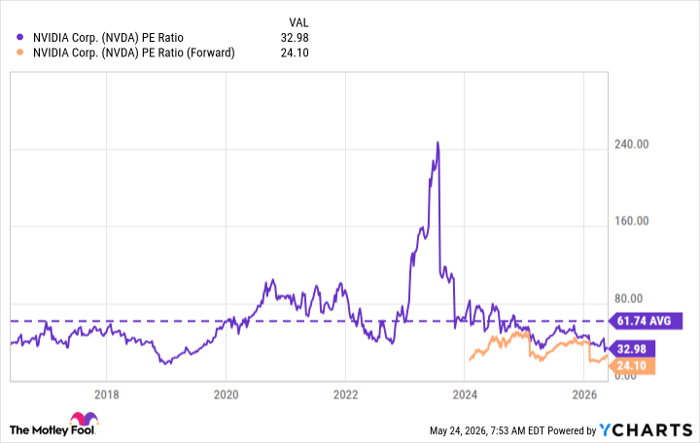
NVDA PE Ratio data by YCharts.
Nvidia stock would have to climb by 37% over the next 12 months just to maintain its current P/E ratio of 33, and it would have to soar by 156% to trade in line with its 10-year average P/E ratio of 61.7.
However, there are some noteworthy downside risks. Nvidia expects data center operators to collectively spend over $1 trillion on AI chips and infrastructure during 2027 alone, but investors are starting to wonder when these enormous capital expenditures will start yielding returns. As a result, some AI companies are significantly raising prices.
Anthropic, for example, shifted some of its AI products off fixed-rate pricing plans and onto usage-based plans instead, triggering a passive -- but enormous -- increase in price. This is partly why one customer, Uber Technologies, burned through its entire 2026 AI budget in just four months (according to a report by Forbes).
Microsoft is also implementing a usage-based pricing model for its Copilot AI assistant for GitHub from June 1, which could increase costs for software developers by several orders of magnitude.
These price hikes could blunt the impact of Vera Rubin's reported ability to reduce inference token costs by 90%. And if that's the case, this new platform might not be a silver bullet for driving further AI adoption after all, which could be a headwind for demand. Therefore, while Nvidia stock looks attractive at the current price, investors should be wary of the increasingly cloudy AI landscape.
Should you buy stock in Nvidia right now?
Before you buy stock in Nvidia, consider this:
The Motley Fool Stock Advisor analyst team just identified what they believe are the 10 best stocks for investors to buy now… and Nvidia wasn’t one of them. The 10 stocks that made the cut could produce monster returns in the coming years.
Consider when Netflix made this list on December 17, 2004... if you invested $1,000 at the time of our recommendation, you’d have $472,852!* Or when Nvidia made this list on April 15, 2005... if you invested $1,000 at the time of our recommendation, you’d have $1,317,207!*
Now, it’s worth noting Stock Advisor’s total average return is 984% — a market-crushing outperformance compared to 210% for the S&P 500. Don't miss the latest top 10 list, available with Stock Advisor, and join an investing community built by individual investors for individual investors.
See the 10 stocks »
*Stock Advisor returns as of May 27, 2026.
Anthony Di Pizio has no position in any of the stocks mentioned. The Motley Fool has positions in and recommends Microsoft, Nvidia, and Uber Technologies. The Motley Fool has a disclosure policy.
Recommended Articles


