

South Korea Stocks Halt Again, SK Hynix Market Cap Breaks $1 Trillion Mark.

Source Tradingkey

TradingKey - During the Asian trading session on May 27, SK Hynix shares surged more than 10% intraday, with its market capitalization historically surpassing $1 trillion, making it the second Asian semiconductor manufacturer to reach this milestone after Samsung Electronics and the third memory chip company globally to exceed a $1 trillion valuation.

1sk-hynix-02deb04f9c6f4273b92ed388dc68aae6
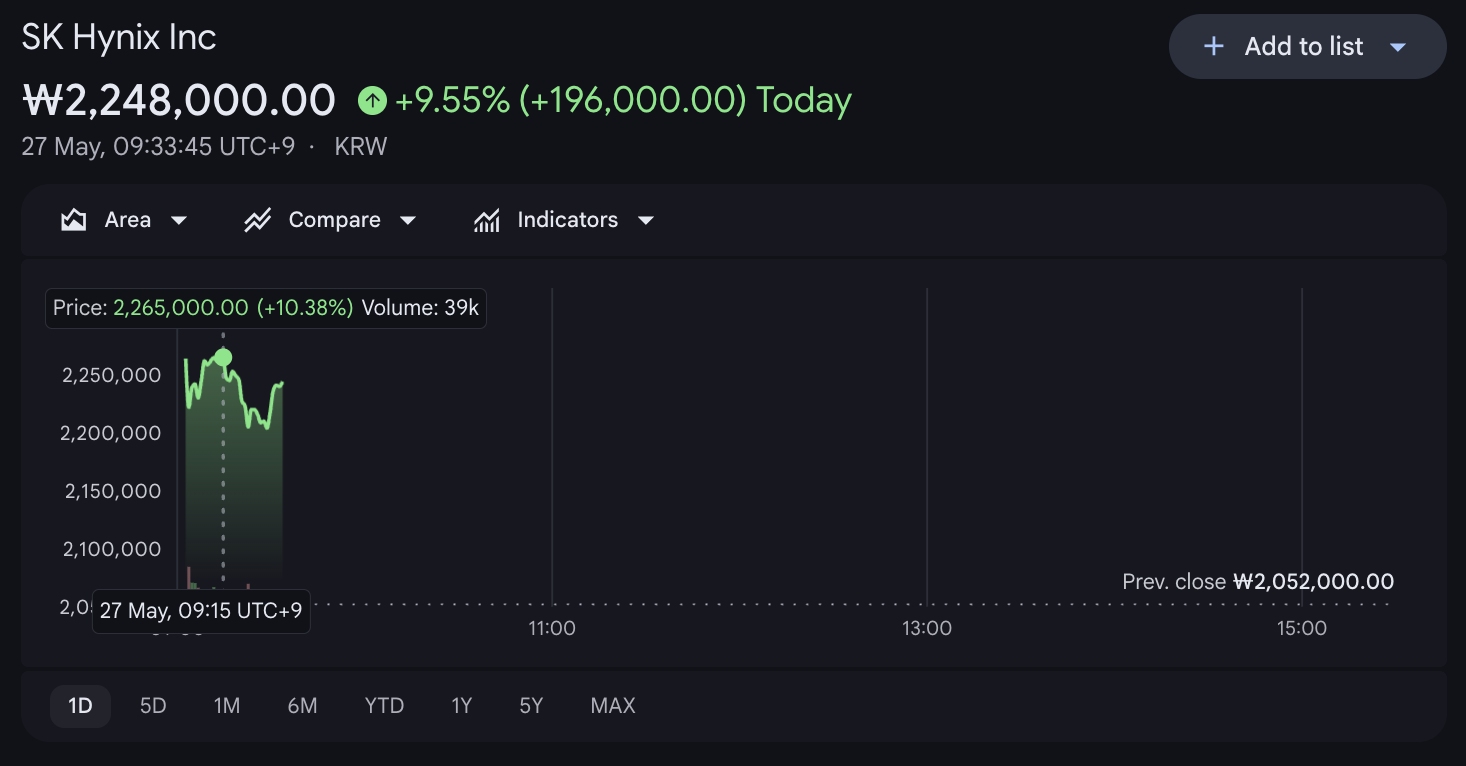
[SK Hynix once rose over 10%, Source: Google Finance]

Earlier, South Korea's KOSPI index surged nearly 5% at one point, and KOSPI 200 futures rose 5%, triggering a circuit breaker that suspended program trading for five minutes.

Over the past year, SK Hynix's stock price has surged over 900% cumulatively, with a total gain of 274% in 2025 and a further increase of more than 200% so far in 2026.

As a core supplier of HBM chips for Nvidia, SK Hynix has benefited deeply from the explosive demand for high-bandwidth memory in AI servers. HBM chips are considered the bottleneck of AI infrastructure, as memory bandwidth replaces pure computing power as the most critical constraint in AI computing deployment.

Strong momentum in AI demand continues to accelerate.

Since 2025, orders from tech giants such as Nvidia, Google, and AMD for SK Hynix have continued to climb, and the company's HBM capacity for the full year of 2026 is already sold out, with shortages expected to persist through 2027.

Meanwhile, earlier this month, over 50,000 employees at Samsung Electronics originally planned an 18-day general strike. Market expectations that Samsung's production hurdles would further exacerbate global memory chip supply constraints drove customers to accelerate order transfers toward competitors like SK Hynix, providing an additional short-term catalyst for the stock price.

Although it was announced late on May 20 that the strike would be suspended, emergency arbitration by South Korea's Ministry of Employment and Labor only delayed the strike by 30 days. The fundamental disagreement between labor and management over bonus distribution remains far from resolved, and supply anxieties have not fully dissipated.

Notably, SK Hynix has confidentially filed for a U.S. ADR listing this year, which will allow American investors to participate directly in its secondary market trading after the listing. This progress opens the door for the company to further attract global capital and is expected to drive a continuation of its valuation re-rating.

While the risk of relying on a few major customers remains, the market is redefining SK Hynix from a cyclical memory manufacturer to a structural core beneficiary of AI infrastructure. Analysts expect the memory chip shortage to last until 2027, granting SK Hynix, Samsung, and Micron unprecedented pricing power.

Disclaimer: For information purposes only. Past performance is not indicative of future results.
placeholder
Bitcoin CME gaps at $35,000, $27,000 and $21,000, which one gets filled first?Prioritize filling the $27,000 gap and even try higher.
Author  FXStreet
Aug 22, 2023
Prioritize filling the $27,000 gap and even try higher.
placeholder
Pinduoduo Earnings Incoming: Morgan Stanley Sees Long-Term Profit Potential​Insights – On November 21, Chinese e-commerce giant Pinduoduo (PDD) will release its Q3 2024 earnings.
Author  Mitrade
Nov 20, 2024
​Insights – On November 21, Chinese e-commerce giant Pinduoduo (PDD) will release its Q3 2024 earnings.
placeholder
Elon Musk’s xAI and Neuralink Launch New Funding Rounds​Billionaire Elon Musk recently raised funds for his two high-profile tech companies, xAI and Neuralink.
Author  Insights
Jun 03, 2025
​Billionaire Elon Musk recently raised funds for his two high-profile tech companies, xAI and Neuralink.
placeholder
GBP/USD extends downside to near 1.3400 as US enters Israel-Iran warThe GBP/USD pair extends the decline to around 1.3405 during the Asian trading hours on Monday.
Author  FXStreet
Jun 23, 2025
The GBP/USD pair extends the decline to around 1.3405 during the Asian trading hours on Monday.
placeholder
Bitcoin briefly loses 2025 gains as crypto plunges over the weekend.Bitcoin experienced a sharp decline this weekend, briefly erasing its 2025 gains and dipping below its year-opening value of $93,507. The cryptocurrency fell to a low of $93,029 on Sunday, representing a 25% drop from its all-time high in October. Although it has rebounded slightly to around $94,209, the pressures on the market remain significant. The downturn occurred despite the reopening of the U.S. government on Thursday, which many had hoped would provide essential support for crypto markets. This year initially appeared promising for cryptocurrencies, particularly after the inauguration of President Donald Trump, who has established the most pro-crypto administration thus far. However, ongoing political tensions—including Trump's tariff strategies and the recent government shutdown, lasting a historic 43 days—have contributed to several rapid price pullbacks for Bitcoin throughout the year. Market dynamics are also being influenced by Bitcoin whales—investors holding large amounts of Bitcoin—who have been offloading portions of their assets, consequently stalling price rallies even as positive regulatory developments emerge. Despite these sell-offs, analysts from Glassnode argue that this behavior aligns with typical patterns seen among long-term investors during the concluding stages of bull markets, suggesting it is not indicative of a mass exodus. Notably, Bitcoin is not alone in its struggles, as Ethereum and Solana have also recorded declines of 7.95% and 28.3%, respectively, since the start of the year, while numerous altcoins have faced even steeper losses. Looking ahead, questions linger regarding the viability of the four-year cycle thesis, particularly given the increasing institutional support and regulatory frameworks now in place in the crypto landscape. Matt Hougan, chief investment officer at Bitwise, remains optimistic, suggesting a potential Bitcoin resurgence in 2026 driven by the “debasement trade” thesis and a broader trend toward increased adoption of stablecoins, tokenization, and decentralized finance. Hougan emphasized the soundness of the underlying fundamentals, pointing to a positive outlook for the sector in the longer term.
Author  Mitrade
Nov 17, 2025
Bitcoin experienced a sharp decline this weekend, briefly erasing its 2025 gains and dipping below its year-opening value of $93,507. The cryptocurrency fell to a low of $93,029 on Sunday, representing a 25% drop from its all-time high in October. Although it has rebounded slightly to around $94,209, the pressures on the market remain significant. The downturn occurred despite the reopening of the U.S. government on Thursday, which many had hoped would provide essential support for crypto markets. This year initially appeared promising for cryptocurrencies, particularly after the inauguration of President Donald Trump, who has established the most pro-crypto administration thus far. However, ongoing political tensions—including Trump's tariff strategies and the recent government shutdown, lasting a historic 43 days—have contributed to several rapid price pullbacks for Bitcoin throughout the year. Market dynamics are also being influenced by Bitcoin whales—investors holding large amounts of Bitcoin—who have been offloading portions of their assets, consequently stalling price rallies even as positive regulatory developments emerge. Despite these sell-offs, analysts from Glassnode argue that this behavior aligns with typical patterns seen among long-term investors during the concluding stages of bull markets, suggesting it is not indicative of a mass exodus. Notably, Bitcoin is not alone in its struggles, as Ethereum and Solana have also recorded declines of 7.95% and 28.3%, respectively, since the start of the year, while numerous altcoins have faced even steeper losses. Looking ahead, questions linger regarding the viability of the four-year cycle thesis, particularly given the increasing institutional support and regulatory frameworks now in place in the crypto landscape. Matt Hougan, chief investment officer at Bitwise, remains optimistic, suggesting a potential Bitcoin resurgence in 2026 driven by the “debasement trade” thesis and a broader trend toward increased adoption of stablecoins, tokenization, and decentralized finance. Hougan emphasized the soundness of the underlying fundamentals, pointing to a positive outlook for the sector in the longer term.
goTop
quote