


Forget IonQ: This New Quantum Computing IPO Could Be This Year's Dark Horse
Key Points
IonQ is a prominent quantum computing company due to its strong year-over-year sales growth, which exceeded 700% in the first quarter.
While IonQ has proven successful, it didn't secure the government funding rival Infleqtion did.
Infleqtion's first-quarter revenue rose 14% year over year, and it has contracts with multiple government agencies.
- 10 stocks we like better than Infleqtion ›
Quantum computing is a promising sector for investors. The technology is so potent that a quantum computer can complete complex calculations in minutes that would take a supercomputer centuries.
That kind of power has brought investor interest to stocks in the sector, such as IonQ (NYSE: IONQ), thanks to its rapidly rising revenue. The company reported jaw-dropping sales growth of 755% year over year to $64.7 million in the first quarter.
Will AI create the world's first trillionaire? Our team just released a report on the one little-known company, called an "Indispensable Monopoly" providing the critical technology Nvidia and Intel both need. Continue »
Despite its success, IonQ is not among the quantum computing businesses the federal government recently awarded funding to. Instead, the U.S. Department of Commerce selected one of its rivals, a newly public company called Infleqtion (NYSE: INFQ). This hints at Infleqtion's potential as this year's dark horse stock. Here's a closer look at the company.

Image source: Getty Images.
Infleqtion's technological advantages
Infleqtion's key differentiator from competitors is its neutral-atom technology. This technique employs lasers to capture and control atoms for use as the bits in its quantum computer to perform computations. These are referred to as qubits and are naturally occurring atoms, so the particles are all identical.
Many rivals employ manufactured qubits, produced via electrical circuits, which must be corrected for defects. IonQ uses natural atoms, but manipulates them to generate ions. The ionization process makes its qubits stable to work with, but the tech is difficult to scale up.
Every quantum technology has its pros and cons. Neutral-atom computers are slower than those using other methods. However, Infleqtion's approach has advanced to a point where it overcomes several shortfalls inherent in rival techniques. The company's use of neutral atoms means its quantum computers are scalable and don't need the costly equipment other techniques require to control qubits.
Infleqtion's approach was validated when Alphabet-owned Google Quantum AI announced in March it was also pursuing neutral-atom technology for its quantum computers. The neutral-atom methodology helped Infleqtion secure a contract worth $100 million with the U.S. Department of Commerce, announced on May 21.
Infleqtion is more than quantum computers
Infleqtion's offerings extend beyond quantum computer chips. It provides quantum-based sensing equipment, such as atomic clocks, as well as quantum computing software.
Thanks to its varied offerings, Infleqtion delivered record first-quarter revenue of $9.5 million, which represents 14% year-over-year growth. It already counts NASA as a customer, having provided quantum technology to the International Space Station since 2018.
The company also contracted with the U.S. Navy and the Department of Energy. Consequently, Infleqtion anticipates reaching at least $40 million in revenue this year, up from $32.5 million in 2025.
Is Infleqtion stock a buy?
Its many successes position Infleqtion as a compelling growth stock in the quantum computing sector. Yet it has downsides. The company is not profitable, and in fact, its costs are rising as it invests in staff to expand its business. Infleqtion's Q1 operating loss widened to $33.6 million, up from $7 million in the prior year.
The operating loss could become a concern if costs continue to rise at this pace. For now, the company has sufficient funds to sustain operations as it continues to ramp up sales. At the end of Q1, it had amassed $569 million in cash and equivalents.
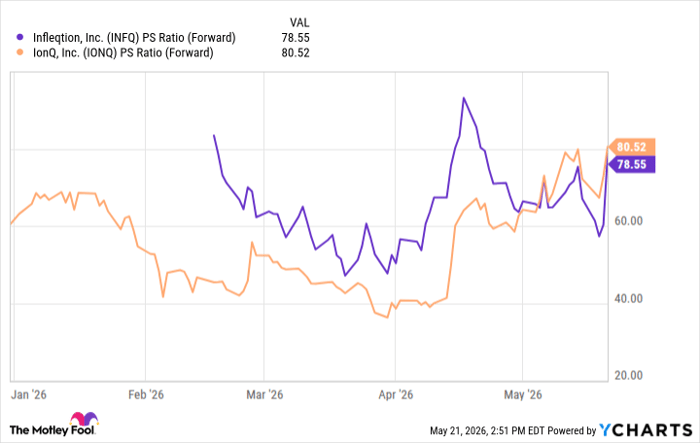
Moreover, its $100 million government award further strengthens its financial health, although the announcement sent its stock soaring. As a result, Infleqtion's share price valuation is elevated, as its forward price-to-sales ratio approaches 80.
Data by YCharts.
Infleqtion's forward sales multiple is on a par with IonQ's. Many quantum computing stocks sport high valuations. Companies in the sector are still building up sales as they work to reach the level of technological maturity required for widespread commercial use.
Given the inflated valuation, is Infleqtion stock a buy? Consider that its initial public offering (IPO) took place in February. The stock debuted at $14.25 per share, but since then, its price has experienced big swings, dropping below the IPO price and bouncing back up multiple times.
Given its recent share price increase and volatility history, the ideal approach is to wait for its share price to drop again before considering it an investment in quantum computing.
Should you buy stock in Infleqtion right now?
Before you buy stock in Infleqtion, consider this:
The Motley Fool Stock Advisor analyst team just identified what they believe are the 10 best stocks for investors to buy now… and Infleqtion wasn’t one of them. The 10 stocks that made the cut could produce monster returns in the coming years.
Consider when Netflix made this list on December 17, 2004... if you invested $1,000 at the time of our recommendation, you’d have $477,813!* Or when Nvidia made this list on April 15, 2005... if you invested $1,000 at the time of our recommendation, you’d have $1,320,088!*
Now, it’s worth noting Stock Advisor’s total average return is 986% — a market-crushing outperformance compared to 208% for the S&P 500. Don't miss the latest top 10 list, available with Stock Advisor, and join an investing community built by individual investors for individual investors.
See the 10 stocks »
*Stock Advisor returns as of May 26, 2026.
Robert Izquierdo has positions in Alphabet and IonQ. The Motley Fool has positions in and recommends Alphabet and IonQ. The Motley Fool has a disclosure policy.
Recommended Articles


