


Prediction: Nvidia Will Become the World's First $15 Trillion Company by 2029
Key Points
Nvidia is the largest company in the world right now, but don't be surprised if it gets even bigger.
Nvidia's latest results provide a clear indication that its AI chip dominance isn't going to fade.
- 10 stocks we like better than Nvidia ›
Nvidia (NASDAQ: NVDA) became the first company in the world to achieve a $5 trillion market capitalization in October 2025, fueled by the artificial intelligence (AI)-powered growth in its revenue and earnings in recent years.
The good news for Nvidia stock investors is that the semiconductor giant's growth isn't showing any signs of slowing down. It continues to dominate the lucrative AI chip market, and more importantly, Nvidia continues to hunt for new opportunities to sustain its phenomenal growth.
Will AI create the world's first trillionaire? Our team just released a report on the one little-known company, called an "Indispensable Monopoly" providing the critical technology Nvidia and Intel both need. Continue »
Nvidia's performance in the first quarter of fiscal 2027 (which ended on April 26) clearly shows that the intensifying competition in the AI chip market isn't affecting its growth. In fact, I won't be surprised if it becomes the world's first $15 trillion company in the next three years. Let's see why that's likely to be the case.

Image source: Nvidia.
Nvidia is poised to deliver stronger growth in the AI inference era
Nvidia has dominated the AI chip market in recent years thanks to its graphics processing units (GPUs), which offer massive parallel computing power, making them ideal for training large language models (LLMs). However, there is enough evidence suggesting that hyperscalers and AI companies prefer custom chips in the inference era to reduce compute costs.
That's not surprising, as inference workloads require much less computational power than the training phase, which is why GPUs are considered overkill for inference applications. However, Nvidia's latest results make it clear that its GPUs remain relevant in the AI inference era.
The company reported an 85% year-over-year increase in revenue in fiscal Q1 to $81.6 billion. That was a significant improvement over the 69% revenue growth it reported in the same quarter last year. The semiconductor specialist's non-GAAP earnings jumped by a whopping 140% year over year to $1.87 per share, again exceeding the 33% growth it clocked in the year-ago period.
Nvidia's guidance clearly suggests that its growth is poised to accelerate. The company anticipates $91 billion in revenue in the current quarter, a 95% increase over the year-ago period. The company's ability to accelerate growth despite achieving a massive revenue base is commendable, indicating that Nvidia is now in a robust position to capitalize on the next phase of the AI computing cycle.
According to Deloitte, AI inference will account for two-thirds of compute power in data centers this year. However, the consulting giant adds that instead of inference-focused chips, the majority of the computing will be performed by powerful chips such as GPUs. Given that Nvidia is designing its server racks to deliver higher inference performance at lower costs, it is easy to see why hyperscalers, sovereign customers, and cloud computing providers continue to line up for its chips.
Nvidia management noted on the latest earnings call that its next-generation Vera Rubin server racks can "deliver up to 35x higher inference throughput and up to 10x greater AI factory revenue compared with Blackwell." So, it is easy to see why Nvidia management is confident of achieving $1 trillion in revenue from its Blackwell and Rubin chips in 2026 and 2027.
What's more, the company believes that inference and agentic AI applications will significantly boost AI infrastructure spending from an estimated $1 trillion in 2026 to a range of $3 trillion to $4 trillion by the end of the decade. Nvidia reported $75.2 billion in data center revenue in fiscal Q1, translating into an annual run rate of $300 billion. The massive AI infrastructure spending the company expects by 2030 suggests it still has significant room for growth in this market.
That's the reason why analysts have become more bullish about its prospects, paving the way for Nvidia to cross the $15 trillion market cap milestone within the next three years.
The math behind Nvidia's $15 trillion valuation
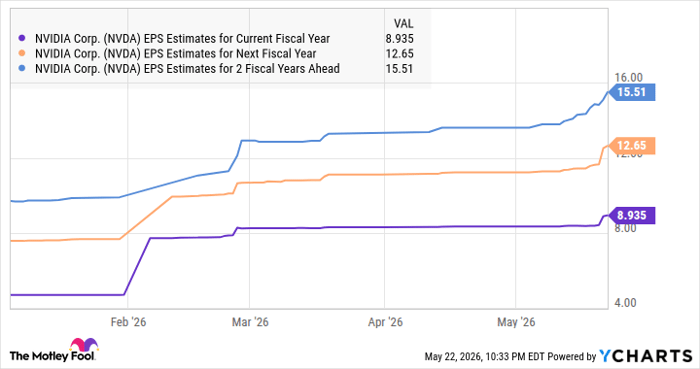
Analysts have revised their growth expectations following Nvidia's latest results. As the following chart shows us, Nvidia's earnings estimates for the next three fiscal years have crept up.
Data by YCharts
Nvidia's expectation of a significant acceleration in AI infrastructure spending over the coming years could help it sustain its remarkable growth. However, even if its earnings increase to $15.51 per share in fiscal 2029 (which will end in January 2029) and it trades at 43 times earnings at that time (in line with the tech-focused Nasdaq Composite index's earnings multiple), its stock price could jump to $667.
That's just over triple its current stock price, which should be enough for this AI stock to breach the $15 trillion market cap milestone, given its current $5.2 trillion market cap. So, it would make sense for investors to continue loading up on Nvidia shares, as it can soar higher over the next three years on account of its outstanding growth potential.
Should you buy stock in Nvidia right now?
Before you buy stock in Nvidia, consider this:
The Motley Fool Stock Advisor analyst team just identified what they believe are the 10 best stocks for investors to buy now… and Nvidia wasn’t one of them. The 10 stocks that made the cut could produce monster returns in the coming years.
Consider when Netflix made this list on December 17, 2004... if you invested $1,000 at the time of our recommendation, you’d have $477,813!* Or when Nvidia made this list on April 15, 2005... if you invested $1,000 at the time of our recommendation, you’d have $1,320,088!*
Now, it’s worth noting Stock Advisor’s total average return is 986% — a market-crushing outperformance compared to 208% for the S&P 500. Don't miss the latest top 10 list, available with Stock Advisor, and join an investing community built by individual investors for individual investors.
See the 10 stocks »
*Stock Advisor returns as of May 23, 2026.
Harsh Chauhan has no position in any of the stocks mentioned. The Motley Fool has positions in and recommends Nvidia. The Motley Fool has a disclosure policy.
Recommended Articles


