


The 2-Year U.S. Treasury Yield Has Now Blown Past the Federal Funds Rate. History Says the Fed Will Do This Next
Key Points
Bond yields have soared as the conflict with Iran continues to drag on, gas prices remain high, and after the April inflation data that came in hot.
Most bond yields are influenced by the market and can tell investors what it is thinking about a variety of economic factors.
Seeing the 2-year U.S. Treasury yield now firmly above the federal funds rate has happened before, and it usually leads the Fed to take certain actions.
- These 10 stocks could mint the next wave of millionaires ›
Perhaps one of the most impressive aspects of the stock market's resilience this year is its ability to overcome surging U.S. Treasury yields.
As of this writing, the yield on the 10-year U.S. Treasury Note was 4.58%. This is slightly higher than it was following "Liberation Day" in April of 2025, after President Donald Trump announced high tariffs on most of the U.S.'s key trading partners.
Will AI create the world's first trillionaire? Our team just released a report on the one little-known company, called an "Indispensable Monopoly" providing the critical technology Nvidia and Intel both need. Continue »
The yield on the 2-year U.S. Treasury note has also blasted higher, now at 4.14%. That's well above the Federal Reserve's benchmark overnight lending rate, the federal funds rate, which sits between 3.50% to 3.75%.
The 2-year yield, which is influenced by market expectations, reflects where investors expect the federal funds rate to go in the near term, and the fact that it is now well above the federal funds rate is meaningful.
History says this will happen next.

Image source: Getty Images.
What 30 years of history tells us
It's certainly understandable to see bond yields up right now. The ongoing feud with Iran has led to minimal passage through the Strait of Hormuz, through which one-fifth of daily oil demand normally flows.
This has led to high oil prices at a time when the U.S. economy has been struggling to beat back higher inflation, which has remained stubbornly above the Fed's preferred 2% target.
April inflation data also came in hot, further stoking inflation concerns. Even if the U.S. and Iran reach an agreement soon, it will take time for supply chains to return to normal.
Oil also isn't likely to return to pre-war levels because the market now knows Iran has enough power to close, or at least significantly slow, overall passage through the Strait of Hormuz. That's likely to lead oil investors to price that aspect in for the foreseeable future.
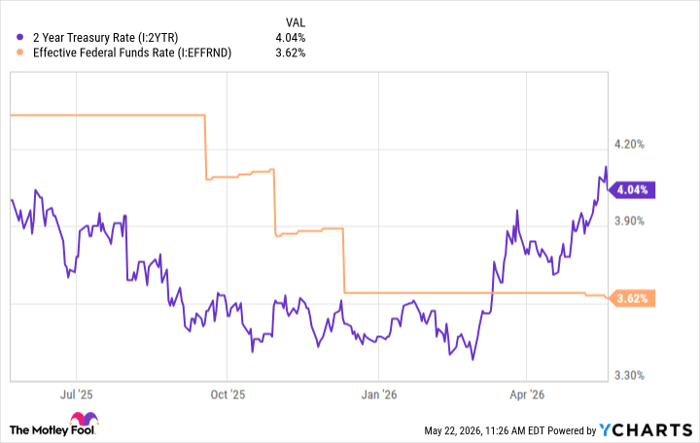
2 Year Treasury Rate data by YCharts
All of this could force the Fed's hand on interest rates, ultimately leading to a hike.
In fact, BCA Research strategist Arthur Budaghyan recently said in a research note that when the 2-year yield has surpassed the federal funds rate over the last three decades, the Fed has hiked rates. The opposite has been true when the 2-year yield dipped below the federal funds rate.
Taking it one step further, Budaghyan said he sees stocks and bonds on a "collision course."
"Only a meaningful equity sell-off is likely to pull bond yields considerably lower. Global equity risk-reward looks poor," he added.
Essentially, if things stay on this path, the Fed will have to hike rates to prevent bond yields from getting out of control, and a hike will trigger a stock sell-off.
How investors should prepare
Budaghyan seems to be right because traders betting on federal funds futures now see the Fed hiking at its December meeting this year, and holding rates at that level for all of 2027. Keep in mind that these probabilities change frequently.
Media reports this week have suggested the U.S. and Iran are close to striking a deal, which, if it happens, could send oil prices lower and push yields lower. However, we've heard reports like this before, and it's unclear if a deal can be reached and hold up.
Furthermore, there's no guarantee this will lead to an immediate reprieve for inflation. If the 10-year Treasury yield continues to move toward 5%, the Fed may ultimately have to raise the federal funds rate.
This is all near-term speculation, and as we've seen this year, things can change drastically and frequently.
Long-term investors don't necessarily need to do anything to their portfolios, but they should be aware of what's going on and that volatility could persist over the next few months, including a short-term pullback or correction.
The more one knows about what's influencing the market, the calmer they will be during more stressful times, enabling them to make more rational investment decisions.
Where to invest $1,000 right now
When our analyst team has a stock tip, it can pay to listen. After all, Stock Advisor’s total average return is 993%* — a market-crushing outperformance compared to 208% for the S&P 500.
They just revealed what they believe are the 10 best stocks for investors to buy right now, available when you join Stock Advisor.
See the stocks »
*Stock Advisor returns as of May 22, 2026.
The Motley Fool has a disclosure policy.
Recommended Articles


