


Is Nvidia's 25x Dividend Increase and New $80 Billion Share Repurchase Authorization a sign the Company Is Slowing Down?
Key Points
Nvidia once again reported strong earnings results for the first quarter of its fiscal year 2027.
However, investors might be concerned that leaning into dividends and repurchases signals that management is not seeing new investment opportunities.
The company is still showing strong growth, despite being the largest stock by market cap.
- 10 stocks we like better than Nvidia ›
The artificial intelligence chip giant Nvidia (NASDAQ: NVDA) has done it again.
Last night, Nvidia reported $1.87 in adjusted earnings per share on revenue of over $81.6 billion in the first quarter of its fiscal year 2027. Both numbers came in solidly ahead of Wall Street analyst consensus estimates.
Will AI create the world's first trillionaire? Our team just released a report on the one little-known company, called an "Indispensable Monopoly" providing the critical technology Nvidia and Intel both need. Continue »
Furthermore, the company provided revenue guidance of $91 billion for the current quarter, well above consensus estimates calling for slightly below $87 billion. The stock traded roughly 1.70% lower, as of 12:34 p.m. ET.
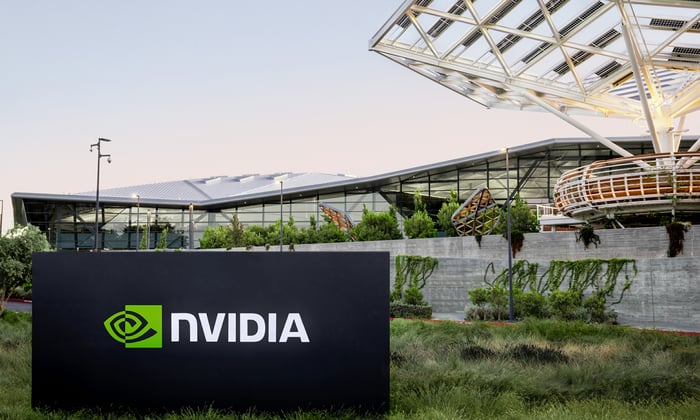
Image source: Nvidia.
Nvidia announced that it will raise its quarterly dividend to $0.25 per share, up from $0.01, a 25-fold increase. Nvidia's board of directors also authorized an additional $80 billion in share repurchases, on top of the $38.5 billion remaining under its old share buyback program.
The company returned roughly $20 billion to shareholders through repurchases and dividends in the first quarter of its fiscal year.
Does the dividend hike and increased share repurchase authorization signal that the company is slowing down?
Yes and no
At first glance, investors might see the increased dividend and repurchase authorization as a positive, which they are overall. The company is returning more money to shareholders.
However, increased capital distributions can lead investors to believe the company may see fewer opportunities to reinvest for growth and is now transitioning into a more mature company.
Typically, larger blue chip stocks return more capital to shareholders, while growth stocks don't return any capital because they want to continue investing and taking market share.
Is Nvidia slowing?
Well, it certainly seemed that way. In the company's fiscal year 2025, Nvidia grew adjusted revenue by 114% and adjusted diluted earnings per share (EPS) by 130%. In fiscal year 2026, Nvidia grew adjusted revenue by 65% and diluted EPS by 60%.
This is natural, of course. The law of numbers says that as companies get bigger, they will also grow more slowly.
That said, applying this reasoning to Nvidia is still an oversimplification in my mind because there's really no company like it. Nvidia is the largest company by market cap in the stock market.
The company has a market cap of over $5.3 trillion and just grew revenue in the first quarter of fiscal 2027 by 85% year over year and diluted EPS by 140%, which is remarkable. On a quarterly basis, this shows growth reaccelerating.
Nvidia is in uncharted waters
Investors need to remember that the company is still in uncharted waters.
Investors aren't used to companies this big. It's a lot more difficult to imagine a $5.3 trillion stock doubling than a normal stock they might encounter in the market.
Furthermore, there are broader concerns about an eventual AI slowdown, whether due to lower capital expenditures by hyperscalers on AI infrastructure or other roadblocks.
The good thing about Nvidia is that the company is generating tremendous earnings and free cash flow. The valuation is also reasonable at 25 times forward earnings.
Increasing the dividend will also help Nvidia attract a wider pool of shareholders, notably income investors who seek companies with strong, durable dividends.
In my mind, the increased dividend and share repurchase authorization are a natural progression for the company, which has grown tremendously. Nvidia can still deliver strong returns for shareholders, but it is unlikely to replicate the stock's jaw-dropping returns delivered over the past five years.
Should you buy stock in Nvidia right now?
Before you buy stock in Nvidia, consider this:
The Motley Fool Stock Advisor analyst team just identified what they believe are the 10 best stocks for investors to buy now… and Nvidia wasn’t one of them. The 10 stocks that made the cut could produce monster returns in the coming years.
Consider when Netflix made this list on December 17, 2004... if you invested $1,000 at the time of our recommendation, you’d have $475,063!* Or when Nvidia made this list on April 15, 2005... if you invested $1,000 at the time of our recommendation, you’d have $1,369,991!*
Now, it’s worth noting Stock Advisor’s total average return is 996% — a market-crushing outperformance compared to 208% for the S&P 500. Don't miss the latest top 10 list, available with Stock Advisor, and join an investing community built by individual investors for individual investors.
See the 10 stocks »
*Stock Advisor returns as of May 21, 2026.
Bram Berkowitz has no position in any of the stocks mentioned. The Motley Fool has positions in and recommends Nvidia. The Motley Fool has a disclosure policy.
Recommended Articles


