


Stock-Split Watch: Micron Could Be Next After Soaring by More Than 600% in 1 Year
Key Points
Micron hasn't split its stock since 2000.
Micron's profits and revenues are soaring thanks to a major shortage of memory chips.
- 10 stocks we like better than Micron Technology ›
After any stock experiences a major (and apparently durable) rise, it's almost inevitable that some people will start discussing the possibility that the company will consider a stock split.
Case in point: A year ago, Micron (NASDAQ: MU) was trading for around $100 per share, a price that's relatively accessible to retail investors. Now, however, after it has risen by more than 600% in just 12 months to over $700 per share, such a move seems more reasonable.
Will AI create the world's first trillionaire? Our team just released a report on the one little-known company, called an "Indispensable Monopoly" providing the critical technology Nvidia and Intel both need. Continue »
So, could Micron be splitting its stock soon?

Image source: Getty Images.
It has been a long time since Micron split its stock
It has been more than 25 years since Micron's last stock split. In May 2000, it split its stock 2-for-1, following another 2-for-1 split in 1995. Stock splits were a lot more common back then, and there's no indication of how Micron will act now. However, once a stock nears $1,000, the general mood of most management teams is to enact a stock split. This makes it more affordable for the company to include stock options in employee compensation plans; otherwise, options contracts (which are usually for 100 shares) would be quite expensive to hand out.
So, can Micron keep running to $1,000 per share? I think it can.
Micron is a memory chip producer, and the supply of server memory chips is essentially sold out, and future production has been bought in advance, thanks to insatiable AI data center demand. Even regular PC memory, which used to be quite cheap, has skyrocketed in price due to the supply crunch. This has allowed Micron and its peers to radically boost their prices, so its revenues and profits are soaring.
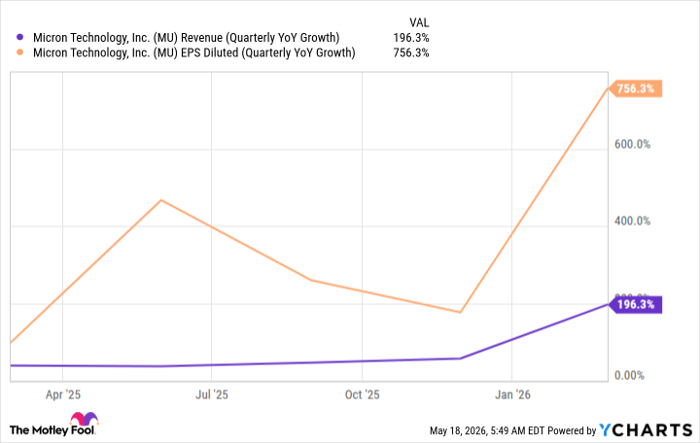
MU Revenue (Quarterly YoY Growth) data by YCharts
The memory chip shortage is likely to continue for some time, as it will take a few years for more production capacity to come online. Furthermore, Micron expects AI memory chip demand to essentially triple from 2025 to 2028. So, just because Micron and its peers plan to add new production facilities over the next few years, that doesn't mean that the capacity crisis will be solved that quickly. As such, we can expect Micron's revenue and profits to remain elevated for some time, which should in turn push its stock price higher.
I wouldn't be surprised to see Micron announce a stock split in the next year or so, especially if it continues rising. That makes the stock a better buy from a business standpoint, but if a stock split happens, the potential short-term boost to its share price that frequently follows such announcements could be a nice cherry on top, too.
Should you buy stock in Micron Technology right now?
Before you buy stock in Micron Technology, consider this:
The Motley Fool Stock Advisor analyst team just identified what they believe are the 10 best stocks for investors to buy now… and Micron Technology wasn’t one of them. The 10 stocks that made the cut could produce monster returns in the coming years.
Consider when Netflix made this list on December 17, 2004... if you invested $1,000 at the time of our recommendation, you’d have $475,063!* Or when Nvidia made this list on April 15, 2005... if you invested $1,000 at the time of our recommendation, you’d have $1,369,991!*
Now, it’s worth noting Stock Advisor’s total average return is 996% — a market-crushing outperformance compared to 208% for the S&P 500. Don't miss the latest top 10 list, available with Stock Advisor, and join an investing community built by individual investors for individual investors.
See the 10 stocks »
*Stock Advisor returns as of May 21, 2026.
Keithen Drury has no position in any of the stocks mentioned. The Motley Fool has positions in and recommends Micron Technology. The Motley Fool has a disclosure policy.
Recommended Articles


