


Rivian's Robotics Company Is Now Worth More Than $3 Billion. Investors Could Benefit in 2 Important Ways.
Key Points
After its latest investment round, Rivian's robotics company is now worth more than $3 billion.
Robotics should help Rivian improve its manufacturing, and it plans to sell robots to other companies.
Rivian is playing the long game in industrial robotics, a market that could be worth $70 billion by 2030.
- 10 stocks we like better than Rivian Automotive ›
Rivian Automotive (NASDAQ: RIVN) spun out its robotics arm, Mind Robotics, into a full-fledged company last year. Since then, the company has had several investment rounds, the latest of which raised $400 million.
That investment comes just two months after Mind Robotics raised $500 million, making it now worth $3.4 billion. That's a pretty impressive achievement for an EV start-up to launch a robotics company that quickly becomes its own unicorn.
Will AI create the world's first trillionaire? Our team just released a report on the one little-known company, called an "Indispensable Monopoly" providing the critical technology Nvidia and Intel both need. Continue »
And it could get even better. Rivian plans to use Mind's robotics systems to improve manufacturing efficiency and become more competitive, and eventually sell these systems to other industrial companies. Both of those plans could become important opportunities for Rivian's future.
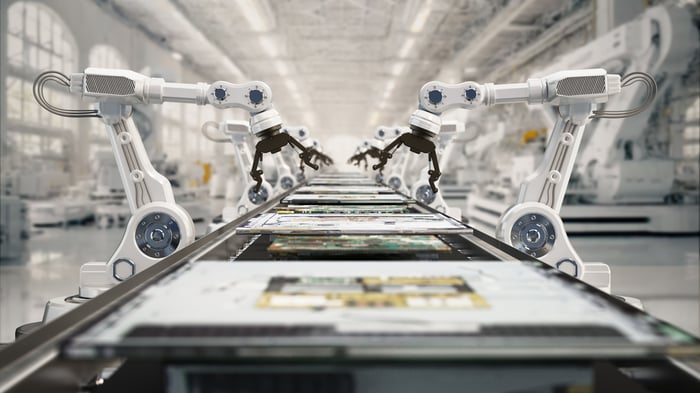
Image source: Getty Images.
Rivian could scale manufacturing more efficiently
One of the biggest hurdles for automotive start-ups is scaling manufacturing at the right pace to match vehicle production demand with high production costs. Rivian has already made plenty of efficiency gains by reducing the number of parts in its vehicles, cutting down its wiring harness sizes, and leveraging economies of scale by sharing parts across its growing model lineup.
But the company believes it can do even more with robotics. Rivian CEO RJ Scaringe has said that Mind's robots could help the company lower its cost of goods by making manufacturing cheaper and solving some labor shortages. Scaringe said in a press release earlier this year:
Advanced robotics are going to be critical for global competitiveness, as well as addressing the substantial industrial labor shortages that exist today. We're building robots that will perform real tasks, in real plants, at real scale.
Electric vehicles are especially costly to produce, and Rivian and its competitors understand that the long-term viability of the EV market depends on manufacturing costs coming down and electric vehicle prices being more in line with those of gas-powered counterparts.
Rivian is acting as the first customer for Mind Robotics, allowing its robots to be used in practical ways, learn from mistakes, and improve in a real-world environment. As they get smarter, Rivian's efficiency will improve, which could eventually trickle down to its margins.
Rivian has posted several quarters of narrow gross margins lately, but is still burning through cash to grow its EV business. Many automakers have felt the squeeze from tariffs, rising inflation, and the Trump administration's early cancellation of EV tax credits.
It might take a while for Mind's robots to add noticeable benefits to Rivian's finances, but the company is preparing its robots now for wider production capabilities later.
Rivian plans to commercialize its robotics company
In addition to making manufacturing more efficient at Rivian, the company plans to commercialize Mind Robotics by selling robots and systems to other industrial companies. To achieve this, it's developing generalized robots for manufacturing use cases, some of which may not even be automotive. It's also worth mentioning that these aren't humanoid robots, so they're not competing with other major robotics players like Tesla.
The potential benefit for Rivian -- and its investors -- is that the company owns about 38% of Mind Robotics. That's a significant portion of the company, and any valuation increases, sale of the company, or even a future IPO could significantly benefit Rivian. What's more, robotics is a very nascent technology poised for rapid acceleration in the coming years. Some estimates put the global industrial robotics industry at a projected $70 billion by 2030.
Mind says it's building an artificial intelligence foundation, including models, hardware, and infrastructure, to make its industrial robots better than existing ones. Artificial intelligence is making robots smarter than ever, and Scaringe believes Mind can utilize this evolving technology to improve the company's robots, too. "As AI enters the physical world, we believe the largest, at-scale application for advanced robotics will be across the industrial sector," he said.
Admittedly, Rivian investors will need to play the long game with this potential robotics angle. But with EVs already taking longer to gain widespread adoption than previously expected, it's probably not too much of an ask for Rivian shareholders to wait and see how this plays out.
Should you buy stock in Rivian Automotive right now?
Before you buy stock in Rivian Automotive, consider this:
The Motley Fool Stock Advisor analyst team just identified what they believe are the 10 best stocks for investors to buy now… and Rivian Automotive wasn’t one of them. The 10 stocks that made the cut could produce monster returns in the coming years.
Consider when Netflix made this list on December 17, 2004... if you invested $1,000 at the time of our recommendation, you’d have $469,293!* Or when Nvidia made this list on April 15, 2005... if you invested $1,000 at the time of our recommendation, you’d have $1,381,332!*
Now, it’s worth noting Stock Advisor’s total average return is 993% — a market-crushing outperformance compared to 207% for the S&P 500. Don't miss the latest top 10 list, available with Stock Advisor, and join an investing community built by individual investors for individual investors.
See the 10 stocks »
*Stock Advisor returns as of May 18, 2026.
Chris Neiger has positions in Rivian Automotive. The Motley Fool has positions in and recommends Tesla. The Motley Fool has a disclosure policy.
Recommended Articles


