


Wall Street Is Nervous. Here's What 100 Years of History Says Happens to the S&P 500 Now.
Key Points
The S&P 500 notched its seventh week of consecutive gains.
Enthusiasm over artificial intelligence is in a tug-of-war with economic concerns, causing jitters in the overall market.
- 10 stocks we like better than iShares Core S&P 500 ETF ›
Depending on who you talked to, and on what day you talked to them, the stock market last week (the week starting on May 11) was either euphorically uplifting, or concernedly jittery.
Indeed, despite a sharp 1.2% pullback on Friday, May 15, the iShares Core S&P 500 ETF (NYSEMKT: IVV) managed to squeeze out a modest 0.1% gain for the week. That tiny gain says nothing, however, of the multiple mid-week record-breaking highs driven in large part by renewed chipmaker fervor and the impressive double-digit market gain of market-debuting Cerebras Systems.
Will AI create the world's first trillionaire? Our team just released a report on the one little-known company, called an "Indispensable Monopoly" providing the critical technology Nvidia and Intel both need. Continue »
The juggernaut of enthusiasm -- however invincible it seemed on Thursday -- was blindsided by spiking bond yields on Thursday night. This rattled the market over fears of worsening inflation, and triggered a tech sell-off that sent all three major stock market indexes down over 1%.

Image source: Getty Images.
Up close, this jumpy swing may seem puzzling. But from a distance, it really isn't. The world continues changing day by day -- wars in the Middle East, artificial intelligence (AI) -- and fast change over short periods isn't good for the nervous system.
History is pretty clear on what happens when the market is especially jittery. Take the S&P 500 Shiller CAPE index, for example. This valuation metric divides an index's price by the last 10 years of earnings, offering a clear-sighted view of the stock market's current valuation. If the last 100 years of history say anything, it's that the stock market might be setting itself up for a setback.
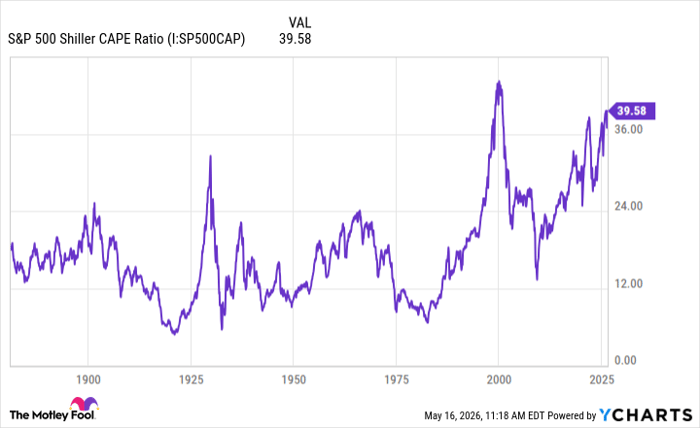
Data by YCharts.
A CAPE ratio of 39.5 isn't the highest the S&P 500 index has ever hit. Veteran investors will remember when this metric hit nearly 45 during the dot-com era -- just before the bubble popped.
Does that mean the stock market will crush records like it's 2000 all over again? Not necessarily. These are different times, and the market is being driven by different factors. But the gap between fundamentals and valuation is getting wider. That means today's winners will need to be those who can outlast temporary hype to deliver long-term value.
Should you buy stock in iShares Core S&P 500 ETF right now?
Before you buy stock in iShares Core S&P 500 ETF, consider this:
The Motley Fool Stock Advisor analyst team just identified what they believe are the 10 best stocks for investors to buy now… and iShares Core S&P 500 ETF wasn’t one of them. The 10 stocks that made the cut could produce monster returns in the coming years.
Consider when Netflix made this list on December 17, 2004... if you invested $1,000 at the time of our recommendation, you’d have $469,293!* Or when Nvidia made this list on April 15, 2005... if you invested $1,000 at the time of our recommendation, you’d have $1,381,332!*
Now, it’s worth noting Stock Advisor’s total average return is 993% — a market-crushing outperformance compared to 207% for the S&P 500. Don't miss the latest top 10 list, available with Stock Advisor, and join an investing community built by individual investors for individual investors.
See the 10 stocks »
*Stock Advisor returns as of May 18, 2026.
Steven Porrello has positions in iShares Core S&P 500 ETF. The Motley Fool has no position in any of the stocks mentioned. The Motley Fool has a disclosure policy.
Recommended Articles


