


The Fed Has a New Boss, Inflation Is at a 3-Year High, and Rate Cuts Look Unlikely. These Stocks Win in That Environment.
Key Points
Energy stocks often rise in inflationary environments.
Financial firms benefit from higher interest rates.
REITs can pass higher costs on to customers.
- 10 stocks we like better than Select Sector SPDR Trust - State Street Energy Select Sector SPDR ETF ›
How quickly the investing environment can change.
Just a few months ago, markets were expecting the Federal Reserve to cut its benchmark interest rate two or even three times by the end of 2026.
Will AI create the world's first trillionaire? Our team just released a report on the one little-known company, called an "Indispensable Monopoly" providing the critical technology Nvidia and Intel both need. Continue »
Suddenly, that thinking seems very dated, and today investors face an entirely different reality.
First, of course, the Fed has a new boss. Kevin Warsh was confirmed by the Senate last week and will be sworn in as the 17th Federal Reserve Chair sometime this week.
There's some uncertainty around what Warsh will do differently from his predecessor, Jerome Powell. The new Fed chief talked about cutting rates in recent months, but rising inflation now makes rate cuts seem highly unlikely.
Inflation hit a three-year high of 3.8% in April, mostly due to the oil shock triggered by the war with Iran. Energy costs jumped almost 18% year over year.
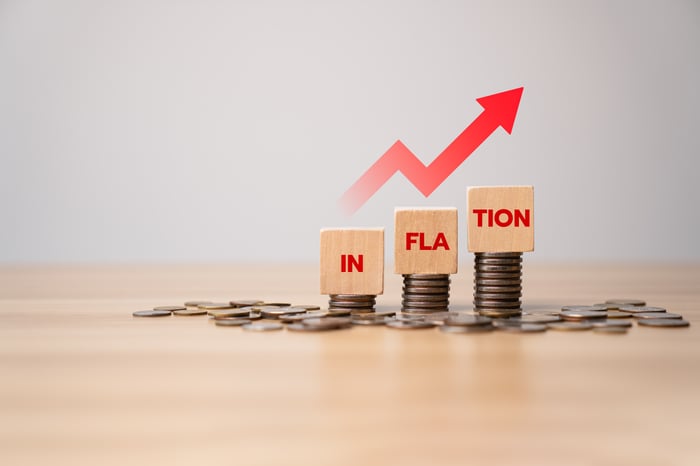
Image source: Getty Images.
As a result, futures traders are now pricing in a 26% chance that the Fed's next policy move is a rate hike, not a cut, and a 74% chance that the Fed remains on hold through year-end -- no rate hike or cut. The bond market also expects a hawkish pivot from the Fed.
It's a jarring new reality for investors who just months ago expected the Fed to begin cutting rates in the coming months.
Some sectors and stocks flourish in rising inflation and rate environments
Fortunately, some sectors and stocks do well in an environment of rising inflation and potentially higher interest rates.
Oil and gas companies are among them. Energy is a major component of inflation indexes (again, it's the primary driver of inflation today), and energy stocks tend to perform well when energy prices are higher.
The State Street Energy Select Sector SPDR ETF (NYSEMKT: XLE), which tracks the entire S&P 500 energy sector, is up 34% year to date (for comparison, the S&P 500 index has climbed about 8.2% this year).
Financial institutions like banks and insurance companies benefit when the Fed raises rates because they can charge higher interest on loans and improve their net interest margins, the difference between the rate they borrow money at and the rate they lend at.
That sector, as measured by the State Street Financial Select Sector SPDR ETF (NYSEMKT: XLF), is down for the year, but its largest holdings, including Berkshire Hathaway (NYSE: BRKB) and JPMorgan Chase (NYSE: JPM), could do well in a high-inflation, rising-rate landscape.
Finally, real estate has always been a smart inflation hedge. Real estate investment trusts (REITs) tend to outperform inflation and post strong returns during periods of rising prices because they're able to pass price increases on to customers via increases in rental contracts and property prices.
There are hundreds of publicly traded REITs, but you can also invest in an index fund such as Vanguard Real Estate ETF (NYSEMKT: VNQ).
If inflation continues to rise and futures and bond markets are correct that the Fed's next move is a hike, energy, financials, and real estate may be the best bets to protect your portfolio.
Should you buy stock in Select Sector SPDR Trust - State Street Energy Select Sector SPDR ETF right now?
Before you buy stock in Select Sector SPDR Trust - State Street Energy Select Sector SPDR ETF, consider this:
The Motley Fool Stock Advisor analyst team just identified what they believe are the 10 best stocks for investors to buy now… and Select Sector SPDR Trust - State Street Energy Select Sector SPDR ETF wasn’t one of them. The 10 stocks that made the cut could produce monster returns in the coming years.
Consider when Netflix made this list on December 17, 2004... if you invested $1,000 at the time of our recommendation, you’d have $469,293!* Or when Nvidia made this list on April 15, 2005... if you invested $1,000 at the time of our recommendation, you’d have $1,381,332!*
Now, it’s worth noting Stock Advisor’s total average return is 993% — a market-crushing outperformance compared to 207% for the S&P 500. Don't miss the latest top 10 list, available with Stock Advisor, and join an investing community built by individual investors for individual investors.
See the 10 stocks »
*Stock Advisor returns as of May 18, 2026.
JPMorgan Chase is an advertising partner of Motley Fool Money. Matthew Benjamin has positions in Berkshire Hathaway and Select Sector SPDR Trust-State Street Energy Select Sector SPDR ETF. The Motley Fool has positions in and recommends Berkshire Hathaway and JPMorgan Chase. The Motley Fool has a disclosure policy.
Recommended Articles


