


Why Would Anyone Buy SPYM Instead of QQQ?
Key Points
The Invesco QQQ ETF has mostly outperformed the S&P 500 index, but tech stocks can be riskier and more volatile.
The Nasdaq-100 suffered a "lost decade" after the dot-com bust in 2000.
The State Street SPDR Portfolio S&P 500 ETF offers an ultra-low expense ratio and has delivered 15.25% annualized returns for the past 10 years.
- These 10 stocks could mint the next wave of millionaires ›
If you've been following the stock market for the past few years, you might assume that tech stocks are always the best place to put your money. Tech stocks always outperform the S&P 500 index, right?
The reality is complicated. It's true that the tech-heavy Nasdaq-100 index, which includes America's most well-known tech companies, has outperformed the S&P 500 for the past 15 years. As of June 30, 2025, the Invesco QQQ ETF (NASDAQ: QQQ), which tracks the Nasdaq-100, had beaten the S&P 500 in seven of the previous 10 years.
Will AI create the world's first trillionaire? Our team just released a report on the one little-known company, called an "Indispensable Monopoly" providing the critical technology Nvidia and Intel both need. Continue »
But past performance doesn't guarantee future results. Loading up on tech stocks isn't the right move for every investor. Many long-term investors might be better off buying an S&P 500 index fund like the State Street SPDR Portfolio S&P 500 ETF (NYSEMKT: SPYM) instead of putting too many eggs in a tech-heavy basket.
Let's look at each of these stock exchange-traded funds (ETFs) and see which could be the right choice for your portfolio.

Image source: Getty Images.
QQQ: World-beating performance -- but for how long?
The Invesco QQQ ETF, informally known as "the Qs," is a massive, popular growth stock fund with more than $472 billion of assets under management. It holds 102 stocks, including some of the biggest names in tech and artificial intelligence (AI). During the past 10 years, the Invesco QQQ ETF has delivered average annual returns (by net asset value) of 18.98%.
As of April 29, this fund had delivered a 10-year cumulative return of 578.64%. That means if you had invested $10,000 in QQQ 10 years ago, your investment would be worth $67,864 today.
Technology holdings make up almost 64% of the Invesco QQQ ETF. Its top five holdings are:
- Nvidia (9.03% of the fund)
- Alphabet (7.4% -- including Class A and Class C shares)
- Apple (7.2%)
- Microsoft (4.95%)
- Amazon (4.8%)
Those top five tech leaders make up about 33% of the fund. But the Qs aren't just about tech companies. This fund also includes household names, like Walmart (2.9% of the fund), Costco (2.1%), Netflix (1.7%), and PepsiCo (0.93%).
Spectacular fortunes have been made by investing in tech stocks. Buying the Invesco QQQ ETF can put the biggest names in tech in your portfolio at a low expense ratio of 0.18%. Why would anyone ever want to buy anything else? Buying an S&P 500 index ETF instead of the Qs might feel like you're leaving money on the table.
But it's important to remember that tech stocks don't always go up, and they don't always beat the rest of the stock market.
SPYM: 10 years of 15.25% annualized returns
Sometimes tech stocks crash hard and stay down for years. Putting too much money into the Invesco QQQ ETF might mean that you're risking too much of your money on just a few companies' future results.
After the dot-com bubble burst in 2000, the Nasdaq-100 had a "lost decade." It took the Qs more than 10 years to recover their losses, and the S&P 500 often outperformed the tech-heavy fund during 2000-2015:
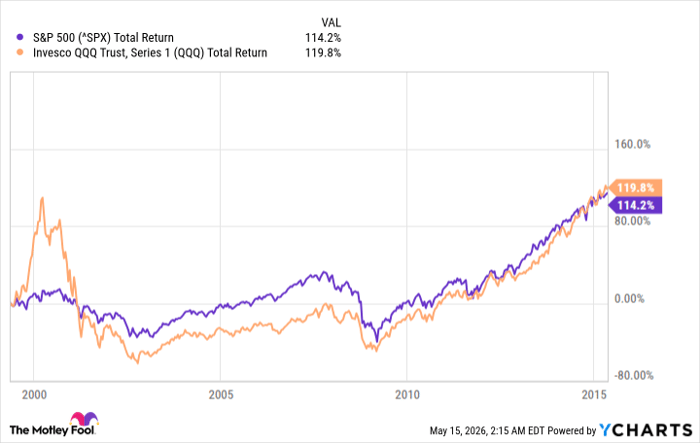
^SPX data by YCharts
Could a dot-com-style bust happen again? Some investors are worried about how many hundreds of billions of dollars are being spent on AI. If the AI hype doesn't pan out, today's tech investors could be left holding the bag for a 2000-style downturn in the Nasdaq-100.
Buying the State Street SPDR Portfolio S&P 500 ETF can be a defensive move if you want to diversify away from tech stocks. This is a low-cost index fund (expense ratio of 0.02%) that tracks the S&P 500. For the past 10 years, it's delivered average annual returns (by net asset value) of 15.25%, which is less than the Qs, but still an impressive return on investment.
One criticism of S&P 500 index funds in recent years is that they've become too top-heavy with tech stocks. It's true that as of May 13, the top 10 holdings in SPYM are all tech stocks. And the same five tech companies that make up the top five holdings of the Qs are also the top five holdings for this S&P 500 tracker fund.
But SPYM is less tech-heavy than the Invesco QQQ ETF. This S&P 500 ETF consists of 37.1% information technology stocks, 11.4% financials, 10.9% communication services, 9.8% consumer discretionary, 8.5% industrials, and other sectors.
Buying SPYM instead of QQQ gives you exposure to a wider range of the U.S. economy beyond the most prominent tech companies. In case investors rotate out of tech, they might move money into other stocks within the S&P 500. Owning an S&P 500 index fund can help you benefit from this kind of background rebalancing that goes on within the stock market.
Why buy SPYM instead of QQQ
If you believe that the AI boom is here to stay, that today's tech stocks are not overvalued, and that U.S. tech companies are going to keep growing and profiting at world-beating levels for years to come, then buying the Invesco QQQ ETF could be the right move.
But if you want more diversification, if you're worried that AI is overhyped and that today's tech stocks are overvalued, then you might want to buy the State Street SPDR Portfolio S&P 500 ETF instead. Buying the S&P 500 instead of the Qs won't protect you from every risk. But it might reduce the volatility in your portfolio while delivering strong long-term growth.
Where to invest $1,000 right now
When our analyst team has a stock tip, it can pay to listen. After all, Stock Advisor’s total average return is 993%* — a market-crushing outperformance compared to 207% for the S&P 500.
They just revealed what they believe are the 10 best stocks for investors to buy right now, available when you join Stock Advisor.
See the stocks »
*Stock Advisor returns as of May 17, 2026.
Ben Gran has no position in any of the stocks mentioned. The Motley Fool has positions in and recommends Alphabet, Amazon, Apple, Costco Wholesale, Microsoft, Netflix, Nvidia, and Walmart. The Motley Fool has a disclosure policy.
Recommended Articles


