


Cerebras IPO: Here's What a $5,000 Investment Could Look Like in 5 Years
Key Points
Cerebras is an artificial intelligence (AI) chip designer that competes with Nvidia.
The company is seeking to raise $4.8 billion in its IPO.
While investing in IPOs seems exciting, history offers some telling clues as to whether following early momentum is worth it.
- 10 stocks we like better than Palantir Technologies ›
The artificial intelligence (AI) infrastructure race has produced no shortage of headline-grabbing companies. With its initial public offering (IPO) set for May 14, Cerebras may be the most closely followed infrastructure name at the moment. The chipmaker is known for its Wafer-Scale Engine (WSE) -- a single chip designed to handle the computational demands of large language models (LLMs) more efficiently than clusters of traditional GPUs.
This capability has caught the attention of leading AI powerhouses OpenAI and Amazon Web Services (AWS). Back in January, OpenAI signed a multiyear, $10 billion deal with Cerebras to purchase 750 megawatts of compute capacity. More recently, the ChatGPT developer doubled down on this relationship by agreeing to purchase $20 billion worth of the company's chips. Meanwhile, AWS agreed to deploy Cerebras' CS-3 system and Elastic Fabric Adapter (EFA) networking on Amazon Bedrock.
Will AI create the world's first trillionaire? Our team just released a report on the one little-known company, called an "Indispensable Monopoly" providing the critical technology Nvidia and Intel both need. Continue »
With these wins so close to its public debut, Cerebras' IPO price range has increased to $150 to $160 per share -- meaningfully higher than its initial band of $115 to $125. At the high end of this range, Cerebras would be valued at roughly $49 billion, more than double its valuation in its most recent funding round in February.
Smart investors are wondering whether this premium will hold in the coming years. Let's take a look at some recent high-profile technology IPOs to determine whether you should invest in the Cerebras IPO this week.
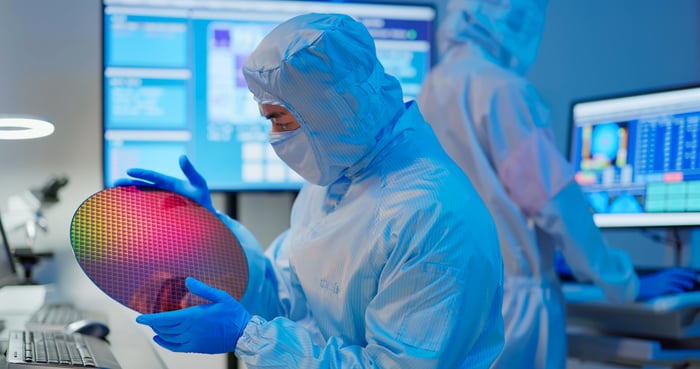
Image source: Getty Images.
How do IPOs actually work?
When a company goes public, the IPO price is set through a process called book building, during which underwriters (investment banks) gauge institutional demand and price shares accordingly. Retail investors rarely have access to IPO shares at this stage. By the time an IPO stock begins trading on the open market, momentum investors, hedge funds, and media coverage have typically pushed the stock above its offering price.
While these pops can feel like validation, they are usually a mirage of manufactured excitement rather than a genuine assessment of a company's intrinsic value. Moreover, the stock float at the IPO date is usually pretty small. This means only a modest amount of buying activity can send shares soaring.
IPO case studies: Palantir and Snowflake
Palantir Technologies (NASDAQ: PLTR) and Snowflake (NYSE: SNOW) both went public in 2020.
Palantir debuted through a direct listing, with shares opening near $10. Wall Street initially treated Palantir with skepticism. In the eyes of most analysts, Palantir was a government contractor with a slow-growing commercial segment and persistent operating losses.
After launching its Artificial Intelligence Platform (AIP) in early 2023, Palantir was able to reinvent itself as an operating system for large corporate enterprises and government agencies. This pivot proved transformational, as shares have now climbed roughly 1,270% from their IPO price over the last five years or so.
Meanwhile, Snowflake tells the complete opposite story. Priced at $120 per share, shares closed at $254 on their first day of trading. By late 2021, Snowflake stock had peaked near $402.
Rising interest rates in 2022 negatively impacted growth stocks trading at premium valuations. Snowflake, which had been trading at a price-to-sales (P/S) multiple of over 200, was hit hard. While the business continued growing, the company's valuation profile was totally reset.
Today, Snowflake stock trades around $154 -- meaning investors who bought shares near its first-day close are still sitting on a loss nearly five years later.
Where could Cerebras be trading in five years?
The tension at the heart of high-profile IPOs is that the story is often real, but the premium embedded in the opening day price already reflects outsize levels of optimism. Investors who follow momentum-driven pops are paying not for where the business truly is today, but for what the market imagines it could become under bullish conditions. And investors often forget that lock-ups expire, triggering waves of selling from insiders and employees.
Cerebras enters the public markets carrying specific risks that smart investors are paying close attention to. Among the most glaring is customer concentration. Almost 90% of Cerebras' revenue stems from two customers. If the relationships with OpenAI or AWS deteriorate for any reason, the company's revenue trajectory essentially goes back to where it is today.
The current valuation profile also prices Cerebras to perfection. At about 95x 2025 sales, there is no margin for error. Meanwhile, the competitive landscape is packed. Nvidia's and AMD's entrenched positions in GPUs and AI accelerators, combined with custom silicon efforts from Broadcom, mean Cerebras will need to justify why its architectural advantage is durable.
A $5,000 investment in the Cerebras IPO could look like Palantir -- a rough early stretch followed by a multibagger return if the company makes AI infrastructure indispensable to the hyperscalers. However, it could just as easily look like Snowflake -- a jaw-dropping opening followed by years of valuation de-rating as the business grows but never quite matches what investors initially paid.
Investing in the Cerebras IPO at its current price assumes paying a premium, arguably before it should exist. That could be a bet worth taking, but only for investors who can tolerate volatility and uncertainty.
Should you buy stock in Palantir Technologies right now?
Before you buy stock in Palantir Technologies, consider this:
The Motley Fool Stock Advisor analyst team just identified what they believe are the 10 best stocks for investors to buy now… and Palantir Technologies wasn’t one of them. The 10 stocks that made the cut could produce monster returns in the coming years.
Consider when Netflix made this list on December 17, 2004... if you invested $1,000 at the time of our recommendation, you’d have $472,744!* Or when Nvidia made this list on April 15, 2005... if you invested $1,000 at the time of our recommendation, you’d have $1,353,500!*
Now, it’s worth noting Stock Advisor’s total average return is 991% — a market-crushing outperformance compared to 207% for the S&P 500. Don't miss the latest top 10 list, available with Stock Advisor, and join an investing community built by individual investors for individual investors.
See the 10 stocks »
*Stock Advisor returns as of May 13, 2026.
Adam Spatacco has positions in Amazon, Nvidia, and Palantir Technologies. The Motley Fool has positions in and recommends Advanced Micro Devices, Amazon, Broadcom, Nvidia, Palantir Technologies, and Snowflake. The Motley Fool has a disclosure policy.
Recommended Articles


