


Wall Street's Next Blockbuster Stock Split Has Arrived -- and This Industry Leader Has Soared Over 10,000% in Less Than 4 Years
Key Points
Investors have gravitated to companies announcing and completing forward stock splits.
An industry-leading company that's handily outpacing its peers in the growth department just completed its first-ever stock split.
Despite record net income last year for Wall Street's newest stock-split stock, valuation and loan quality concerns persist.
- 10 stocks we like better than Carvana ›
Although the rise of artificial intelligence has hogged the spotlight for years, it's not the only trend responsible for lifting the tide on Wall Street. Companies enacting forward stock splits are also drawing a crowd and exciting investors.
The first blockbuster stock split of the year occurred five weeks ago, when online travel giant Booking Holdings completed its first-ever forward split (25-for-1). This was followed by five Vanguard exchange-traded funds (ETFs) taking the plunge on April 21. Now, it's online used-car retailer Carvana's (NYSE: CVNA) turn to take center stage.
Will AI create the world's first trillionaire? Our team just released a report on the one little-known company, called an "Indispensable Monopoly" providing the critical technology Nvidia and Intel both need. Continue »
Image source: Getty Images.
Wall Street's next blockbuster stock split is here
On Dec. 27, 2022, Carvana shares closed at an all-time low of $3.72, with years of persistent losses and a sizable debt load seemingly portending disaster. Roughly 3.5 years later, Carvana is trading at $379 per share, representing a gain of 10,091%! Perhaps it's no surprise that its board of directors announced the company's first-ever forward split (5-for-1) on March 13, which goes into effect before the start of trading today, May 7.
Carvana's board stated that this historic stock split is aimed at "keeping our stock accessible to all of our team members." But it'll also make the company's shares more nominally affordable for retail investors who lack access to fractional-share purchases through their broker. Once effected, Carvana's 5-for-1 forward split will lower its share price to around $76 (based on its closing price on May 5).
Carvana's five-figure rally appears to be a function of three factors:
- Outsize growth: Whereas chief used-car rival CarMax is growing its annual sales by low single digits, Carvana delivered 49% sales growth last year on the heels of a 43% increase in vehicles sold.
- A decisive shift to recurring profitability: Investors have also rewarded the company for its record net income of nearly $1.9 billion last year, which was aided by a significant tax benefit against prior losses.
- Historically high short interest: Lastly, Carvana was a prime target for short-sellers in late 2022 and throughout 2023. As Carvana shares rose, it prompted short-sellers to buy shares in order to cover their losing positions.
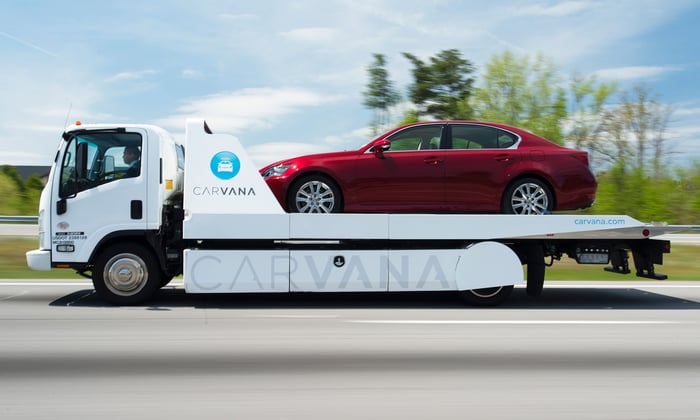
Image source: Carvana.
Headed for a breakdown?
While a greater-than-10,000% gain makes clear that used-car buyers and investors appreciate its online-based approach, this doesn't make Carvana a slam-dunk buy.
For instance, even with its outsize sales and profit growth, Carvana may struggle to justify its significant valuation premium. Investors are currently paying 50 times estimated 2026 earnings and 37 times forecast earnings per share for 2027. If Wall Street's historically expensive stock market rolls over, companies with exorbitant valuation premiums, like Carvana, are often among the hardest hit.
Additionally, Carvana has historically targeted subprime and non-prime borrowers. Buyers with less-than-stellar credit are hit with higher loan rates, but there's also a heightened risk of the borrower defaulting on their loan.
In January 2026, subprime borrowers who were at least 60 days behind on their auto loans jumped to a record 6.9%! In other words, Carvana's auto loan portfolio might be a minefield that's waiting to explode.
Should you buy stock in Carvana right now?
Before you buy stock in Carvana, consider this:
The Motley Fool Stock Advisor analyst team just identified what they believe are the 10 best stocks for investors to buy now… and Carvana wasn’t one of them. The 10 stocks that made the cut could produce monster returns in the coming years.
Consider when Netflix made this list on December 17, 2004... if you invested $1,000 at the time of our recommendation, you’d have $473,985!* Or when Nvidia made this list on April 15, 2005... if you invested $1,000 at the time of our recommendation, you’d have $1,204,650!*
Now, it’s worth noting Stock Advisor’s total average return is 950% — a market-crushing outperformance compared to 203% for the S&P 500. Don't miss the latest top 10 list, available with Stock Advisor, and join an investing community built by individual investors for individual investors.
See the 10 stocks »
*Stock Advisor returns as of May 7, 2026.
Sean Williams has no position in any of the stocks mentioned. The Motley Fool has positions in and recommends Booking Holdings and CarMax. The Motley Fool has a disclosure policy.
Recommended Articles


