


Prediction: This Artificial Intelligence (AI) Growth Stock Will Be the Nasdaq's Biggest Winner Over the Next 12 Months
Key Points
Some of the biggest casualties of the Nasdaq correction were artificial intelligence (AI) chip stocks.
Micron's parabolic rise came to a screeching halt, but the company is well positioned for a rebound.
Demand for high-bandwidth memory (HBM), DRAM, and NAND chips provides Micron with compelling secular growth tailwinds.
- 10 stocks we like better than Micron Technology ›
Picking the next multibagger is never easy. But when it comes to artificial intelligence (AI) stocks, one company stands out as my top choice over the next 12 months: Micron Technology (NASDAQ: MU).
While many AI chip stocks have already witnessed big runs, I think Micron still carries meaningful upside in the near term. Next-generation AI systems are hungry for more memory than most investors realize, and Micron is uniquely positioned as a key supplier. In parallel, the company's legacy businesses covering phones, PCs, and data storage are recovering nicely.
Will AI create the world's first trillionaire? Our team just released a report on the one little-known company, called an "Indispensable Monopoly" providing the critical technology Nvidia and Intel both need. Continue »
If Micron delivers on its revenue and earnings expectations, the stock could gravitate toward the top performers on the Nasdaq. With that said, smart investors are considering the dynamics of memory chip businesses, which have a complicated history of cyclical swings.
I'll break down both sides of the story, detailing why Micron could come out on top or how it might fall short over the next year.

Image source: Micron Technology.
Accelerating AI infrastructure investment is fueling explosive demand for DRAM and NAND chips
Today's AI models can generate text, images, and even video. While much progress has been made in model intelligence, some investors overlook that these products require enormous volumes of low-latency, high-capacity memory to train and deploy.
Micron specializes in high-bandwidth memory (HBM), which stacks tiny chips to move data across graphic processing unit (GPU) clusters at lightning speed. AI hyperscalers such as Microsoft, Alphabet, Amazon, and Meta Platforms are ordering more of these memory solutions than they were previously, as each company doubles down on its data center build-outs.
What makes this current memory cycle different from the past is how swiftly the need for HBM is growing. When the AI revolution kicked off at the end of 2022, memory comprised only a small fraction of the cost of an AI server. Now, the HBM market is expected to triple -- eclipsing $100 billion by 2028 -- as AI becomes more ubiquitous.
At the same time, Micron's legacy businesses -- supplying chips for non-AI devices -- are turning around after a lackluster couple of years, thanks to consumer refresh trends.
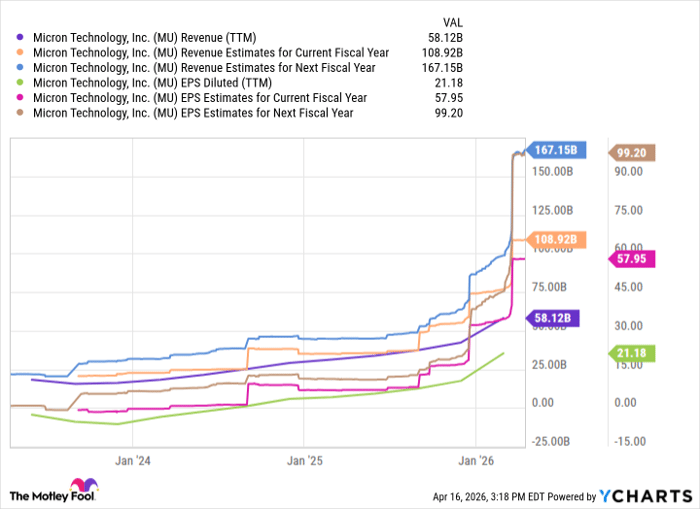
MU Revenue (TTM) data by YCharts.
If Micron can keep its machine running smoothly and sell its memory chips at premium prices, the company's sales and profits could easily increase materially over the next year. Because many of its costs are already covered thanks to sold-out inventory, a good portion of this revenue should flow straight to the bottom line.
Micron's strategic capital allocation creates structural advantages
On the money side of the equation, Micron has worked to clean up its balance sheet. The company now generates steady cash flow, easing the need to borrow heavily or issue new shares to fund growth. This financial flexibility allows Micron to keep investing in new manufacturing capabilities without worrying about short-term supply hiccups.
Micron's marquee customers include the biggest names in tech, including none other than Nvidia. That's on top of steady consumer buyers in automotive, manufacturing, and consumer electronics. This customer mix provides a cushion if any singular area begins to plateau.
Investors should be vigilant of industry cycles, competition, and economic headwinds
No prediction is foolproof, and I'd be remiss to not acknowledge the risks facing Micron. The memory chip industry has always been cyclical -- meaning it goes through pronounced ups and downs like the housing market. Right now, rising capital expenditures (capex) from big tech have ignited something of a supercycle in the AI memory chip market.
While that sounds great on the surface, there is a downside: If too many competitors rush to build new factories, supply could catch up with demand, driving prices lower as DRAM and NAND become commoditized.
Samsung and SK Hynix, Micron's biggest rivals, are also expanding their advanced memory output. Any delay in Micron's own production could erode its margins. On the demand side, pullbacks in AI infrastructure budgets could emerge if a broader economic slowdown or an interest rate hike materializes.
Lastly, if Wall Street prices in too much optimism, even the perception of one disappointing quarter could cause Micron stock to reverse sharply.
Micron's path to the top of the Nasdaq over the next 12 months is exciting, but it's far from a lock. The combination of surging AI memory needs, a recovering broader tech market, and the company's operational improvements gives it a real chance to generate outsized gains.
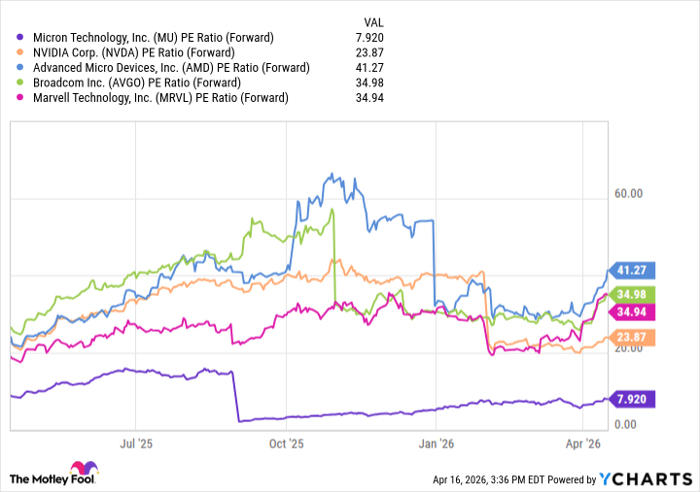
MU PE Ratio (Forward) data by YCharts.
With that said, smart investors understand that the memory industry's boom-and-bust nature and lingering macro uncertainties mean you need to stay grounded. For investors new to growth stocks, Micron offers a compelling bet on the future of AI without the sky-high valuations seen elsewhere. Only time will tell if a position in Micron today pays off in the biggest way down the road.
Should you buy stock in Micron Technology right now?
Before you buy stock in Micron Technology, consider this:
The Motley Fool Stock Advisor analyst team just identified what they believe are the 10 best stocks for investors to buy now… and Micron Technology wasn’t one of them. The 10 stocks that made the cut could produce monster returns in the coming years.
Consider when Netflix made this list on December 17, 2004... if you invested $1,000 at the time of our recommendation, you’d have $524,786!* Or when Nvidia made this list on April 15, 2005... if you invested $1,000 at the time of our recommendation, you’d have $1,236,406!*
Now, it’s worth noting Stock Advisor’s total average return is 994% — a market-crushing outperformance compared to 199% for the S&P 500. Don't miss the latest top 10 list, available with Stock Advisor, and join an investing community built by individual investors for individual investors.
See the 10 stocks »
*Stock Advisor returns as of April 20, 2026.
Adam Spatacco has positions in Alphabet, Amazon, Meta Platforms, Microsoft, and Nvidia. The Motley Fool has positions in and recommends Advanced Micro Devices, Alphabet, Amazon, Broadcom, Marvell Technology, Meta Platforms, Micron Technology, Microsoft, and Nvidia. The Motley Fool has a disclosure policy.
Recommended Articles


