


Michael Burry of "The Big Short" Fame is Betting Against This Stock That's Soared 1,400% During the AI Boom So Far -- and Thinks It Could Drop 60%. Should You Follow His Lead?
Key Points
Michael Burry correctly predicted the subprime market crash -- and his bet against the housing market delivered millions for his clients.
Today, Burry considers one AI stock in particular “wildly overvalued.”
- 10 stocks we like better than Palantir Technologies ›
Investors and movie buffs alike may recognize the name Michael Burry. The hedge fund manager bet against the U.S. housing market back in the early 2000s when most others saw this market as safe -- and, as a result, Burry made more than $700 million for his clients following the subsequent subprime market crash. A few years later, Hollywood brought the story to the general public in the movie The Big Short.
Since, retail investors look to Burry's latest moves and may be tempted to follow his lead. After all, this famous investor has proven his ability to spot trouble, take action, and score an investing win.
Will AI create the world's first trillionaire? Our team just released a report on the one little-known company, called an "Indispensable Monopoly" providing the critical technology Nvidia and Intel both need. Continue »
What's Burry been doing in recent times? He's amplified his warning that certain AI stocks are overvalued or that some of these companies could weaken due to competition. And Burry recently extended his bet against a stock that's soared 1,400% during the AI boom so far. In fact, he thinks it could drop 60% from today's price. Should you follow his lead? Let's find out.

Image source: Getty Images.
Benefiting from AI
This company has been one of the first to benefit from AI, as it offers customers a platform that allows them to quickly and easily apply this hot technology to their problems. I'm referring to Palantir Technologies (NASDAQ: PLTR), which develops software systems that help customers make better use of their data.
Palantir has been building out its systems for more than 20 years, but with the launch of large language models (LLMs), it entered the AI era. Seizing the power of LLMs, the company rolled out its Artificial Intelligence Platform (AIP) in 2023, and since that time, revenue has soared. AIP helps government and commercial customers in a wide range of ways, each time relying on the power of the given customer's data. For example, AIP can help the military anticipate problems on the battlefield, and AIP at a fast-food restaurant may optimize workflow.
But Burry isn't convinced that Palantir, despite recent valuation declines, is worth its current price. In fact, he said in a recent Substack post cited by CNBC, Palantir is "wildly overvalued," and in his view, the company's fundamental value is less than $50 per share.
Considering Palantir's closing price of $128 on April 10, that suggests Burry expects a decline of 60%.
Burry holds put options
Burry initiated his bet against Palantir with put options in the fall of last year, and in the recent Substack post, said he continues to hold these options. Put options, allowing the holder to sell a stock during a certain time frame at a predetermined price, are essentially bets that the stock will decline.
Now, the question is: Should you follow Burry and either bet against Palantir or avoid the stock? Though this famous investor was clearly right about the subprime mortgage crisis, that doesn't mean his every prediction, even when based on compelling data, will come true. It's also important to note that, even if Palantir stock falls in the near term, it could go on to advance over time. So, while a short-term investor might gain by following Burry's move, an investor who aims to hold the stock for five or 10 years may be better off holding onto Palantir -- or even buying the stock today.
Considering all of this, which move is right for you? It's important to note that Palantir has demonstrated the strengths of its commercial and government businesses in recent quarters, with revenue and contract value rising. The company is also profitable, and demand has remained solid quarter after quarter. So we haven't seen any concrete signs of a potential slowdown.
A high valuation
It's true that Palantir's valuation is high, even after recent declines.
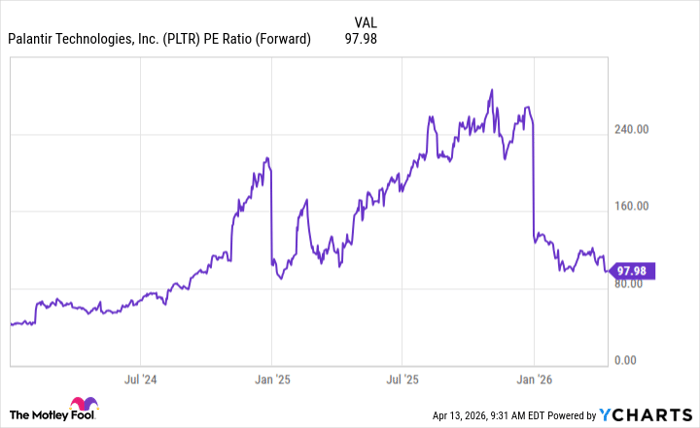
PLTR PE Ratio (Forward) data by YCharts
Still, this metric doesn't account for Palantir's revenue growth prospects farther down the road -- it only includes estimates for the coming year.
Palantir stock has lost momentum in recent times, along with other AI stocks -- growth-related stocks have faltered amid investor concerns about the economy and ongoing turmoil in Iran. And it's impossible to predict whether Palantir and peers will rebound soon or remain in the doldrums for a while.
This reminds us of one of the key ingredients in the successful investing recipe, and that's focusing on the long term. You'll want to consider whether the company has what it takes to continue delivering growth in the years to come. Palantir's earnings and comments on demand so far offer us reason for optimism.
Still, the valuation problem and ongoing stock market pressure mean this stock isn't the best choice for cautious investors. But aggressive investors may see now, while Palantir isn't in favor, as an opportunity to add some shares to their portfolios -- and sit back and wait.
Should you buy stock in Palantir Technologies right now?
Before you buy stock in Palantir Technologies, consider this:
The Motley Fool Stock Advisor analyst team just identified what they believe are the 10 best stocks for investors to buy now… and Palantir Technologies wasn’t one of them. The 10 stocks that made the cut could produce monster returns in the coming years.
Consider when Netflix made this list on December 17, 2004... if you invested $1,000 at the time of our recommendation, you’d have $555,526!* Or when Nvidia made this list on April 15, 2005... if you invested $1,000 at the time of our recommendation, you’d have $1,156,403!*
Now, it’s worth noting Stock Advisor’s total average return is 968% — a market-crushing outperformance compared to 191% for the S&P 500. Don't miss the latest top 10 list, available with Stock Advisor, and join an investing community built by individual investors for individual investors.
See the 10 stocks »
*Stock Advisor returns as of April 13, 2026.
Adria Cimino has no position in any of the stocks mentioned. The Motley Fool has positions in and recommends Palantir Technologies. The Motley Fool has a disclosure policy.
Recommended Articles


