

Prediction: Amazon Will Beat The Market in The Next 10 Years -- Here's Why

Source The Motley Fool

Key Points

  • Amazon has unimpressive margins.

  • The company could improve on that front in the coming years.

  • With increasing margins and profits, the stock could outpace broader equities through 2036.

  • These 10 stocks could mint the next wave of millionaires ›

Amazon (NASDAQ: AMZN) has had its share of detractors in recent years. Some worry that the company's cloud computing business is facing increased competition and may give up the top spot to its closest competitor. Others argue that Amazon's heavy capex spending may not yield the return on investment the company hopes for. If that's the case, Amazon's top-line growth might flatline while its margins and profits decline.

On top of all that, broader equities are experiencing significant volatility right now due to several factors, including geopolitical tensions. Even amid all that, Amazon remains an excellent stock to buy as there are good reasons to think that it could outperform broader equities over the next 10 years. Read on to discover one reason why the tech leader could pull it off.

Will AI create the world's first trillionaire? Our team just released a report on the one little-known company, called an "Indispensable Monopoly" providing the critical technology Nvidia and Intel both need. Continue »

Amazon logo.

Image source: The Motley Fool.

Amazon's margins aren't great

First, it's important to note that although Amazon generates significant revenue -- over $700 billion in its latest fiscal year -- its margins are relatively poor compared to its similarly sized tech peers. Among the Magnificent Seven, Amazon consistently has some of the lowest margins.
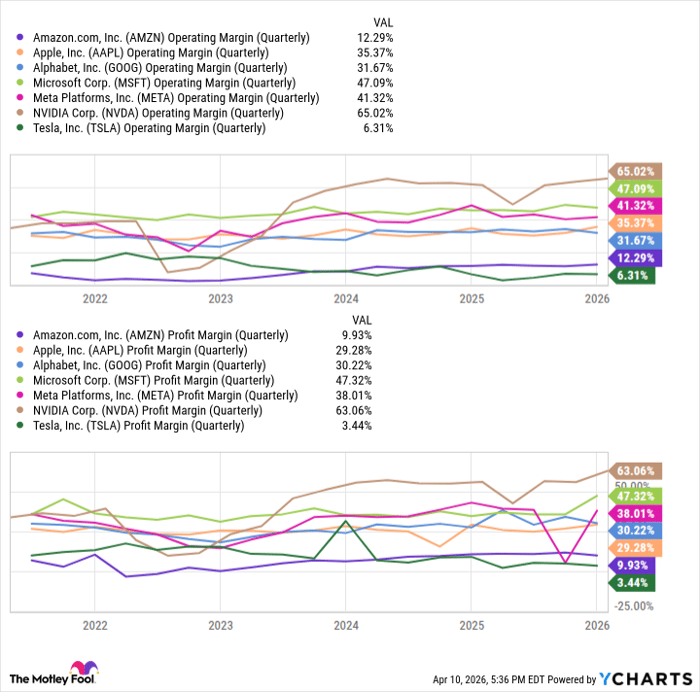
AMZN Operating Margin (Quarterly) Chart

AMZN Operating Margin (Quarterly) data by YCharts

Only Tesla, a company operating in a capital-intensive automotive industry, had lower operating and net margins in this group, as of their latest respective reporting periods. On the one hand, it's not too surprising. Some of Amazon's Magnificent Seven peers -- such as Alphabet and Meta Platforms -- make most of their money from digital advertising, while others, like Nvidia and Apple, benefit from immense pricing power.

Meanwhile, Amazon's core e-commerce business relies on an expensive infrastructure that allows it to offer fast shipping on millions of items. Even though the company's cloud unit boasts higher margins, it also needs to invest heavily in data centers to keep that segment going. Here's the good news: if Amazon can cut costs and improve margins, it will boost profits, and that could lead to stronger long-term returns. Of course, that's true of any business, but Amazon actually has the means to make it happen.

The path forward for the tech giant

Amazon could improve its margins within its two most important businesses. First, consider the company's e-commerce operations. Amazon is increasingly relying on industrial robots. That could help cut expenses and improve efficiency in its warehouses. This initiative also has the potential to increase e-commerce sales volume as Amazon's fulfillment capabilities continue to improve. Amazon's online shopping business still generates most of its revenue, but has razor-thin margins.

If the company can cut costs by a few percentage points over the next decade, that will have a meaningful impact on its net income. Amazon could also improve margins within its cloud computing division, Amazon Web Services (AWS). The company's internally developed artificial intelligence (AI) chips may not match Nvidia's in raw performance, but they offer viable alternatives for customers who choose not to opt for the high-performing but very expensive market leader.

Amazon's chips include Trainium, which the company built to train machine learning models. As Amazon's CEO, Andy Jassy, recently said:

At scale, we expect Trainium will save us tens of billions of capex dollars per year, and provide several hundred basis points of operating margin advantage versus relying on others' chips for inference.

Then there is Amazon's rapidly growing digital advertising business. This segment does not need to do a whole lot of work to improve the company's margins -- it just needs to expand faster than the rest and make up a larger part of Amazon's top-line. And it has been doing that, more or less, in recent years. Here's the bottom line: Not only does Amazon have significant growth opportunities ahead, but ongoing initiatives could help boost its margins and bring them closer to those of its large tech peers. If Amazon can pull that off, the company could perform extremely well in the next decade.

Don’t miss this second chance at a potentially lucrative opportunity

Ever feel like you missed the boat in buying the most successful stocks? Then you’ll want to hear this.

On rare occasions, our expert team of analysts issues a “Double Down” stock recommendation for companies that they think are about to pop. If you’re worried you’ve already missed your chance to invest, now is the best time to buy before it’s too late. And the numbers speak for themselves:

  • Nvidia: if you invested $1,000 when we doubled down in 2009, you’d have $489,281!*
  • Apple: if you invested $1,000 when we doubled down in 2008, you’d have $49,600!*
  • Netflix: if you invested $1,000 when we doubled down in 2004, you’d have $555,526!*

Right now, we’re issuing “Double Down” alerts for three incredible companies, available when you join Stock Advisor, and there may not be another chance like this anytime soon.

See the 3 stocks »

*Stock Advisor returns as of April 13, 2026.

Prosper Junior Bakiny has positions in Alphabet, Amazon, Meta Platforms, and Nvidia. The Motley Fool has positions in and recommends Alphabet, Amazon, Apple, Meta Platforms, Microsoft, Nvidia, and Tesla and is short shares of Apple. The Motley Fool has a disclosure policy.

Disclaimer: For information purposes only. Past performance is not indicative of future results.
placeholder
Bitcoin CME gaps at $35,000, $27,000 and $21,000, which one gets filled first?Prioritize filling the $27,000 gap and even try higher.
Author  FXStreet
Aug 22, 2023
Prioritize filling the $27,000 gap and even try higher.
placeholder
Pinduoduo Earnings Incoming: Morgan Stanley Sees Long-Term Profit Potential​Insights – On November 21, Chinese e-commerce giant Pinduoduo (PDD) will release its Q3 2024 earnings.
Author  Mitrade
Nov 20, 2024
​Insights – On November 21, Chinese e-commerce giant Pinduoduo (PDD) will release its Q3 2024 earnings.
placeholder
Elon Musk’s xAI and Neuralink Launch New Funding Rounds​Billionaire Elon Musk recently raised funds for his two high-profile tech companies, xAI and Neuralink.
Author  Insights
Jun 03, 2025
​Billionaire Elon Musk recently raised funds for his two high-profile tech companies, xAI and Neuralink.
placeholder
Bitcoin briefly loses 2025 gains as crypto plunges over the weekend.Bitcoin experienced a sharp decline this weekend, briefly erasing its 2025 gains and dipping below its year-opening value of $93,507. The cryptocurrency fell to a low of $93,029 on Sunday, representing a 25% drop from its all-time high in October. Although it has rebounded slightly to around $94,209, the pressures on the market remain significant. The downturn occurred despite the reopening of the U.S. government on Thursday, which many had hoped would provide essential support for crypto markets. This year initially appeared promising for cryptocurrencies, particularly after the inauguration of President Donald Trump, who has established the most pro-crypto administration thus far. However, ongoing political tensions—including Trump's tariff strategies and the recent government shutdown, lasting a historic 43 days—have contributed to several rapid price pullbacks for Bitcoin throughout the year. Market dynamics are also being influenced by Bitcoin whales—investors holding large amounts of Bitcoin—who have been offloading portions of their assets, consequently stalling price rallies even as positive regulatory developments emerge. Despite these sell-offs, analysts from Glassnode argue that this behavior aligns with typical patterns seen among long-term investors during the concluding stages of bull markets, suggesting it is not indicative of a mass exodus. Notably, Bitcoin is not alone in its struggles, as Ethereum and Solana have also recorded declines of 7.95% and 28.3%, respectively, since the start of the year, while numerous altcoins have faced even steeper losses. Looking ahead, questions linger regarding the viability of the four-year cycle thesis, particularly given the increasing institutional support and regulatory frameworks now in place in the crypto landscape. Matt Hougan, chief investment officer at Bitwise, remains optimistic, suggesting a potential Bitcoin resurgence in 2026 driven by the “debasement trade” thesis and a broader trend toward increased adoption of stablecoins, tokenization, and decentralized finance. Hougan emphasized the soundness of the underlying fundamentals, pointing to a positive outlook for the sector in the longer term.
Author  Mitrade
Nov 17, 2025
Bitcoin experienced a sharp decline this weekend, briefly erasing its 2025 gains and dipping below its year-opening value of $93,507. The cryptocurrency fell to a low of $93,029 on Sunday, representing a 25% drop from its all-time high in October. Although it has rebounded slightly to around $94,209, the pressures on the market remain significant. The downturn occurred despite the reopening of the U.S. government on Thursday, which many had hoped would provide essential support for crypto markets. This year initially appeared promising for cryptocurrencies, particularly after the inauguration of President Donald Trump, who has established the most pro-crypto administration thus far. However, ongoing political tensions—including Trump's tariff strategies and the recent government shutdown, lasting a historic 43 days—have contributed to several rapid price pullbacks for Bitcoin throughout the year. Market dynamics are also being influenced by Bitcoin whales—investors holding large amounts of Bitcoin—who have been offloading portions of their assets, consequently stalling price rallies even as positive regulatory developments emerge. Despite these sell-offs, analysts from Glassnode argue that this behavior aligns with typical patterns seen among long-term investors during the concluding stages of bull markets, suggesting it is not indicative of a mass exodus. Notably, Bitcoin is not alone in its struggles, as Ethereum and Solana have also recorded declines of 7.95% and 28.3%, respectively, since the start of the year, while numerous altcoins have faced even steeper losses. Looking ahead, questions linger regarding the viability of the four-year cycle thesis, particularly given the increasing institutional support and regulatory frameworks now in place in the crypto landscape. Matt Hougan, chief investment officer at Bitwise, remains optimistic, suggesting a potential Bitcoin resurgence in 2026 driven by the “debasement trade” thesis and a broader trend toward increased adoption of stablecoins, tokenization, and decentralized finance. Hougan emphasized the soundness of the underlying fundamentals, pointing to a positive outlook for the sector in the longer term.
placeholder
Gold edges lower below $4,750 amid fragile Middle East ceasefire Gold price (XAU/USD) trades in negative territory around $4,705 during the early Asian session on Thursday. The precious metal edges lower amid a temporary two-week ceasefire between the US and Iran.   
Author  FXStreet
Apr 09, Thu
Gold price (XAU/USD) trades in negative territory around $4,705 during the early Asian session on Thursday. The precious metal edges lower amid a temporary two-week ceasefire between the US and Iran.   
goTop
quote