

Iran Conflict Threatens Lucrative Luxury Stock -- Time to Panic, or Time to Buy?

Source The Motley Fool

Key Points

  • How drastically the Iran conflict impacts automakers depends on the specific situation.

  • Ferrari will be more impacted due to its high-margin business in the ultra-luxury Middle East market.

  • Recent developments, including the Iran conflict, have sunk Ferrari's valuation -- giving investors a rare opportunity.

  • 10 stocks we like better than Ferrari ›

Despite a fragile ceasefire currently, there's still potential trouble brewing from the conflict in Iran. Mainstream automakers such as Ford Motor Company (NYSE: F) and General Motors (NYSE: GM) don't do big business in the Middle East and remain relatively unimpacted by the current Iran conflict.

It's a different scenario for high-flying luxury stocks such as Ferrari (NYSE: RACE), which took a hit in the markets after the Iran conflict began. Dubai (in the United Arab Emirates) has been a massive driver of growth in recent years, and the rising Middle East tensions come at a crucial time in the luxury industry and for Ferrari investors. Here's how much it should concern you.

Will AI create the world's first trillionaire? Our team just released a report on the one little-known company, called an "Indispensable Monopoly" providing the critical technology Nvidia and Intel both need. Continue »

Not so luxurious situation

High-end and super-luxury automakers face growing uncertainty across the globe with demand in China and Europe slower, tariffs eroding profits in the U.S., and now the conflict in Iran disrupting a highly coveted luxury region. In fact, according to Bernstein, the Middle East was the fastest-growing luxury market last year. Former Aston Martin CEO Andy Palmer told Automotive News, "For a manufacturer of premium and luxury cars in particular, it's an utter disaster."

Sales in the ultra-luxury Middle East market are very high margin, and brands such as Ferrari, Lamborghini, Jaguar, Land Rover, and Porsche are watching closely to adapt to drastic and sudden changes in demand and distribution capabilities, leaving some to wonder if production cuts could be necessary if the conflict drags on for a few more weeks.
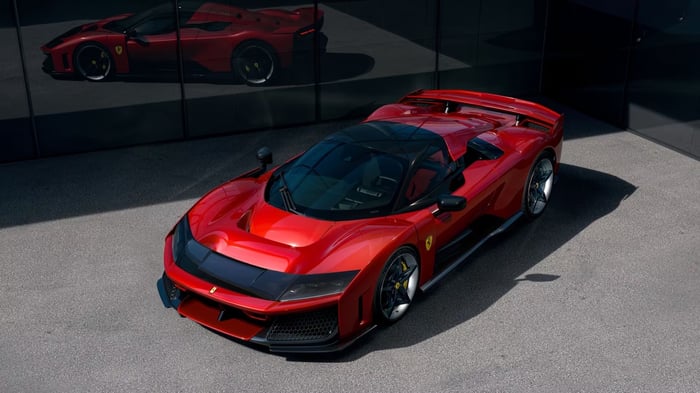
Ferrari supercar

Image source: Ferrari.

The good and bad news

For Ferrari investors in particular, there's a little more insight. While many luxury automakers don't disclose regional profit margins and some no longer publish global sales figures, Ferrari reported that the Middle East generated 4.6% of total sales in 2025. That's more important than the figure would seem, considering it's a larger market for Ferrari than China, and the Middle East accounted for a lesser 3.5% of Ferrari's total sales only a year earlier.

Despite being a fraction of total sales for Ferrari, supply chain constraints, rising air freight costs, and declining regional demand do present direct and immediate profitability risks. That said, Ferrari does have some flexibility with its long, stable-yet-flexible purchase order book and can redirect vehicles to other regions in many cases.

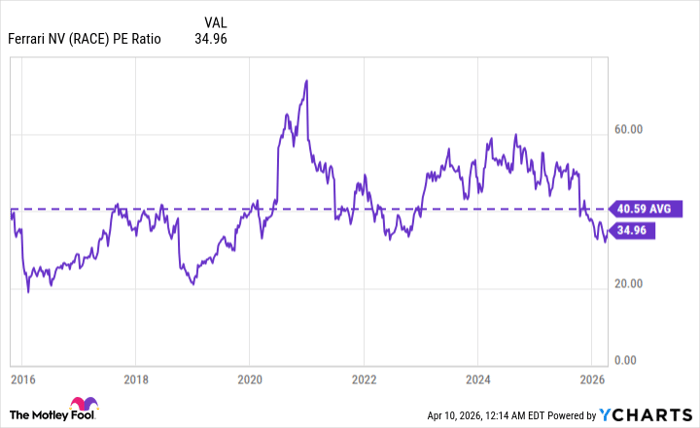
There is also a risk of further disruption as higher oil prices could weigh on luxury sales, and especially aspirational luxury customers who remain more sensitive to inflation and economic turmoil. Meanwhile, spending by wealthier consumers is more dependent on the stock markets, which could be more negatively impacted by higher oil prices spurring a downward trend in global markets. Between the recent Iran conflict and Ferrari's 2030 guidance disappointing analysts -- remember that Ferrari has a tendency to lowball guidance -- it's giving investors a rare opportunity to purchase the stock at a lower valuation.
RACE PE Ratio Chart

RACE PE Ratio data by YCharts

What it all means

Ultimately, while the war in Iran is hitting ultra-luxury companies such as Ferrari, and is certainly disrupting highly coveted high-margin sales, investors should view this as a speedbump for now.

Ferrari has durable competitive advantages that span the globe, a brand image that took decades to curate and strengthen, and margins that handily beat the competition. The Iran conflict is a definite negative for Ferrari business, but investors should also see this as an opportunity to scoop up shares of a long-term winner at a time of uncertainty.

Should you buy stock in Ferrari right now?

Before you buy stock in Ferrari, consider this:

The Motley Fool Stock Advisor analyst team just identified what they believe are the 10 best stocks for investors to buy now… and Ferrari wasn’t one of them. The 10 stocks that made the cut could produce monster returns in the coming years.

Consider when Netflix made this list on December 17, 2004... if you invested $1,000 at the time of our recommendation, you’d have $550,348!* Or when Nvidia made this list on April 15, 2005... if you invested $1,000 at the time of our recommendation, you’d have $1,127,467!*

Now, it’s worth noting Stock Advisor’s total average return is 959% — a market-crushing outperformance compared to 191% for the S&P 500. Don't miss the latest top 10 list, available with Stock Advisor, and join an investing community built by individual investors for individual investors.

See the 10 stocks »

*Stock Advisor returns as of April 10, 2026.

Daniel Miller has positions in Ford Motor Company and General Motors. The Motley Fool has positions in and recommends Ferrari. The Motley Fool recommends General Motors. The Motley Fool has a disclosure policy.

Disclaimer: For information purposes only. Past performance is not indicative of future results.
placeholder
Bitcoin CME gaps at $35,000, $27,000 and $21,000, which one gets filled first?Prioritize filling the $27,000 gap and even try higher.
Author  FXStreet
Aug 22, 2023
Prioritize filling the $27,000 gap and even try higher.
placeholder
Pinduoduo Earnings Incoming: Morgan Stanley Sees Long-Term Profit Potential​Insights – On November 21, Chinese e-commerce giant Pinduoduo (PDD) will release its Q3 2024 earnings.
Author  Mitrade
Nov 20, 2024
​Insights – On November 21, Chinese e-commerce giant Pinduoduo (PDD) will release its Q3 2024 earnings.
placeholder
Elon Musk’s xAI and Neuralink Launch New Funding Rounds​Billionaire Elon Musk recently raised funds for his two high-profile tech companies, xAI and Neuralink.
Author  Insights
Jun 03, 2025
​Billionaire Elon Musk recently raised funds for his two high-profile tech companies, xAI and Neuralink.
placeholder
Bitcoin briefly loses 2025 gains as crypto plunges over the weekend.Bitcoin experienced a sharp decline this weekend, briefly erasing its 2025 gains and dipping below its year-opening value of $93,507. The cryptocurrency fell to a low of $93,029 on Sunday, representing a 25% drop from its all-time high in October. Although it has rebounded slightly to around $94,209, the pressures on the market remain significant. The downturn occurred despite the reopening of the U.S. government on Thursday, which many had hoped would provide essential support for crypto markets. This year initially appeared promising for cryptocurrencies, particularly after the inauguration of President Donald Trump, who has established the most pro-crypto administration thus far. However, ongoing political tensions—including Trump's tariff strategies and the recent government shutdown, lasting a historic 43 days—have contributed to several rapid price pullbacks for Bitcoin throughout the year. Market dynamics are also being influenced by Bitcoin whales—investors holding large amounts of Bitcoin—who have been offloading portions of their assets, consequently stalling price rallies even as positive regulatory developments emerge. Despite these sell-offs, analysts from Glassnode argue that this behavior aligns with typical patterns seen among long-term investors during the concluding stages of bull markets, suggesting it is not indicative of a mass exodus. Notably, Bitcoin is not alone in its struggles, as Ethereum and Solana have also recorded declines of 7.95% and 28.3%, respectively, since the start of the year, while numerous altcoins have faced even steeper losses. Looking ahead, questions linger regarding the viability of the four-year cycle thesis, particularly given the increasing institutional support and regulatory frameworks now in place in the crypto landscape. Matt Hougan, chief investment officer at Bitwise, remains optimistic, suggesting a potential Bitcoin resurgence in 2026 driven by the “debasement trade” thesis and a broader trend toward increased adoption of stablecoins, tokenization, and decentralized finance. Hougan emphasized the soundness of the underlying fundamentals, pointing to a positive outlook for the sector in the longer term.
Author  Mitrade
Nov 17, 2025
Bitcoin experienced a sharp decline this weekend, briefly erasing its 2025 gains and dipping below its year-opening value of $93,507. The cryptocurrency fell to a low of $93,029 on Sunday, representing a 25% drop from its all-time high in October. Although it has rebounded slightly to around $94,209, the pressures on the market remain significant. The downturn occurred despite the reopening of the U.S. government on Thursday, which many had hoped would provide essential support for crypto markets. This year initially appeared promising for cryptocurrencies, particularly after the inauguration of President Donald Trump, who has established the most pro-crypto administration thus far. However, ongoing political tensions—including Trump's tariff strategies and the recent government shutdown, lasting a historic 43 days—have contributed to several rapid price pullbacks for Bitcoin throughout the year. Market dynamics are also being influenced by Bitcoin whales—investors holding large amounts of Bitcoin—who have been offloading portions of their assets, consequently stalling price rallies even as positive regulatory developments emerge. Despite these sell-offs, analysts from Glassnode argue that this behavior aligns with typical patterns seen among long-term investors during the concluding stages of bull markets, suggesting it is not indicative of a mass exodus. Notably, Bitcoin is not alone in its struggles, as Ethereum and Solana have also recorded declines of 7.95% and 28.3%, respectively, since the start of the year, while numerous altcoins have faced even steeper losses. Looking ahead, questions linger regarding the viability of the four-year cycle thesis, particularly given the increasing institutional support and regulatory frameworks now in place in the crypto landscape. Matt Hougan, chief investment officer at Bitwise, remains optimistic, suggesting a potential Bitcoin resurgence in 2026 driven by the “debasement trade” thesis and a broader trend toward increased adoption of stablecoins, tokenization, and decentralized finance. Hougan emphasized the soundness of the underlying fundamentals, pointing to a positive outlook for the sector in the longer term.
placeholder
WTI holds steady above $92.00 as Strait of Hormuz remains closed; bulls seem hesitant West Texas Intermediate (WTI) – the benchmark US Crude Oil price – trades with a mild positive bias during the Asian session on Friday, though it lacks bullish conviction amid hopes of Iran ceasefire stabilizing.
Author  FXStreet
23 hours ago
West Texas Intermediate (WTI) – the benchmark US Crude Oil price – trades with a mild positive bias during the Asian session on Friday, though it lacks bullish conviction amid hopes of Iran ceasefire stabilizing.
goTop
quote