


If I Had $5,000 to Invest in Artificial Intelligence (AI) Stocks After the Nasdaq Correction, I'd Buy These 3
Key Points
The Nasdaq Composite tumbled this year as investors rotated capital out of big tech.
While artificial intelligence stocks are experiencing outsized volatility, some now trade at bargain valuations.
Nvidia, Microsoft, and Amazon look appealing given the dichotomy between their dipping valuations and compelling growth trajectories.
- 10 stocks we like better than Nvidia ›
On March 26, the Nasdaq Composite (NASDAQINDEX: ^IXIC) index officially entered correction territory, trading more than 10% below its recent peak. The downward pressure wasn't driven by any single narrative but rather by a cocktail of headwinds, including sticky inflation, tariffs, consumer anxiety, a rotation out of growth stocks, and geopolitics.
While declines like these feel dramatic in the moment, historically speaking, they tend to offer lucrative buying opportunities. Remember, corrections are not crashes -- they are resets. Investors who have dry powder to put to work should see these moments as rare invitations to buy quality companies at bargain prices.
Will AI create the world's first trillionaire? Our team just released a report on the one little-known company, called an "Indispensable Monopoly" providing the critical technology Nvidia and Intel both need. Continue »
Of course, buying the dip is a winning strategy only if you choose the right companies. Indiscriminately reaching for the most beaten-down stocks simply because they've fallen furthest is a classic value trap setup.
The stocks actually worth buying during corrections are the ones with competitive advantages, compounding earnings power, and durable runways that are likely to extend beyond the current news cycle. With those criteria in mind, here are three Nasdaq stocks worth serious consideration for your portfolio.

Image source: Getty Images.
1. Nvidia
No company is more central to the artificial intelligence (AI) infrastructure buildout than Nvidia (NASDAQ: NVDA). Quarter after quarter, the company continues to generate record revenues and earnings. Moreover, Nvidia's order book of $1 trillion offers compelling visibility into its path to sustained growth over the next several years.
Nevertheless, Nvidia stock is currently valued at a lower forward price-to-earnings ratio than the S&P 500. It hasn't traded at such a low level by that metric in 13 years. Smart investors will see the disconnect between Nvidia's underlying performance and its valuation profile as an opportunity.
Fundamentally speaking, the demand picture for Nvidia's Blackwell and Vera Rubin chips hasn't changed because of any macroeconomic factors investors see in headlines. In other words, AI hyperscalers are not putting the data center construction plans on pause over something like tariff concerns. Meanwhile, sovereign AI projects across Europe and the Middle East continue to accelerate. Indeed, Nvidia's competitive moat is deep. The company's CUDA software ecosystem took years to build and is not something that its competitors will be able to replicate in a single product cycle.
The only thing that seems to be swaying growth stocks right now -- Nvidia included -- is sentiment. In the long run, however, sentiment tends to revert back to the mean as companies with strong earnings quality eventually reattain premium valuations.
If you see the AI capital expenditure boom as a multiyear supercycle, then this opportunity to buy Nvidia at a correction discount presents one of the most obvious asymmetric bets available to investors right now.
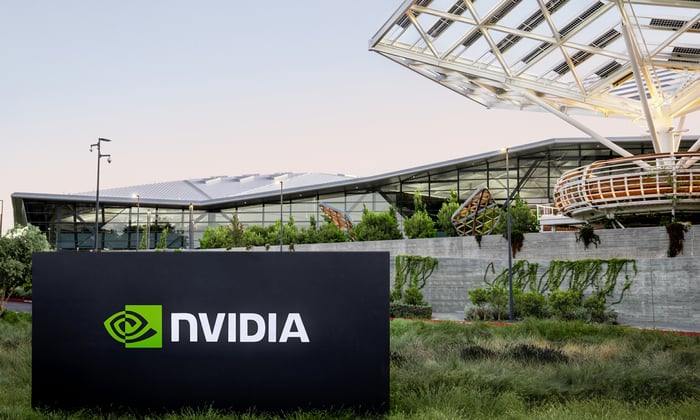
Image source: Nvidia.
2. Microsoft
For years, Microsoft (NASDAQ: MSFT) was the definition of a blue chip stock. Nothing fancy, but at least the company offered steady, reliable cash flow thanks to its vast ecosystem spanning personal computing, enterprise software, gaming, and cloud infrastructure.
Then came the glow-up in late 2022 following the company's multibillion-dollar investment in OpenAI. Since Microsoft began integrating ChatGPT and AI-powered services throughout its various services and devices, its Azure platform has scaled into a hyperscaler rivaling incumbents like Amazon Web Services (AWS).
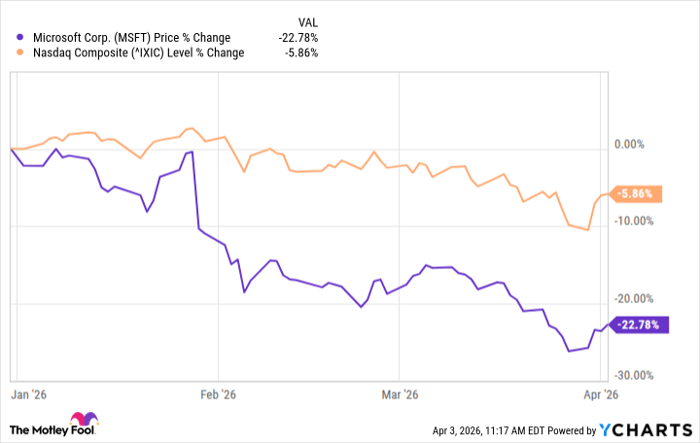
The recent pullback in Microsoft stock stemmed from two things: concerns over its ballooning capex and its heavy concentration on OpenAI as the catalyst fueling future growth. Investors are fixated on the question of whether Microsoft is building an AI empire or just bankrolling a massive cash-burning machine in OpenAI.
MSFT data by YCharts.
While these concerns are legitimate, they are also overblown. Last quarter, Azure reported 39% year-over-year growth as services are increasingly driven by Microsoft's expanding AI services. Azure's future doesn't hinge on one partner. Rather, Microsoft is monetizing a platform at scale across a growing number of enterprise customers in a way that becomes more measurable with each passing earnings call. While its capex spend looks significant in isolation, I think it's both rational and required to maintain the company's revenue trajectory.
3. Amazon
Amazon (NASDAQ: AMZN) is quietly in the middle of one of its most dramatic evolutions in years, and the market has yet to fully recognize it.
AWS' reacceleration is no longer a thesis -- it is showing up in cold, hard numbers thanks to the company's partnership with Anthropic, which has helped drive AI workloads to Amazon's cloud. In addition, Amazon's advertising business continues to compound at a rate that rivals Meta Platforms and Alphabet. Lastly, retail margins -- which have long been the drag on Amazon's growth story -- are positioned to continue improving as the company augments its fulfillment network with AI-driven automation.
For an investor putting money to work in a correction environment, Amazon provides diversification, accelerating growth, and profitability across multiple high-quality vectors in cloud computing, advertising, e-commerce, logistics, entertainment, and AI infrastructure -- all inside a single ticker. That's a rare combination.
Should you buy stock in Nvidia right now?
Before you buy stock in Nvidia, consider this:
The Motley Fool Stock Advisor analyst team just identified what they believe are the 10 best stocks for investors to buy now… and Nvidia wasn’t one of them. The 10 stocks that made the cut could produce monster returns in the coming years.
Consider when Netflix made this list on December 17, 2004... if you invested $1,000 at the time of our recommendation, you’d have $532,929!* Or when Nvidia made this list on April 15, 2005... if you invested $1,000 at the time of our recommendation, you’d have $1,091,848!*
Now, it’s worth noting Stock Advisor’s total average return is 928% — a market-crushing outperformance compared to 186% for the S&P 500. Don't miss the latest top 10 list, available with Stock Advisor, and join an investing community built by individual investors for individual investors.
See the 10 stocks »
*Stock Advisor returns as of April 8, 2026.
Adam Spatacco has positions in Alphabet, Amazon, Meta Platforms, Microsoft, and Nvidia. The Motley Fool has positions in and recommends Alphabet, Amazon, Meta Platforms, Microsoft, and Nvidia. The Motley Fool has a disclosure policy.
Recommended Articles


