


1 Brilliant Energy Stock to Buy Now and Hold for the Long Term
Key Points
Energy prices are soaring in large part due to accelerated investments in artificial intelligence (AI) infrastructure.
Training and inference for AI models demands huge amounts of electricity, underscoring the need for more cost-efficient solutions.
Bloom Energy offers fuel cells that provide constant, clean, and low-cost energy to AI developers.
- 10 stocks we like better than Bloom Energy ›
Power demand is exploding amid surging investment in artificial intelligence (AI) infrastructure. Traditional grids simply can't expand at the same speed AI buildouts are happening. Moreover, they struggle to generate steady, clean electricity required by next-generation AI systems.
Bloom Energy (NYSE: BE) seeks to mitigate these structural pain points with its solid oxide fuel cell technology. The company offers a proven, deployed solution that has already gained legitimate traction in an intense AI infrastructure market.
Will AI create the world's first trillionaire? Our team just released a report on the one little-known company, called an "Indispensable Monopoly" providing the critical technology Nvidia and Intel both need. Continue »
To me, Bloom is far more than just another AI energy story. The stock represents a compelling choice to buy and hold for years to come.

Image source: Getty Images.
Bloom Energy's solid oxide fuel cell technology is a game changer
At its core, Bloom Energy makes solid oxide fuel cells. In layman's terms, these systems create electricity through electrochemical reactions rather than burning fuel.
The company's Bloom Energy Servers are both compact and modular, allowing for quick installation times. Currently, these servers run primarily on natural gas but the company has its eyes on shifting to biogas or hydrogen solutions down the road.
Unlike batteries or solar power, Bloom's technology provides developers with high-efficiency, low-emission baseload output around the clock.
Bloom's power solution could become indispensable for AI data centers
Bloom's infrastructure sits behind the meter, delivering power straight to server racks. While alternatives to Bloom exist, they are cumbersome.
For example, combined cycle gas turbines are another option behind the meter. However, they take years to permit and build, demand significant volumes of cooling water, and lock operators into long-duration, capital-intensive capacity commitments.
Bloom's modular fuel cells can be deployed in months and scale incrementally alongside AI infrastructure budgets. By bypassing transmission bottlenecks, Bloom's electrochemical process produces power that fits neatly into modern AI architectures -- helping reduce losses that diminish capacity each time a new data center comes online.
Bloom's breakout 2025 performance paves the way for enduring gains
Last year marked a clear turning point for Bloom. Revenue climbed 37% year over year, reaching a record $2 billion. Perhaps even more impressive was the company's profitability profile. Gross margin rose by 160 basis points while operating income rose 46% and free cash flow was positive for a second consecutive year.
The combination of accelerating revenue and improving unit economics is particularly enticing for a capital-intensive business. Given the forecasts below, it would also appear that Wall Street remains firmly bullish on Bloom's growth prospects over the next several years -- fueled by the company's $20 billion backlog.
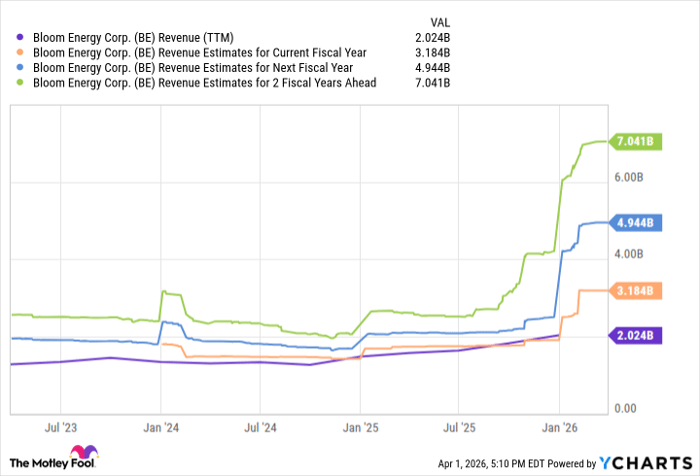
BE Revenue (TTM) data by YCharts
This is all to say that Bloom's growth story is not merely the product of fleeting, one-time gains. Rather, as the company ramps its manufacturing capacity to serve multi-gigawatt AI campuses, Bloom entered 2026 with a rare combination: visibility and optionality.
While the company's price-to-sales (P/S) ratio of 16 isn't cheap, I think Bloom's valuation still discounts the company's runway supported by multi-year secular tailwinds from AI electrification.
Bloom's profile -- featuring technological differentiation, proven execution, and a growing total addressable market -- fits the classic definition of a compounder in the making. Investors with a long time horizon may consider a position in Bloom Energy as the company looks poised to deliver multibagger returns as the need to power ever-hungry accelerated computing infrastructure expands for years to come.
Should you buy stock in Bloom Energy right now?
Before you buy stock in Bloom Energy, consider this:
The Motley Fool Stock Advisor analyst team just identified what they believe are the 10 best stocks for investors to buy now… and Bloom Energy wasn’t one of them. The 10 stocks that made the cut could produce monster returns in the coming years.
Consider when Netflix made this list on December 17, 2004... if you invested $1,000 at the time of our recommendation, you’d have $532,929!* Or when Nvidia made this list on April 15, 2005... if you invested $1,000 at the time of our recommendation, you’d have $1,091,848!*
Now, it’s worth noting Stock Advisor’s total average return is 928% — a market-crushing outperformance compared to 186% for the S&P 500. Don't miss the latest top 10 list, available with Stock Advisor, and join an investing community built by individual investors for individual investors.
See the 10 stocks »
*Stock Advisor returns as of April 8, 2026.
Adam Spatacco has no position in any of the stocks mentioned. The Motley Fool has positions in and recommends Bloom Energy. The Motley Fool has a disclosure policy.
Recommended Articles


