


Do Wall Street Analysts Know Something Hedge Funds Don't? As Nvidia's Stock Has Sold Off, They Continue to Raise the AI Giant's Earnings Estimate.
Key Points
Despite struggles with the stock, Nvidia has performed very well this year.
CEO Jensen Huang recently said he expects $1 trillion of GPU sales between March of this year and the end of 2027.
While concerns about AI linger, Wall Street analysts continue to raise their earnings-per-share estimates for the company.
- 10 stocks we like better than Nvidia ›
While market conditions have been turbulent this year, largely due to the Iran war, it's hard to imagine investors could have asked for more from Nvidia (NASDAQ: NVDA) thus far.
The artificial intelligence (AI) chip giant recently delivered a knockout earnings report and provided several important updates on its business and guidance. Yet the stock is down over 6% this year. Do Wall Street analysts know something that hedge funds don't? They've continued to increase their earnings estimates, while investors have sold the stock.
Will AI create the world's first trillionaire? Our team just released a report on the one little-known company, called an "Indispensable Monopoly" providing the critical technology Nvidia and Intel both need. Continue »
Understanding the analyst-hedge fund relationship
While retail investors have become a bigger part of financial markets in recent years, the smart money, or the institutions, such as hedge funds, asset managers, and insurance companies, still represent the bulk of flows and therefore have the most influence.
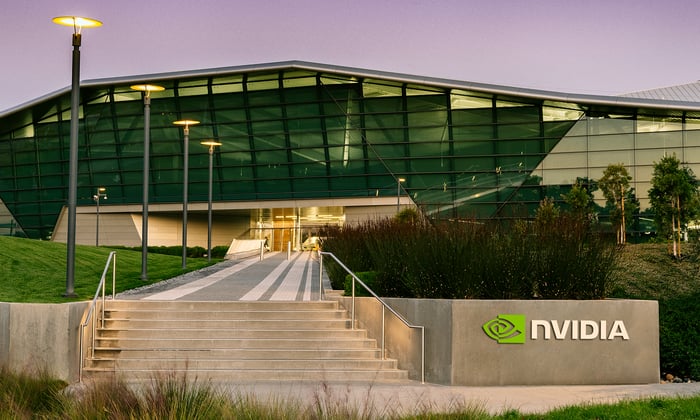
Image source: Nvidia.
While it varies, funds typically charge high fees, such as the 2-and-20 structure, where investors pay a 2% annual fee to buy into a fund, which then also takes 20% of profits above a certain threshold. Investors pay these fees to generate annual returns that beat the market, so most funds invest on a near-term basis, usually 12 to 18 months.
Wall Street analysts, who typically don't own the stocks they cover, cater to these funds by providing coverage of stocks they may be interested in, with the ultimate goal of getting them to purchase shares with their prospective broker's equity trading desk.
Analysts regularly model a company's future earnings. A consensus estimate averages earnings estimates from all the analysts who cover a stock, which institutional investors closely monitor. For instance, if a company reports earnings above consensus estimates or provides forward guidance above future estimates, a stock will tend to rise to reset to the new expectations.
Nvidia estimates keep rising
The surprising thing about this year, especially for Nvidia, is that earnings estimates have only been revised higher in recent months, as the stock has sold off.
According to data from Visible Alpha, the consensus diluted operating earnings-per-share estimate among 31 Wall Street analysts covering Nvidia for the company's fiscal year 2027, which ends in late January of next year, was $7.67 in mid-December. As of April 1, despite everything that has happened in the world, consensus estimates rose to $8.15. For Nvidia's fiscal year 2028, consensus estimates have risen from $9.57 in mid-December to $10.85 as of April 1.
The increase in operating EPS estimates shouldn't come as a total surprise. In late February, Nvidia reported its fiscal 2026 fourth-quarter earnings, easily beating estimates. Management also said it is projecting roughly $78 billion in revenue for its 2027 fiscal first quarter, close to $6 billion above consensus estimates at the time.
Furthermore, at a company conference, CEO Jensen Huang guided for $1 trillion in sales from its Blackwell and Vera Rubin platforms between March of this year and the end of 2027, which was about $50 billion ahead of consensus estimates.
Huang has also said that Nvidia is restarting its supply chain to deliver orders to businesses in China, another potentially material source of revenue that has been dead for several quarters.
How to think about Nvidia stock
While Nvidia has given investors many reasons to be bullish, it's a tough environment for AI stocks right now, the sector in which Nvidia is a leader.
Nvidia sells its graphics processing units (GPUs) and full rack-scale platforms to data centers, which companies often rent out to train large language models and deploy AI solutions. So demand for Nvidia's chips and products is key to its success. This year, major hyperscalers are projected to spend close to $700 billion, largely to build out AI infrastructure.
However, if capital expenditures dry up, the environment could change quickly. It's also possible that competitors come out with their own custom chips, which has already begun to happen, and start to cut into Nvidia's high margins. Investors have also expressed concerns about circular financing, in which Nvidia invests in some of its biggest customers or suppliers.
While all of these concerns are valid, Huang's $1 trillion guidance and Nvidia's guidance to keep its gross margin in the mid-70th percentile suggest that these headwinds have not been affecting Nvidia or the sector at large.
As Wall Street analysts raise estimates and the stock has moved lower, Nvidia's forward earnings multiple has compressed, and the stock now trades at about 21 times forward earnings, roughly half of what it traded at earlier this year.
Investors should keep a close eye on the risks to AI, but the risk-reward proposition for Nvidia is now quite favorable, offering potentially one of the best buying opportunities over the past few years.
Should you buy stock in Nvidia right now?
Before you buy stock in Nvidia, consider this:
The Motley Fool Stock Advisor analyst team just identified what they believe are the 10 best stocks for investors to buy now… and Nvidia wasn’t one of them. The 10 stocks that made the cut could produce monster returns in the coming years.
Consider when Netflix made this list on December 17, 2004... if you invested $1,000 at the time of our recommendation, you’d have $533,522!* Or when Nvidia made this list on April 15, 2005... if you invested $1,000 at the time of our recommendation, you’d have $1,089,028!*
Now, it’s worth noting Stock Advisor’s total average return is 930% — a market-crushing outperformance compared to 185% for the S&P 500. Don't miss the latest top 10 list, available with Stock Advisor, and join an investing community built by individual investors for individual investors.
See the 10 stocks »
*Stock Advisor returns as of April 7, 2026.
Bram Berkowitz has no position in any of the stocks mentioned. The Motley Fool has positions in and recommends Nvidia. The Motley Fool has a disclosure policy.
Recommended Articles


