


Microsoft Stock Is Down 30% From Its Peak. History Says This Is What Happens Next.
Key Points
Microsoft stock has fallen 30% or greater in value only once over the past decade.
Microsoft's valuation now looks cheap.
- 10 stocks we like better than Microsoft ›
Microsoft (NASDAQ: MSFT) has been one of the worst big tech stocks to own this year. It's trading down over 23% in 2025 alone, and down around 31% from its all-time highs. While that may cause some investors to panic, I don't think it should. I think Microsoft will likely be fine over the long term, and long-term investors should view this recent sell-off as a buying opportunity.
Let's take a look at what history says will happen next with Microsoft's stock.
Will AI create the world's first trillionaire? Our team just released a report on the one little-known company, called an "Indispensable Monopoly" providing the critical technology Nvidia and Intel both need. Continue »

Image source: Getty Images.
Microsoft rarely sells off this much
Microsoft has an interesting company history. If you've been investing in the stock market only over the last decade, you may be unaware that Microsoft set an all-time high at the start of the year 2000, then promptly crashed when the dot-com bubble burst. It didn't set a new all-time high until 2016. However, the company that Microsoft was during those years is a lot different from the Microsoft we know now.
The current iteration of Microsoft has a hefty chunk of its business in subscription-based products, which provide continual cash flows for the business. Additionally, clients cannot choose not to upgrade to the next model year during downtime; they have to continue paying a monthly or annual subscription to maintain access. Microsoft has also transformed into a cloud computing giant, which brings in more subscription revenue. These changes make Microsoft completely different from the company that it used to be, and I think the history of Microsoft's stock before 2016 doesn't really help explain its current situation. Investors need to focus on what happened over the past decade.
Over the past decade, Microsoft's share price has fallen 30% or more from a recently set all-time high exactly once. That was during late 2022 to early 2023, when every investor was convinced the U.S. was heading into a deep recession. That recession wasn't deep and was short-lived, and over the course of 2023, Microsoft recovered, heading toward multiple new all-time highs until the most recent crash in late October 2025.
Artificial intelligence (AI) spending fears have been cited as the main reason for why the stock is down so much right now, but that's not a great argument, because Microsoft is making a ton of money from its cloud infrastructure that supports all the AI models being run. Additionally, Microsoft shares are trading near the cheapest they have been over the past decade from a price-to-earnings standpoint.
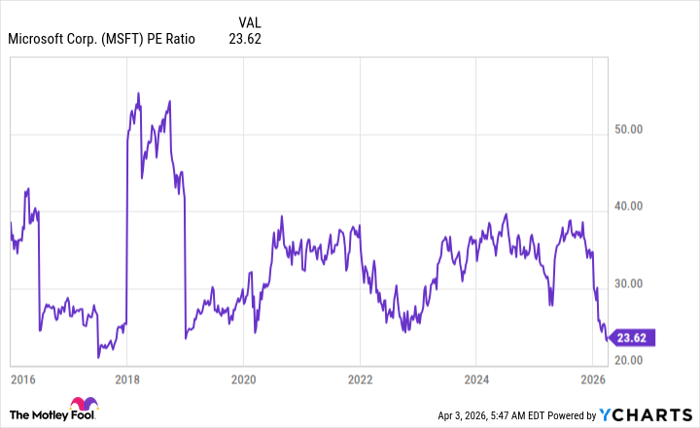
Data by YCharts.
As a result, I think right now is an excellent time to buy the stock. I predict that Microsoft's stock will bottom out soon and march back toward its all-time high throughout the rest of 2026. If something changes in its business, then this projection isn't accurate. But if Microsoft can maintain its status quo, I think it can set a new all-time high before 2026 is over.
Should you buy stock in Microsoft right now?
Before you buy stock in Microsoft, consider this:
The Motley Fool Stock Advisor analyst team just identified what they believe are the 10 best stocks for investors to buy now… and Microsoft wasn’t one of them. The 10 stocks that made the cut could produce monster returns in the coming years.
Consider when Netflix made this list on December 17, 2004... if you invested $1,000 at the time of our recommendation, you’d have $532,066!* Or when Nvidia made this list on April 15, 2005... if you invested $1,000 at the time of our recommendation, you’d have $1,087,496!*
Now, it’s worth noting Stock Advisor’s total average return is 926% — a market-crushing outperformance compared to 185% for the S&P 500. Don't miss the latest top 10 list, available with Stock Advisor, and join an investing community built by individual investors for individual investors.
See the 10 stocks »
*Stock Advisor returns as of April 7, 2026.
Keithen Drury has positions in Microsoft. The Motley Fool has positions in and recommends Microsoft. The Motley Fool has a disclosure policy.
Recommended Articles


