

1 Number From Nvidia's Earnings Report That Changes Everything

Source The Motley Fool

Key Points

  • Nvidia's future is now almost completely dependent on data center customers.

  • There is a possibility that data center construction will come in below estimates.

  • 10 stocks we like better than Nvidia ›

Nvidia (NASDAQ: NVDA) is largely viewed by investors as a graphics processing unit (GPU) stock. That is, the company primarily manufactures, markets, and sells GPUs: specialized electronic circuits that make everything from modern gaming to image rendering possible.

And while GPUs are critical components for a wide variety of industries, only one industry really matters for Nvidia and its investors right now: artificial intelligence (AI). Of course, Nvidia has been perhaps the most popular AI stock globally over the last few years. But as the number discussed below proves, this is no longer just a growth opportunity for the company. Nvidia's future will nearly completely rely on what happens to its AI infrastructure business.

Will AI create the world's first trillionaire? Our team just released a report on the one little-known company, called an "Indispensable Monopoly" providing the critical technology Nvidia and Intel both need. Continue »
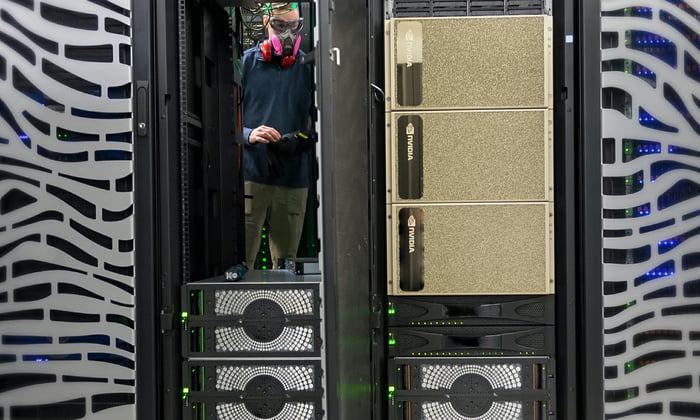
engineer looking over data center infrastructure

Image source: Nvidia.

AI is now the only thing that matters for Nvidia investors

Right now, the world is experiencing an unprecedented growth in data center construction. Data centers, at least for now, use a lot of energy. That's why we're also seeing sizable interest in new energy technologies like small modular nuclear reactors. But what data centers need just as much as energy are GPUs. Nvidia's GPUs are largely considered the best on the market. That's why data center and cloud infrastructure operators are scrambling to buy as many Nvidia chips as possible.

Historically, Nvidia's GPU revenue has come from a variety of sources. But last quarter, $62.3 billion of its $68.1 billion in total revenue came from data center customers. And while these data centers also serve a variety of end markets, there's no doubt among experts as to what is causing their rapid expansion: AI.

"As technology companies race to develop cutting-edge artificial intelligence (AI) models, data centers have become some of the most important infrastructure in the world," concludes a recent Goldman Sachs report. "Over the next five to six years, we forecast substantial demand growth in the global data center market."

So while the market has long viewed Nvidia as a beneficiary of AI, that is no longer the entire story. Almost all of Nvidia's revenue now comes solely from data center customers, which are scrambling to scale up due to rapidly rising demand from AI. In a nutshell, Nvidia's investment thesis is now centered almost entirely on AI. And it's not just centered on growth in AI applications and services. The company's future will hinge specifically on the continued buildout of data centers designed to meet the needs of these data centers' AI customers.

While most experts are predicting a huge surge in data center construction, there is no guarantee that the buildout will fully meet expectations. In fact, a recent Goldman Sachs report recently outlined several potential scenarios where AI adoption falls short, resulting in excess supply of data centers. Growth will still occur, the firm predicts, but it may come in lower than expected -- a direct blow to investors who buy at a price point that already prices in this unrealized growth.

Nvidia is still a very promising business in the long term. But an investment today completely hinges on the pace and scale of the global data center buildout to make sense.

Should you buy stock in Nvidia right now?

Before you buy stock in Nvidia, consider this:

The Motley Fool Stock Advisor analyst team just identified what they believe are the 10 best stocks for investors to buy now… and Nvidia wasn’t one of them. The 10 stocks that made the cut could produce monster returns in the coming years.

Consider when Netflix made this list on December 17, 2004... if you invested $1,000 at the time of our recommendation, you’d have $534,008!* Or when Nvidia made this list on April 15, 2005... if you invested $1,000 at the time of our recommendation, you’d have $1,090,073!*

Now, it’s worth noting Stock Advisor’s total average return is 949% — a market-crushing outperformance compared to 192% for the S&P 500. Don't miss the latest top 10 list, available with Stock Advisor, and join an investing community built by individual investors for individual investors.

See the 10 stocks »

*Stock Advisor returns as of March 7, 2026.

Ryan Vanzo has no position in any of the stocks mentioned. The Motley Fool has positions in and recommends Nvidia. The Motley Fool has a disclosure policy.

Disclaimer: For information purposes only. Past performance is not indicative of future results.
placeholder
Bitcoin CME gaps at $35,000, $27,000 and $21,000, which one gets filled first?Prioritize filling the $27,000 gap and even try higher.
Author  FXStreet
Aug 22, 2023
Prioritize filling the $27,000 gap and even try higher.
placeholder
Pinduoduo Earnings Incoming: Morgan Stanley Sees Long-Term Profit Potential​Insights – On November 21, Chinese e-commerce giant Pinduoduo (PDD) will release its Q3 2024 earnings.
Author  Mitrade
Nov 20, 2024
​Insights – On November 21, Chinese e-commerce giant Pinduoduo (PDD) will release its Q3 2024 earnings.
placeholder
The dollar weakened, equities dipped, and gold hit record highsThe dollar weakened, equities fell, and gold set new records on Wednesday as investors waited for a Fed rate cut later in the day.
Author  Cryptopolitan
Sep 17, 2025
The dollar weakened, equities fell, and gold set new records on Wednesday as investors waited for a Fed rate cut later in the day.
placeholder
Bitcoin briefly loses 2025 gains as crypto plunges over the weekend.Bitcoin experienced a sharp decline this weekend, briefly erasing its 2025 gains and dipping below its year-opening value of $93,507. The cryptocurrency fell to a low of $93,029 on Sunday, representing a 25% drop from its all-time high in October. Although it has rebounded slightly to around $94,209, the pressures on the market remain significant. The downturn occurred despite the reopening of the U.S. government on Thursday, which many had hoped would provide essential support for crypto markets. This year initially appeared promising for cryptocurrencies, particularly after the inauguration of President Donald Trump, who has established the most pro-crypto administration thus far. However, ongoing political tensions—including Trump's tariff strategies and the recent government shutdown, lasting a historic 43 days—have contributed to several rapid price pullbacks for Bitcoin throughout the year. Market dynamics are also being influenced by Bitcoin whales—investors holding large amounts of Bitcoin—who have been offloading portions of their assets, consequently stalling price rallies even as positive regulatory developments emerge. Despite these sell-offs, analysts from Glassnode argue that this behavior aligns with typical patterns seen among long-term investors during the concluding stages of bull markets, suggesting it is not indicative of a mass exodus. Notably, Bitcoin is not alone in its struggles, as Ethereum and Solana have also recorded declines of 7.95% and 28.3%, respectively, since the start of the year, while numerous altcoins have faced even steeper losses. Looking ahead, questions linger regarding the viability of the four-year cycle thesis, particularly given the increasing institutional support and regulatory frameworks now in place in the crypto landscape. Matt Hougan, chief investment officer at Bitwise, remains optimistic, suggesting a potential Bitcoin resurgence in 2026 driven by the “debasement trade” thesis and a broader trend toward increased adoption of stablecoins, tokenization, and decentralized finance. Hougan emphasized the soundness of the underlying fundamentals, pointing to a positive outlook for the sector in the longer term.
Author  Mitrade
Nov 17, 2025
Bitcoin experienced a sharp decline this weekend, briefly erasing its 2025 gains and dipping below its year-opening value of $93,507. The cryptocurrency fell to a low of $93,029 on Sunday, representing a 25% drop from its all-time high in October. Although it has rebounded slightly to around $94,209, the pressures on the market remain significant. The downturn occurred despite the reopening of the U.S. government on Thursday, which many had hoped would provide essential support for crypto markets. This year initially appeared promising for cryptocurrencies, particularly after the inauguration of President Donald Trump, who has established the most pro-crypto administration thus far. However, ongoing political tensions—including Trump's tariff strategies and the recent government shutdown, lasting a historic 43 days—have contributed to several rapid price pullbacks for Bitcoin throughout the year. Market dynamics are also being influenced by Bitcoin whales—investors holding large amounts of Bitcoin—who have been offloading portions of their assets, consequently stalling price rallies even as positive regulatory developments emerge. Despite these sell-offs, analysts from Glassnode argue that this behavior aligns with typical patterns seen among long-term investors during the concluding stages of bull markets, suggesting it is not indicative of a mass exodus. Notably, Bitcoin is not alone in its struggles, as Ethereum and Solana have also recorded declines of 7.95% and 28.3%, respectively, since the start of the year, while numerous altcoins have faced even steeper losses. Looking ahead, questions linger regarding the viability of the four-year cycle thesis, particularly given the increasing institutional support and regulatory frameworks now in place in the crypto landscape. Matt Hougan, chief investment officer at Bitwise, remains optimistic, suggesting a potential Bitcoin resurgence in 2026 driven by the “debasement trade” thesis and a broader trend toward increased adoption of stablecoins, tokenization, and decentralized finance. Hougan emphasized the soundness of the underlying fundamentals, pointing to a positive outlook for the sector in the longer term.
placeholder
Silver Price Forecast: XAG/USD falls to near $72.00 amid fading safe-haven demandSilver price (XAG/USD) continues to lose ground after registering tiny losses in the previous day, trading around $72.90 during the Asian hours on Thursday. The safe-haven demand for the precious metal fades amid rising optimism over Middle East peace.
Author  FXStreet
Apr 02, Thu
Silver price (XAG/USD) continues to lose ground after registering tiny losses in the previous day, trading around $72.90 during the Asian hours on Thursday. The safe-haven demand for the precious metal fades amid rising optimism over Middle East peace.
goTop
quote