


1 No-Brainer Artificial Intelligence (AI) Stock to Buy With $60 and Hold for the Long Term
Key Points
Lemonade is transforming the insurance industry by using artificial intelligence (AI) to calculate premiums, write quotes, and process claims.
The company's revenue grew by 40% last year and is forecast to soar by 61% in 2026, which highlights the company's significant momentum.
Lemonade stock is trading at an attractive valuation, especially considering management's goal to grow the business almost tenfold from here.
- 10 stocks we like better than Lemonade ›
Lemonade (NYSE: LMND) is on a mission to disrupt the insurance industry by using artificial intelligence (AI) to write quotes, process claims, and calculate premiums more accurately. It only offers five insurance products (car, renters, homeowners, life, and pet insurance), but it has attracted almost 3 million customers so far.
Lemonade has a plan to grow its in-force premium (IFP), which is the value of the premiums from all active policies, almost tenfold over the next decade. If the company pulls this off, it could translate into significant returns for shareholders.
Will AI create the world's first trillionaire? Our team just released a report on the one little-known company, called an "Indispensable Monopoly" providing the critical technology Nvidia and Intel both need. Continue »
After soaring by 94% in 2025, Lemonade stock has started 2026 on the back foot with a decline of 24%, but that might be an opportunity for investors who can now pick up a single share for under $60. Here's why it could be a great long-term addition to almost any portfolio.

Image source: Getty Images.
AI is the future of insurance
The Lemonade customer experience starts with Maya, an AI chatbot that can write quotes in under 90 seconds through the company's website. For existing customers, AI Jim can process claims in as little as three seconds with no human intervention, a massive departure from the lengthy waiting periods and multiple phone calls common with traditional insurers.
This is resonating really well with customers. Lemonade had almost 3 million policyholders at the end of 2025, which was up 23% from the year-ago period. Plus, its IFP soared by 31% to a record $1.24 billion, marking the ninth consecutive quarter in which that growth rate accelerated.
Lemonade also uses AI extensively behind the scenes to calculate risk so customers receive the most accurate premiums, which ultimately saves them money in the long run. Since AI automates many of these operational workflows, Lemonade has unlocked a significant amount of operating leverage. Over the last three years or so, it added 1.2 million customers while reducing its workforce by 6%.
In fact, Lemonade ended 2025 with a loss adjustment expense ratio (the cost of handling claims divided by gross earned premium) of just 6%. The company says most traditional insurers aim for a ratio of around 9%, so its business is already significantly more efficient than many of its much older, entrenched competitors.
Lemonade's revenue is surging
Lemonade ended 2025 with a record-low trailing-12-month gross loss ratio of 64%, which represents the percentage of premiums paid out as claims. It believes 75% is the sweet spot for a thriving insurance business, so it's comfortably ahead of that mark. A declining gross loss ratio combined with a growing IFP results in more money in the insurer's pocket.
As a result, Lemonade brought in a record $738 million in revenue during 2025, which was a whopping 40% increase from the previous year. It was much higher than the company's most recent forecast of $729.5 million, which management had already raised three times throughout last year.
Lemonade also improved its bottom line in 2025. It still lost $165.5 million on a generally accepted accounting principles (GAAP) basis, but that was an 18% reduction from its loss in 2024. The company continues to spend aggressively on growth initiatives, which is the right strategy for as long as its IFP growth is accelerating. In theory, once its business achieves sufficient scale, it can pull back on its operating costs to allow more money to flow to the bottom line as profit.
Lemonade stock looks like a great long-term buy
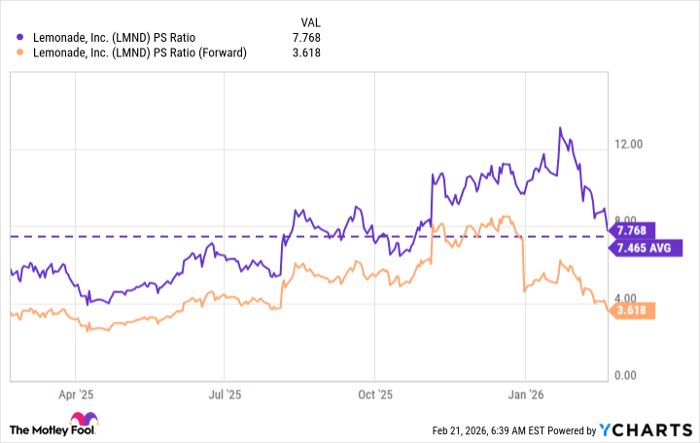
Lemonade's price-to-sales (P/S) ratio peaked at almost 13 last year, which was a three-year high. However, the 24% decline in its stock in 2026, combined with the company's surging revenue growth, has pushed its P/S ratio down to 7.7, which is close to its trailing-12-month average.
But here's the kicker: Management's latest guidance suggests Lemonade's revenue will soar by 61% in 2026, to $1.19 billion, placing its stock at a forward P/S ratio of just 3.6.
LMND PS Ratio data by YCharts
If Lemonade delivers on that guidance, there is a very good chance its stock ends this year much higher than it is today. But the real rewards might come long term, because management believes it can grow IFP to $10 billion over the next decade by continuing to deliver an excellent customer experience and by leaning more aggressively into high-value segments like car insurance.
Should you buy stock in Lemonade right now?
Before you buy stock in Lemonade, consider this:
The Motley Fool Stock Advisor analyst team just identified what they believe are the 10 best stocks for investors to buy now… and Lemonade wasn’t one of them. The 10 stocks that made the cut could produce monster returns in the coming years.
Consider when Netflix made this list on December 17, 2004... if you invested $1,000 at the time of our recommendation, you’d have $409,970!* Or when Nvidia made this list on April 15, 2005... if you invested $1,000 at the time of our recommendation, you’d have $1,174,241!*
Now, it’s worth noting Stock Advisor’s total average return is 889% — a market-crushing outperformance compared to 192% for the S&P 500. Don't miss the latest top 10 list, available with Stock Advisor, and join an investing community built by individual investors for individual investors.
See the 10 stocks »
*Stock Advisor returns as of February 24, 2026.
Anthony Di Pizio has no position in any of the stocks mentioned. The Motley Fool has positions in and recommends Lemonade. The Motley Fool has a disclosure policy.
Recommended Articles


